
What’s actually slowing this PC down?
Pick the symptom - the matching free tool is one click away.
iTechGuides is reader-supported. When you buy through links on our site, we may earn an affiliate commission. As an Amazon Associate I earn from qualifying purchases. Learn more
A loud crackle accompanied by a visible spark usually indicates an arcing or intermittent high-current connection—not a capacitor operating normally. Switch the amplifier off, unplug it, disconnect the speakers, and do not power it again until the capacitor connection, circuit board, and stored voltage have been checked safely.
What the original “crackling capacitor” case describes
The phrase comes from a November 17, 2010 forum report about a Sony TA-N80ES amplifier. The reported part was a 4700 µF, 100 V capacitor, and its ground-side connection had become loose or detached during solder work. The owner saw sparks and heard crackling, then later reported that the amplifier powered up and played normally after resoldering. That is one anecdotal outcome, not proof that the repair was safe or that no hidden damage remained. Read the original report.

What crackling can mean
“Crackling” is a symptom, not a diagnosis. The timing and accompanying signs help narrow it down:
| Symptom | More likely causes |
|---|---|
| Only when a volume or tone control moves | Dirty or worn potentiometer, or DC leakage across the control |
| Changes when the chassis is tapped or moved | Loose solder joint, cracked trace, or bad connector |
| At power-up with a spark | Loose high-current connection, arcing, rectifier fault, or capacitor fault |
| Loud hum after a capacitor connection opens | Lost power-supply filtering or an open return path |
| Fuse blows immediately | Shorted capacitor, rectifier, output device, or wiring fault |
| Power comes on but there is no sound | Open fusible resistor, protection fault, damaged output stage, or missing supply rail |
| Speaker crackles with the amplifier disconnected | Voice-coil, driver, or crossover damage |
| Crackling with heat or smell | Active arcing, overloaded parts, damaged insulation, or semiconductor failure |
Speaker faults can be mistaken for amplifier faults. Focal identifies damaged voice coils and crossover parts such as capacitors or inductors as possible sources of speaker crackling. See Focal’s support guidance.
Why a loose smoothing-capacitor joint can spark
Large electrolytics in an amplifier’s rectifier supply act as energy reservoirs and smooth the rectified waveform. If the negative connection or return path opens, the supply no longer behaves as designed. A joint that repeatedly makes and breaks contact under load can force current across a tiny air gap, producing a snap, visible arc, heat, and carbonized solder or board material.
Forum responders to the Sony case interpreted the event as the smoothing capacitor being effectively removed from the rectifier output, leaving the amplifier exposed to pulsating supply conditions. That is a plausible explanation of the report, not a schematic-level confirmation without inspecting the amplifier.
Rank #2

- HIGH-CAPACITY PERFORMANCE - Elevate your car audio system with a 6.0 Farad Digital Power Capacitor Car Audio boasting ± 5% capacitance for optimal energy storage. Surge confidently with a 20-24 Volt range and 105℃ durability.
- INTUITIVE BLUE DISPLAY - Experience precision monitoring with a vibrant Blue Digital Display and LED flash of our car audio capacitor. Enhance your installation with a sleek aluminum brushed case and Chrome Plated Post Kits.
- ADVANCED PROTECTION FEATURES - Drive with confidence, thanks to Electronic Polarity Protection and Over Voltage Protection Circuits. Ensure a seamless installation w/ the included 1 Pair Clear Brackets and Mounting Charging Hardware for convenience.
- ROBUST CONSTRUCTION - Benefit from a strong finishing touch for superior results. The package includes essential items like the Digital Power Capacitor, Clear Brackets, and Mounting Charging Hardware.
- TECHNICAL EXCELLENCE - Unleash the power of DC 12-24V with a carefully constructed Aluminum build. Marvel at the compact dimensions of 3.5'' x 8.86'' and enjoy the exceptional performance of this high-quality car audio accessory.
Do this immediately
- Switch off and unplug the amplifier.
- Disconnect speakers and source equipment. Do not risk valuable speakers while a power-stage fault is possible.
- Do not touch terminals, heatsinks, or the solder joint. Unplugged equipment can retain hazardous charge.
- Photograph the area before removing parts or scraping residue.
- Have the supply discharged through an appropriate resistance and verify the voltage with a meter. Never short capacitor terminals with a screwdriver; Digi-Key’s capacitor guidance warns against direct shorting and touching charged terminals. See the safety guidance.
Inspect the joint and board before resoldering
- Look for a lifted pad, cracked trace, darkened fiberglass, soot, carbon tracking, or melted insulation.
- Check whether the capacitor lead is pitted, fractured, or too short to make a sound joint.
- Inspect both sides of a through-hole board and the entire ground plane.
- Check for bulging, leaking, vented, or heat-damaged electrolytics.
- Confirm polarity markings and the original voltage rating.
- Remove oxidized or burned solder, clean the joint appropriately, and check for shorts to adjacent pads.
- Mechanically secure a heavy capacitor so vibration cannot stress the solder joint again.
If the copper land has separated from the board, simply adding solder can leave a visually neat but electrically unreliable connection. A damaged trace may require suitable wire or copper reinforcement.
Free tools Windows power users keep installed
One-click scans. No signup required.
Could the amplifier be damaged?
Yes, although the severity depends on the circuit and how long the fault persisted. Possible consequences include a failed rectifier diode, blown fuse or fusible resistor, overheated transformer winding, damaged output transistors, excessive ripple reaching amplifier stages, burned traces, capacitor damage, or speaker damage from DC. A brief spark does not prove the whole amplifier is destroyed, and the absence of smoke or immediate failure does not prove it is unharmed. The Sony owner’s later report of normal operation remains an uncontrolled, single-unit anecdote. Source account.
Rank #3
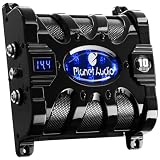
- 3-digit, super bright LED voltage meter
- Blue illuminated display
- Voltage measurement accurate to +/- 0.1VCD
- Warning tones for - Reverse polarity connection, Over-voltage limit, Low battery voltage
- Capacitance / Microfarads - 10,000,000, Working Voltage - 16VCD
Tests required before normal use
After the unit is safely discharged, a qualified repairer should work through the circuit rather than repeatedly switching it on:
- Inspect and verify continuity of the capacitor’s positive and return paths, while remembering that a continuity beep alone does not prove a high-current connection is sound.
- Check resistance to ground with power removed and investigate unexpected shorts.
- Test rectifier diodes and fuses or fusible resistors as appropriate.
- Measure capacitance and ESR with the capacitor isolated or removed when necessary. In-circuit readings can be altered by parallel components; a Mesa Boogie repair discussion highlights this limitation and cautions against indiscriminate recapping. See the discussion.
- Perform a current-limited first energization while monitoring rail voltage, idle current, heat, smell, hum, and renewed arcing.
- Measure output DC offset before connecting speakers.
- Use a suitable dummy load before testing with valuable speakers.
The B&K Precision Model 881 is specified for in-circuit or out-of-circuit ESR/DC-resistance testing from approximately 0.47 µF to 2200 µF, so it does not directly cover every 4700 µF amplifier capacitor. It also cannot replace rail-voltage, leakage, ripple, or output-stage tests. Check the Model 881 specifications. LCR instruments can add capacitance, ESR, and dissipation-factor measurements, but their results still require circuit knowledge. Mouser test-equipment reference.
Rank #4
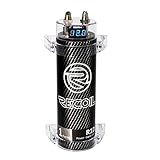
- 1.0 Farad 20V Surge Volt, Runs on 10-16 Volts DC
- Improves sound quality for cleaner mids and highs. It’s perfect for systems up to 1000W
- Low ESR (Equivalent Series Resistance)
- Digital volt meter (Blue)
- Accepts any gauge of wire with ring terminals. Equipped with automatic shutoff protection
When replacement is justified
Replace the capacitor when it is bulging, leaking, vented, heat-damaged, materially out of tolerance, has poor ESR or ripple performance, or cannot be mounted securely. Select a replacement that matches or exceeds the original requirements for capacitance, voltage, ripple current, temperature, dimensions, lead spacing, polarity, insulation, and inrush suitability.
“Higher” is not automatically safer. Increasing capacitance in a rectifier supply can increase diode and transformer inrush current beyond the design’s limits. Do not install a generic “4700 µF” part without checking the circuit and mechanical fit.
Best Value

- Red digital voltage display
- Low E.S.R. (Equivalent Series Resistance)
- 16 V / 20 V surge
- Audible warning tone for reverse polarity
- Audible warning tone for low battery voltage
Current-limited power-up is not a beginner safety shortcut
A technician may use a properly designed current limiter, isolation arrangement, or variac where appropriate. A series incandescent-lamp limiter can restrict fault energy on equipment for which that method is suitable; the old forum discussion mentioned a 100 W filament lamp and interpreted a persistently bright lamp as a serious fault. That advice is equipment-dependent, modern LED lamps are unsuitable for this purpose, and a lamp does not make a mains circuit safe to touch. Original discussion.
Bad advice to avoid
- Do not repeatedly power-cycle a sparking amplifier “to see what happens.”
- Do not short a charged capacitor with a screwdriver.
- Do not connect speakers before checking output DC offset.
- Do not assume in-circuit ESR or a continuity beep is definitive.
- Do not replace every capacitor without diagnosing the fault.
- Do not scrape component bodies, leads, or solder joints as an alleged sound upgrade. The forum thread provides no controlled evidence for an audible benefit; abrasion can damage insulation, weaken joints, add contamination, and promote oxidation.
DIY or professional repair?
DIY is more reasonable when
- The circuit is known to be low-voltage and isolated.
- You can read the schematic and identify stored-energy points.
- Board damage is superficial and you have suitable meters, a current-limited setup, and a dummy load.
- The replacement part and its mechanical support are fully specified.
Use a qualified technician when
- The amplifier has high-voltage rails or visible arcing near mains wiring or the transformer.
- A fuse blows repeatedly, output transistors may be involved, or the PCB is carbonized or badly lifted.
- You cannot verify discharge safely or lack current-limited test equipment.
- The amplifier is rare, expensive, or connected to valuable speakers.
Manufacturers such as Fluke describe certified service, RMA, evaluation, and possible additional-parts charges for their own test equipment; that model should not be read as confirmation that Fluke services a Sony TA-N80ES. Fluke repair information. Independent specialists may offer broader board diagnosis, but model acceptance, location, and quote terms must be confirmed before shipping equipment. ESRS.
Quick Recap
Decision path
- Spark, smoke, repeated crackle, or burning smell: stop, unplug, isolate the speakers, and obtain professional inspection.
- Blown fuse or visibly damaged board: do not substitute a larger fuse or power up again; diagnose the rectifier, capacitor, wiring, and output stage.
- No visible damage: still discharge, inspect the joint mechanically, and use current-limited testing.
- Stable rails, normal idle current, low DC offset, and a clean dummy-load test: reconnect speakers gradually while monitoring for heat, hum, or renewed crackling.
Product prices and availability are accurate as of the date/time indicated and are subject to change. Any price and availability information displayed on Amazon at the time of purchase will apply.
Do these 3 things before closing this tab:
1Clear out junk files and repair common Windows errors2Fix the driver behind crashes, sound loss and screen glitches3Repair Windows errors before they cause bigger problems
