
Quick wins for a faster PC:
Repair Windows errors before they cause bigger problemsFix Now →Fix the driver behind crashes, sound loss and screen glitchesFind Drivers →Clear out junk files and repair common Windows errorsFree Scan →iTechGuides is reader-supported. When you buy through links on our site, we may earn an affiliate commission. As an Amazon Associate I earn from qualifying purchases. Learn more
Yes. A kit zoom can make strong photographs of travel, family events, landscapes and many other everyday subjects. A more expensive lens is useful when it solves a recurring problem—such as not having enough reach or light—not simply because it costs more.
What a kit zoom can do well
A general-purpose zoom is meant to cover a range of common subjects. Nikon describes kit combinations for travel, family events, landscapes, nature and action, and calls an 18–55mm DX lens versatile for portraits and landscapes. That range is useful, though no single lens is ideal for every subject or shooting condition. Nikon’s lens-selection guide explains the kinds of work a kit lens can cover and when a specialized lens may help.
Use the focal-length range deliberately
An 18–55mm lens on an APS-C camera spans wide-angle to short-telephoto framing. At the wide end, you can include more of a scene; toward 55mm, you can frame a more distant or smaller subject more tightly. Move through the range and notice how the framing changes. The range is flexible, but it does not provide the ultra-wide view or long telephoto reach some subjects require.
Those numbers do not describe every kit lens: focal lengths and sensor formats vary. Check the markings on your lens and the camera format before applying an 18–55mm example to your setup. For instance, Nikon’s AF-P DX NIKKOR 18–55mm f/3.5–5.6G VR is a DX-format lens with an f/3.5–5.6 maximum-aperture range; its specifications and compatibility details are in the D3500 manual.
#1 Best Overall
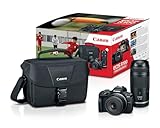
- EOS R100 Mirrorless camera.
- RF75-300mm F4-5.6 telephoto zoom lens (approx.120-480mm on APS-C equipped bodies).
- RF-S 18-45mm F4.5-6.3 lens (approx. 29-72mm on APS-C equipped bodies).
- Shoulder Bag 200 ES provides a protective space for carrying around a pair of lenses.
- Excellent introduction lenses to telephoto (zoom) shooting.
Zooming can be more useful than carrying several primes
A zoom lets you change focal length without swapping lenses. That is practical when you cannot move to reframe, or when you want several compositions without carrying extra gear. Fujifilm’s comparison of a prime and a zoom describes these convenience and framing tradeoffs. Fujifilm’s lens comparison also illustrates what a prime gives up in range and what it can gain in maximum aperture.
Why technique and light often matter more than the lens price
A photograph is shaped by focus, exposure, light, composition and the photographer’s position as well as by the lens. If a picture is soft, too dark or poorly framed, a new lens may not address the actual cause. Try identifying what you wanted the image to do and what specifically prevented it before deciding that the lens is the problem.
Rank #2

- Compact, lightweight, and portable: Carrying a lens capable of reaching 300mm usually means a big heavy lens that is not easy to always have with you, but through our years of expertise with lenses we have been able to produce a compact, lightweight, and portable option about the weight of a 500ml water bottle that won’t break the bank.
- All the angles: The Canon RF75-300mm F4-5.6 has an impressive range of focal lengths to choose from which can dramatically change the feel of your photo.
- Focus on the eyes: Eye detection is achievable even at the 300mm zoom range with Servo AF during still image shooting and Movie Servo AF for videos, automatically focusing on subjects’ pupils, even when their faces or bodies are moving.
- RF Mount Lens: Only compatible with Canon EOS R series cameras like the R100, R50, R10, R7, R8, R6 and R5. This lens is not compatible with Canon DSLR cameras with the EF, EF-S or EF-M mount.
- Lens Box Includes: Canon 58mm Lens Cap and Canon RF Rear Lens Cap
For landscapes and scenes that need deeper focus
Try a smaller aperture when you want more of the scene in focus, then check that shutter speed and focus remain appropriate. A practical kit-lens guide offers f/8 and f/11 as example stopped-down settings, not universal sweet spots; the best choice depends on the lens and scene. Discover Digital Photography’s kit-lens guide discusses aperture and other ways to work with a general-purpose zoom.
For architecture
Look at straight lines near the edges of the frame, where distortion may be noticeable. If it affects the result, use the lens-correction options available in your camera or editing software. Check the corrected image’s edges, since correction can alter the framing.
Rank #3

- Canon USA AUTHORIZED - Includes Full Canon USA WARRANTY
- Canon EOS Rebel T7 DSLR Camera with 18-55mm IS II + 75-300mm III Double Zoom Lenses
- 24.1 Megapixel CMOS (APS-C) Sensor with ISO 100-6400 (H: 12800) | DIGIC 4+ Image Processor | Full HD 1080p Video Recording | Continuous Shooting at up to 3.0 fps | Built-in Wi-Fi and NFC | Remote Shooting and Wireless Printing | 9-Point AF system and AI Servo AF | Optical Viewfinder with approx. 95% viewing coverage | 3.0" LCD with 920,000 dots
- CAMERA INCLUDES: Canon EOS Rebel T7 Camera Body | EF-S 18-55mm II Lens | EF 75-300mm III Lens | EOS Shoulder Bag 200ES (Black) | LP-E10 Lithium-Ion Battery Pack | LC-E10 Battery Charger | Eyecup Ef | EW-400D Neck Strap | Battery Cover | Canon USA 1-Year Warranty
- BUNDLE INCLUDES: Sandisk Ultra SDHC Memory Card 64GB 100MB/s(R) Gray | Microfiber Cloth | Deco Essentials The Premium Photography Protocol: A Masterclass in High-End Operations Guidebook Digital Ebook
For still scenes at slower shutter speeds
Optical stabilization can reduce blur caused by camera shake. Nikon describes vibration reduction (VR) on its cited 18–55mm lens as a way to reduce camera-shake blur. Stabilization does not freeze a moving subject, so action still calls for an appropriate shutter speed and enough light. Nikon’s manual gives model-specific VR and compatibility information.
When a different lens solves a real limitation
Consider an upgrade when you repeatedly encounter a specific limit that the kit zoom cannot overcome. Match the lens to the job rather than treating price as a proxy for picture quality. Nikon’s examples include more reach for sports, wider views for landscapes, macro close-ups and improved low-light shooting without flash or a tripod. Nikon’s guide outlines those use cases.
Rank #4

- CANON DSLR WITH SUPER TELEPHOTO REACH – Capture stunning photos with the Canon EOS Rebel T7 featuring a 24.1MP APS-C CMOS sensor, DIGIC 4+ image processor, 9-point autofocus system, built-in WiFi, and two versatile lenses. The Canon EF-S 18-55mm IS II lens is perfect for everyday photography, while the included 420-800mm manual focus T-mount telephoto lens provides incredible long-range capability for wildlife, birds, aviation, nature, and moon photography.
- FROM EVERYDAY SHOOTING TO EXTREME TELEPHOTO – The Canon EF-S 18-55mm f/3.5-5.6 IS II lens handles landscapes, portraits, travel, and family photos with image stabilization for sharper handheld shots. The included 420-800mm manual focus telephoto lens with Canon EOS T-mount adapter delivers exceptional reach for photographing distant subjects that standard lenses cannot capture.
- COMPLETE PHOTOGRAPHY ACCESSORY KIT – Capture in nearly any environment with the included slave flash for improved indoor lighting, rechargeable LED video light, 64GB high-speed SD memory card, replacement battery, travel charger, professional tripod, flexible spider tripod, stabilizing grip with extension, camera gadget bag, and protective carrying case.
- PREMIUM LENS & CAMERA ACCESSORIES – Enhance your photography with premium 58mm UV, Circular Polarizer (CPL), and FLD filters plus a 58mm tulip lens hood for the Canon 18-55mm lens. Also included are photo and video editing software, HDMI cable, USB card reader, memory card wallet, camera maintenance kit, lens pen, air blower, lens cleaning cloth, protective pouch, and wrist strap.
- READY FOR ANY PHOTOGRAPHY ADVENTURE – Whether you're just starting out or expanding your photography skills, this Canon EOS Rebel T7 bundle includes everything needed for portraits, travel, landscapes, wildlife, bird photography, aviation, moon photography, sports, and everyday photography with premium lighting, storage, stabilization, and protection accessories.
| What you need | What to look for | Tradeoff to consider |
|---|---|---|
| Indoor action or dim conditions | A lens with a wider maximum aperture can allow faster shutter speeds in low light. | A brighter lens may provide a narrower focal-length range than a kit zoom. |
| More subject separation | A wider maximum aperture can make background blur easier to achieve. | Background blur also depends on focal length, subject distance and background distance. |
| Distant sports or wildlife | More telephoto reach. | A longer lens may be larger or heavier; check the specific model. |
| Wide landscapes or interiors | A wider field of view than your current lens provides. | Check that the lens fits your camera and covers the sensor format you use. |
| Small subjects photographed close up | A lens designed for macro or close focusing. | Ordinary zooms may not focus closely enough for the magnification you want. |
| Flexible framing with less gear | A zoom that covers the focal lengths you use most. | A zoom’s maximum aperture may be narrower than that of a prime lens. |
Fujifilm’s comparison at 35mm illustrates the aperture tradeoff: its XF35mmF1.4 R prime has a wider maximum aperture than the XF18-55mmF2.8-4 R LM OIS zoom set to 35mm, which can help in low light and with background blur. In exchange, the prime does not provide the zoom’s range. The comparison is an example of those particular lenses, not a test of every kit zoom. See Fujifilm’s comparison.
Do these 3 things before closing this tab:
1Scan for outdated or missing drivers - takes under a minute2Repair Windows errors before they cause bigger problems3Fix the driver behind crashes, sound loss and screen glitchesCheck compatibility before buying
A lens has to work with your specific camera, not just match a focal-length description. Verify the mount, sensor format, autofocus support and stabilization features. Compatibility can vary even within a camera maker’s range. Nikon’s cited AF-P DX lens has model- and firmware-specific restrictions listed in the D3500 manual; do not assume that another Nikon body—or a lens with a similar name—has identical support.
Model examples in the cited Nikon materials are older DSLR lenses, so confirm current availability and compatibility for the body and lens you are considering. The specifications of Nikon’s AF-S DX Zoom-NIKKOR 18–55mm f/3.5–5.6G ED II, for example, are on its Nikon USA product page.
A practical way to decide whether to upgrade
- Use your current zoom across its range. Make photographs at different focal lengths and compare the framing you can achieve from where you are.
- Name the recurring limitation. Is the subject too far away, the view too narrow, the close focus insufficient, or the shutter speed too slow in available light?
- Separate technique from equipment. Check focus, exposure, shutter speed and composition. For a still scene, stabilization may help with camera shake; for a moving subject, it cannot replace a fast enough shutter speed.
- Choose gear for that specific job. Compare reach, field of view, close-focusing ability and maximum aperture, then verify compatibility with your camera.
If you cannot identify a repeated limitation, keep using the lens you have. A kit zoom is not a promise that every image will be effortless; it is a versatile starting point that can be enough for many photographers’ everyday work.
Quick Recap
Product prices and availability are accurate as of the date/time indicated and are subject to change. Any price and availability information displayed on Amazon at the time of purchase will apply.
Free tools Windows power users keep installed
One-click scans. No signup required.

