
iTechGuides is reader-supported. When you buy through links on our site, we may earn an affiliate commission. As an Amazon Associate I earn from qualifying purchases. Learn more
Perfluorocubane can accept an extra electron, and experiments on its radical anion have been interpreted as evidence that the unpaired electron is predominantly inside the molecule’s cage. But “electron in a box” is a useful model, not a settled, literal picture of where the electron is. A later theoretical analysis disputes electron encapsulation as the general explanation for the perfluoro cage effect.
What perfluorocubane is—and what “catching” an electron means
Perfluorocubane (C8F8) is cubane, a compact molecule with a cube-like carbon framework, in which the hydrogen atoms are replaced by fluorine. An electron acceptor can take up an additional electron, forming a negatively charged species called a radical anion. The phrase “electron in a molecular box” describes the proposed behavior of that added electron; it does not mean a particle was photographed sitting inside a tiny hollow cube.
The distinction matters because scientists describe electron distribution through measurements and models, including spectra, orbitals and calculated spin density. Those descriptions can support an inside-the-cage interpretation without making the simple box image an uncontested account of the molecule’s electronic structure.
Free tools Windows power users keep installed
One-click scans. No signup required.
What the 2022 experiments established
Researchers reported synthesizing and characterizing perfluorocubane in 2022. The University of Tokyo’s account says fluorine gas was used in a liquid-phase reaction to fluorinate cubane, and X-ray crystallography confirmed the resulting solid-state structure. Electrochemical and spectroscopic findings supported the molecule’s ability to accept an electron.
#1 Best Overall

- FOR BASIC TEACHING TO ADVANCED SCIENCE: 444 pieces molecular model kit, including 136 atoms, 158 bonds and 150 parts for Carbon-60(Fullerene), provides to students from Grade 7 to Graduate level.
- TWO CHEMICAL STRUCTURE MODELS: The ball-and-stick models use spheres to represent atoms and sticks to represent chemical bonds. In the space-filling model, the spheres are drawn to scale and are next to one another as atoms are in real molecules.
- CHEMISTRY EDUCATIONAL MOLECULE MODEL IN 3D: It can display chemical structure, molecular bond, and bond angle in all directions. Demonstrate fundamental molecular geometry, chemical molecular structure, stereochemistry with 3D modeling studies.
- EASY TO LEARN: The universal standard adopted for each atom's color makes it easier for you to use and learn. Atoms and chemical bonds combine tightly and firmly and can be easily disassembled by disconnecting tools.
- If you’re not in love with it for whatever reason, we’ll give you a full replacement or refund—no questions asked. If you have any doubt, please tell us. With nothing to worry about, or even to share with your friends, try it now.
For the radical anion, the researchers used matrix-isolation electron spin resonance (ESR). The University of Tokyo reports that the ESR signal was measured at 77 K and interpreted as showing the unpaired electron predominantly inside the cage. This is an experimental result interpreted through spectroscopy—not a direct image of the electron’s position. University of Tokyo: “Electron in a cube” (17 August 2022).
What the 2026 charge-transfer study added
A 2026 study examined a different system: Flu-Cub, a donor–acceptor molecule that links dimethylfluorene to perfluorocubane. After photoexcitation, picosecond transient absorption spectroscopy showed charge separation and subsequent recombination in polar solvents. The researchers analyzed the electron-transfer kinetics using the semiclassical Marcus framework.
Rank #2

- Visualize Molecular: The molecular model kit simplifies complex chemistry concepts into tangible 3D structures improve learning efficiency, suitable for students from Grade 7 to Graduate level.
- 444 Pcs Complete Set: The atom model kit includes with 136 atoms,158 bonds, and 150 fullerene model parts, explore most the molecules structures from simple compounds to complex polymers.
- Effortless Assembly: Embedded component design ensures easy to construct Ball-and-stick and Space-filling models that maximizes focus on exploration without complex assembly.
- Durable & Portable: Built to last, the chemistry set is crafted from high-quality materials. Plus, its portable Snap-Lock design allows you to take your experiments learning anywhere, between the home, classroom and lab.
- Essential Study Tool: Whether you're studying organic chemistry, biochemistry, or molecular biology, molecule building kit is an perfect learning tool for you deeper comprehension of molecular science.
The authors describe perfluorocubane’s lowest unoccupied molecular orbital as composed entirely of σ* orbitals and attribute its electron-accepting behavior to its compact cubic structure. Their model characterizes the confined state as point-charge-like, in contrast with the surface-delocalized electron distribution associated with conventional π-conjugated acceptors. These are the authors’ electronic-structure interpretation, not a direct observation of an electron as a tiny object in a box.
Fitted parameters apply to Flu-Cub
For the studied Flu-Cub system, the paper reports fitted solvent reorganization energy λs = 1.08 eV, vibrational reorganization energy λv = 0.509 eV, and electronic coupling V = 76.3 cm−1. These values belong to that linked molecule and its analysis; they are not universal constants for perfluorocubane. The article was published online on 30 July 2026, with a version of record dated 28 August 2026. Akiyama et al., Nature Communications (2026).
Rank #3

- UNLOCK YOUR CHEMISTRY POTENTIAL: Our comprehensive molecular model kit includes 238 pieces, featuring 84 atoms, 153 bonds and a remover tool. Suitable for chemistry learners from beginners to advanced levels. Manufacturer recommended age: 15 years and up
- ORGANIZED STORAGE AND EASY LOCATING: Experience hassle-free organization with our storage box, complete with divided compartments and labeled sections. Say goodbye to clutter and quickly find the components you need
- EXTRA LEARNING MATERIALS FOR EXCELLENCE: Enhance your studies with our bonus 6-page learning guide and stencils. From grade 9 to college, from organic to inorganic, finish and master your assignments faster and create numerous molecular structures with ease
- IMMERSIVE 3D VISUAL LEARNING: Explore chemistry in a captivating way with our 3D visual learning approach. The universal color-coded Atomic Balls provide a better understanding of molecular structure, boosting your chemistry knowledge. It's also a perfect gift for someone who are going to learn those complex molecule
- EASY-TO-USE DESIGN: Crafted from smooth, burr-free plastic, our molecular science kit ensures easy assembly. With the included remover tool, disassembling is a breeze
Why the “caged electron” picture remains disputed
The electron-transfer paper itself notes that the precise nature of the confined electronic state remains under discussion. In a 2026 theoretical analysis, Riedmiller and coauthors say their calculations do not support electron encapsulation as the common cause of the perfluoro cage effect. They instead report a central confining nodal surface in spin density and develop a quantitative confined-particle account that does not invoke encapsulation.
These descriptions are not interchangeable. “Inside the cage” is a spatial shorthand; orbital composition, spin density and a nodal surface describe different aspects of an electronic state. The disagreement is about how to interpret the state and explain the broader cage effect, not whether the 2022 team synthesized perfluorocubane or reported electron-accepting behavior. Riedmiller et al., “How (not) to Cage an Electron” (first published 28 February 2026).
Rank #4
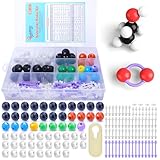
- ADVANCED LEARNING SCIENCE EDUCATION KIT --- Perfect chemistry model kit for modeling simple and small to more advanced and complex chemical structures for schools and college level, students of all ages, researchers and enthusiasts. Fun and interactive early learning molecular set for kids of all years and for use in the classroom.
- HIGH QUALITY --- Made from high quality durable materials designed for easy construction and perfect fit. These Molecular Model Kit pieces are color coded to national standards for easy ID. Organic Chemistry Model Kit includes box for easy storage and transport with your other textbooks, notes, and books. Excellent for the classroom.
- POWERFUL FUNCTIONS --- This Molecular Model Kit has a total of 136 pieces including short link remover tool. Super easy to build models for organic and inorganic chemistry, This model contains C, H, O, N, S and a variety of single and double bonds, Can be put high school, university chemistry in most of the organic or inorganic molecular structure model for the study of experimental operation.
- QUICK AND EASY ASSEMBLY OF COMPLEX STRUCTURES --- Atoms and bonds that are perfectly suited to being connected and disconnected easily without making your fingers hurt. We've also included a link remover to make the task of easy.
- CONVENIENT STORAGE --- The pieces come in a slim plastic box for convenient storage. See the pictures on this listing for a full understanding of what's inside
Why calculations and molecule choice matter
Evidence about one fluorinated cage cannot automatically be generalized to every cage or every kind of anion. A 2025 density-functional and coupled-cluster study reports evidence for interior electron capture only for perfluoroadamantane among the molecules it considered, and only before geometry relaxation. A vertical, unrelaxed calculation describes electron attachment without allowing the molecular geometry to adjust; it is not by itself proof that the relaxed anion is stable.
When comparing claims, keep the system and method clear: matrix-isolated perfluorocubane radical anion ESR is not the same experiment as photoinduced charge transfer in linked Flu-Cub, and a calculated vertical electron affinity is not the same as evidence for a stable, geometry-relaxed anion. “A combined density functional and coupled-cluster theory study on correlation-bound anions of perfluorinated compounds” (2025).
Quick Recap
Best Value

- Visualize Molecular: The molecular model kit simplifies complex chemistry concepts into tangible 3D structures improve learning efficiency, suitable for students from Grade 7 to Graduate level.
- 240 Pcs Complete Set: The atom model kit includes with 86 atoms and 154 bonds, explore most the molecules structures from simple compounds to complex polymers.
- Effortless Assembly: Embedded component design ensures easy to construct Ball-and-stick and Space-filling models that maximizes focus on exploration without complex assembly.
- Durable & Portable: Built to last, the chemistry set is crafted from high-quality materials. Plus, its portable design allows you to take your experiments learning anywhere, between the home, classroom and lab.
- Essential Study Tool: Whether you're studying organic chemistry, biochemistry, or molecular biology, molecule building kit is an perfect learning tool for you deeper comprehension of molecular science.
What to take away
- Perfluorocubane is an experimentally synthesized electron acceptor, and its radical anion’s ESR signal was interpreted as evidence of an unpaired electron predominantly inside the cage.
- A later photoinduced charge-transfer study investigated a linked donor–acceptor molecule, not the isolated radical anion.
- The “molecular box” image is a helpful shorthand, while the literal electronic-structure explanation remains contested.
Product prices and availability are accurate as of the date/time indicated and are subject to change. Any price and availability information displayed on Amazon at the time of purchase will apply.

