
What’s actually slowing this PC down?
Pick the symptom - the matching free tool is one click away.
iTechGuides is reader-supported. When you buy through links on our site, we may earn an affiliate commission. As an Amazon Associate I earn from qualifying purchases. Learn more
Yes—some oil and gas wells bring mineral-bearing water to the surface, and that water could become a source of lithium and other critical minerals. But “could” matters: promising concentrations and theoretical resource estimates are not the same as recovered material or commercial production. The opportunity depends on what is in the water at a particular site, whether it can be separated and treated economically, and how the remaining water is managed.
What does it mean for an oil well to become a mine?
Oil and gas operations often bring water up with the hydrocarbons. Called produced water, this water comes from the geological formation and may contain dissolved lithium and other elements. Recovering those materials would make produced water a potential mineral-bearing feedstock associated with existing energy operations—not turn every well into a conventional mine.
The distinction between finding a mineral and producing it is essential. A sample can contain lithium; a basin-wide estimate can suggest a large theoretical resource; and a facility can recover a saleable product. Those are three different milestones. Evidence of the first or second does not establish the third.
Do these 3 things before closing this tab:
1Clear out junk files and repair common Windows errors2Fix the driver behind crashes, sound loss and screen glitches3Repair Windows errors before they cause bigger problemsHow much lithium is in produced water?
Concentrations differ by basin, formation, depth, and production history. The U.S. Geological Survey reported lithium concentrations above 400 milligrams per liter in some studied brines from the Smackover Formation in southern Arkansas. That is a notable regional finding, not a typical value for all wells or a measure of lithium already recovered. The USGS describes its work on formation brines and resource assessment through its Oil and Gas Waters Project.
#1 Best Overall

- PROFESSIONAL GEOLOGY TOOLS: Complete mineral identification kit includes streak plates, glass plate, dropper bottle, magnet, nail, and hand lens for comprehensive rock and mineral analysis.
- MOHS HARDNESS TEST KIT: Essential geology kit enables accurate hardness testing, streak color analysis, magnetic properties assessment, and effervescence testing for field identification.
- ROCKHOUNDING TOOLS: Professional-grade equipment perfect for rock hounding enthusiasts, geology students, and educators conducting mineral classification demonstrations.
- COMPLETE GEOLOGY KIT: 7 precision instruments support comprehensive rocks and minerals identification in classroom settings, field work, and educational demonstrations.
- ROCK HOUNDING EQUIPMENT FOR ADULTS: Durable lapidary supplies designed for serious collectors, geology professionals, and science educators requiring reliable testing tools.
For a broader comparison, the U.S. Government Accountability Office reported a median estimate of 44 milligrams per liter for lithium in produced water, citing an EPA technical document. A median is a summary across the data considered; it does not predict the concentration in any individual well.
The U.S. Department of Energy’s June 2024 fact sheet estimated that produced water from the Permian shale play could contain over 15,500 metric tons of lithium per year. DOE compared that theoretical potential with estimated U.S. annual consumption of 3,000 metric tons. Neither figure represents measured annual recovery, existing production, or a guarantee that the resource can be extracted economically.
Rank #2

- IDENTIFY KEY VITAMINS & MINERALS YOU MAY NOT BE PROPERLY ABSORBING. When your body isn’t properly absorbing the key vitamins and minerals from your diet, nutrient imbalances can occur. If they’re left unchecked, symptoms like low energy, brittle nails, dry skin, hair shedding, and fatigue can develop. This test identifies the specific nutrients that may need diet adjustments to support better absorption.
- TESTS 112 VITAMINS, MINERALS & TRACE ELEMENTS. Our nutrition test analyzes your hair sample’s response across Vitamins A, B-Complex, C, D, E, K, Calcium, Magnesium, Zinc, Iron, Selenium, Trace Minerals, Essential Amino Acids, plus Omega-3 and Omega-6 fatty acids.
- HOW OUR TESTING WORKS. 1) Register your test online or in the 5Strands app. 2) Collect 10 to 15 strands of hair. 3) Mail your sample to our certified lab using the included prepaid envelope. Once the lab receives it, your results are delivered to your email and mobile dashboard within 4 days. No blood draw, no office visits, or extra fees.
- CLEAR ANSWERS TO MAKE TARGETED DIET ADJUSTMENTS. Your hair analysis report organizes each nutrient into 4 response levels so you know which vitamins or minerals your body may have the most trouble absorbing. Use your results to adjust food choices and supplements to support better absorption and improve energy levels, skin hydration, hair and nail strength, and mental clarity.
- INDEPENDENTLY VALIDATED & DOUBLE-SCAN LAB PROCESS. Backed by third-party research and analyzed twice in a certified U.S. lab for accuracy, 5Strands is trusted by more than 345,000 customers and pets to uncover nutritional imbalances affecting daily performance, skin and hair health, and overall wellbeing.
Why a high concentration does not prove a viable mine
A useful project assessment has to look beyond a headline concentration. It must establish how much water is available, how consistently it is produced, what else is dissolved in it, and how well treatment and recovery work at the site. A single high-lithium sample cannot answer those questions or establish recoverable tonnage.
Quick wins for a faster PC:
Clear out junk files and repair common Windows errorsFree Scan →Scan for outdated or missing drivers - takes under a minuteDriver Scan →Repair Windows errors before they cause bigger problemsFix Now →- Water volume and consistency: the quantity and production history of the water affect how much feedstock is available over time.
- Local chemistry: water chemistry varies, and produced water can contain salts, organic compounds, heavy metals, and naturally occurring radioactive materials.
- Sampling and uncertainty: sparse or inconsistent data make it difficult to estimate the resource reliably.
- Recovery and treatment: a process must separate the target material from the water and its other constituents while treating the resulting streams.
- Site-level management: a mineral project still has to handle the water that remains, including reuse or disposal.
DOE identifies variability, incomplete or inconsistent data, and high costs as significant challenges for produced-water recovery. In practice, feasibility is a combined question of geology, processing, water management, and economics—not just the lithium reading.
Rank #3

- Complete Mineral Testing Kit: Includes 10 carefully selected mineral specimens and a durable ceramic streak plate for conducting scratch tests and determining hardness levels (1-10 on the Mohs scale).
- Perfect for Education & Fieldwork: Ideal for geology students, teachers, rock collectors, and professionals to practice mineral identification, conduct experiments, or enhance classroom learning.
- Premium Quality Materials: Crafted with authentic minerals and a scratch-resistant ceramic streak plate to ensure accurate, long-lasting results for repeated testing.
- Portable & User-Friendly: Compact box with organized compartments for easy storage and transport, making it a convenient tool for labs, field trips, or home study.
- Trusted by SuiToWan: Backed by a satisfaction guarantee and clear instructions, empowering users to confidently explore geological science and rock classification.
Are oilfield-brine mineral projects producing commercial lithium now?
The cited federal work supports describing this as an active research and development opportunity, not as established commercial lithium production. On April 18, 2024, DOE announced nearly $8 million for five research and development projects related to wastewater, water reuse, and critical materials. The funding supports investigation; it is not a measure of mineral output.
One DOE National Energy Technology Laboratory project led by Ohio University describes plans to characterize and treat wastewater and test batch electrochemical extraction of rare earth elements and other critical materials. Its listed project period is September 1, 2024, through August 31, 2027. Those are project objectives and dates, not proof of successful commercial-scale recovery. DOE’s announcement and project information are available on its 2024 funding announcement.
Rank #4
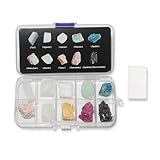
- COMPREHENSIVE MOHS HARDNESS TEST KIT: Includes 10 Certified Mineral Specimens And Testing Tools For Accurate Rock Identification Tacl, Gypsum, Calcite, Fluorite, Apatite, Orthoclase, Quartz, Topaz, Cornudum, Synthetic Silicon Carbide (is a type of synthetic diamond) and 1 Unglazed Porcelain Streak Plates
- IDEAL FOR EDUCATIONAL USE: Designed For Geology Classrooms And Rock Collecting Enthusiasts
- MULTIPLE APPLICATIONS: Identify Rocks, Teach Mineral Properties, Or Expand Personal Collections
- DURABLE AND PORTABLE: Lightweight Case With Organized Compartments For Easy Storage And Fieldwork
- INCLUDES GUIDE: Simplified Instructions For Beginners And Advanced Users Alike
The USGS also describes a pilot demonstration that uses produced water to mineralize carbon dioxide into stable carbonate minerals intended for cement. That is an example of produced-water reuse and mineralization; it does not demonstrate commercial lithium production.
Outdated Drivers Are Slowing You Down
One free scan finds every outdated or missing driver and matches the right update for your exact hardware.Free scan · exact hardware matchWindows Errors? Fix Them Before They Spread
Repair common Windows errors and clear accumulated junk for a smoother, more stable PC - no reinstall needed.Free scan · no reinstallWhat happens to the water—and why management matters
Mineral recovery would not make produced water disappear. Its salts, organic compounds, metals, and naturally occurring radioactive materials can make treatment and handling challenging. A recovery process therefore has to be judged partly by how it manages the treated water and any remaining waste streams.
Best Value

- Explore the wonders of the natural world and unlock the mysteries of common minerals with the Toysmith Mineral Science
- Encourage youthful curiosity in geology with this hands-on natural science activity
- Identify 15 different mineral specimens using a magnifying glass and detailed identification guide
- The kit includes 15 mineral specimens, a magnifying viewer and an identification guide
- Recommended for ages 8 and up
Deep-well injection is a common disposal method. DOE notes that injection raises pressure in the disposal formation and can, in some cases, induce seismicity. The department also lists possible reuse applications such as fire control, power generation, equipment washing, and irrigation of non-edible crops. These are potential uses that require appropriate characterization and treatment, not blanket assurances that produced water is safe for reuse.
DOE’s fact sheet on produced water and critical minerals discusses both the recovery opportunity and the associated water-management challenges.
What would make the “oil wells as mines” idea credible?
The strongest evidence for a mineral project would connect local sampling to repeatable recovery and responsible water handling. For a particular basin or facility, the key questions are:
The Tool Desk
Outbyte PC Repair FREERepair Windows errors before they cause bigger problemsFix Now →Outbyte Driver Updater FREEScan for outdated or missing drivers - takes under a minuteDriver Scan →- Do samples represent the formation and the site’s production over time?
- How much produced water is available, and how stable is that supply?
- Can the target mineral be separated from the site’s actual mixture of salts and contaminants?
- Does the process work reliably beyond a laboratory or batch test?
- Can the remaining water and waste streams be treated, reused, or disposed of appropriately?
- Do the demonstrated recovery and treatment costs support a viable operation?
Until those questions are answered for a project, claims should be framed as potential, estimates, or research goals—not as proof that oil wells have become operating mines.
Quick Recap
Product prices and availability are accurate as of the date/time indicated and are subject to change. Any price and availability information displayed on Amazon at the time of purchase will apply.

