
The Tool Desk
Outbyte Driver Updater FREEScan for outdated or missing drivers - takes under a minuteDriver Scan →Outbyte PC Repair FREEClear out junk files and repair common Windows errorsFree Scan →iTechGuides is reader-supported. When you buy through links on our site, we may earn an affiliate commission. As an Amazon Associate I earn from qualifying purchases. Learn more
In a 2019 proof-of-concept experiment, researchers found that a tuned optical cavity could slow a fluoride-mediated reaction and change the ratio of products formed at two competing sites on one molecule. The cavity’s reflective surfaces did not act like ordinary mirrors directing a reaction; they helped couple electromagnetic fluctuations to molecular vibrations in a specific laboratory setup.
What did the experiment show?
The team studied a silane derivative engineered with two different functional groups, either of which fluoride could remove, or deprotect. They flowed its solution through a microfluidic infrared spectroscopy cell whose windows had been made highly reflective. When the cavity was tuned to couple with vibrations associated with carbon–silicon or oxygen–silicon bonds, the researchers reported a slower reaction and a changed ratio of products. In other words, the relative preference between the two reaction sites shifted.
The result addresses a focused question: can changing the electromagnetic environment around vibrating bonds affect a chemical reaction’s rate or selectivity? In this particular reaction, the reported answer was yes. The source does not give a numerical effect size, so the magnitude of the rate change or product-ratio shift should not be inferred.
How can a cavity affect molecular vibrations?
Vibrational strong coupling, or VSC, occurs when molecular vibrations interact strongly with electromagnetic fluctuations confined by an optical cavity. In the researchers’ physical framing, the relationship between the electromagnetic wavelength and the distance between reflective surfaces can enhance those fluctuations. If the cavity is tuned to vibrations associated with particular bonds, the interaction may influence the reaction involving those bonds.
#1 Best Overall
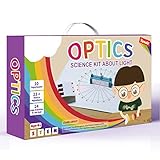
- Explore the Science of Light: Discover the fascinating world of optics with 15+ hands-on light experiments and learn how light travels, reflects, refracts, and forms images through real scientific exploration.
- Create Rainbows & Optical Effects: Use the included prism, lenses, mirrors, and transparent optical blocks to observe amazing optical phenomena such as rainbow formation, color mixing, and light refraction.
- Complete Optical Science Lab Kit: This STEM kit includes more than 25 experimental components, allowing kids to build their own mini physics laboratory and perform a wide variety of optics experiments at home or in school.
- Easy-to-Follow Experiment Guide: The 32-page full-color manual provides clear step-by-step instructions and explanations that help students understand key physics concepts while encouraging curiosity and scientific thinking.
- Perfect STEM Gift for Curious Kids: A fun and educational science kit designed for boys and girls ages 8-16, ideal for STEM learning, science projects, homeschooling, classroom demonstrations, birthdays, and holiday gifts.
This is not a claim that any pair of mirrors will change any reaction. The reported effect depended on a tuned cavity, selected molecular vibrations and a specific fluoride-mediated deprotection. The experiment shows a possible way to influence chemistry under those conditions, not a universal rule for controlling reactions.
What was the apparatus?
The researchers used a bespoke microfluidic infrared spectroscopy cell placed between highly reflective mirrors. The solution flowed through the cell while the team adjusted the spacing between mirrors by compressing a spacer with four screws. Changing that spacing tuned the cavity’s harmonic resonances.
Rank #2
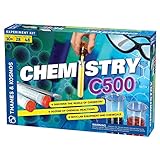
- An introductory tour of chemistry with 28 classic experiments
- Discover the colorful effects of acids and bases
- Make fizzy and foamy reactions and write messages with invisible ink
- Learn about reactions between solids, liquids, and gases
- The 48-page, full-color experiment manual gives simple instructions for setting up and performing each experiment, and then clear explanations of what happened and why
The Chemistry World report does not identify a commercial instrument or ready-to-buy version of this arrangement. Its description is of a specialized research setup, not a consumer device.
PC Slower Than It Used to Be?
A free scan shows the junk files, broken settings and background clutter dragging Windows down - then fixes them in one click.Free scan · Windows 10 & 11Crashes, No Sound, or Screen Glitches?
Random freezes, missing sound and display glitches usually trace back to one bad driver. Find and replace yours safely.Free scan · under a minuteHow did coupled and uncoupled conditions differ?
| Condition | Vibration and cavity relationship | Reported outcome |
|---|---|---|
| Uncoupled comparison | The report contrasts this with coupling relevant molecular vibrations to cavity fluctuations. | Used as the comparison for the coupled condition; no numerical baseline is given. |
| Vibrationally coupled | The cavity was tuned to molecular vibrations associated with carbon–silicon or oxygen–silicon bonds. | The reaction slowed and the relative product ratio changed, shifting which of the two sites was favored. |
The comparison is qualitative in the report: it establishes the direction of the reported rate effect and a change in selectivity, but not exact rates or product percentages.
Rank #3

- S.T.E.M PLAY FOR KIDS - Build and erupt a volcano, crystal growing,holographic projection, rainbow walking water and cause some awesome chemical magic physics reactions! Each experiment is easy to conduct and a whole lot of fun!
- 272 EXPERIMENTS in a KIT- Kids will have hours of fun as they explore the multiple experiments and is great to share with family, friends, or classmates; Encourages children to critically think and problem solves.
- QUALITY TOYS TOOLS - The UNGLINGA SCIENCE series provides kids quality educational toys. Kid's size test tube, measuring spoon, beaker, conical flask are tested plastic. Just like a real scientist in a lab!
- EASY-TO-FOLLOW MANUAL - The experiment guide instructions with clear illustrations for each step. Allowing your child to develop a deep, lasting appreciation for a variety of science.
- SCIENCE GIFTS IDEA: Learning to play for Christmas, birthdays, activities, school breaks, and weekend fun. Kids can start to build science concepts just by doing these activities with you.
What does the result not establish?
- It does not show that researchers can predict the direction or size of VSC’s effect for a new reaction.
- It does not demonstrate a general-purpose method for choosing products across chemical synthesis.
- It does not establish broad practical adoption or the current consensus across later studies.
In the February 8, 2019 report, University of Strasbourg researcher Joseph Moran said, “We’re trying to learn what the rules are.” The article described Strasbourg studies up to that point as showing reaction slowing, while two then-available preprints reported acceleration. Those remarks describe the research landscape as presented in 2019; they should not be read as a summary of all subsequent findings.
Independent reader supportYour contribution helps us test, update, and keep practical guides available for everyone.Why was the study notable?
The experiment offered an early demonstration that a cavity could affect both reaction rate and which of two competing sites reacted in one designed substrate. Moran described the setup simply: “You can just make a microfluidic system and you pass the solution between the mirrors and the reactivity changes,” while Thomas W. Ebbesen said the motivating possibility was “maybe we could change chemistry.” Independent commentator Julia Weinstein called it a “really exciting proof-of-concept study” and was particularly interested in its selectivity and potential for studying reaction mechanisms.
Rank #4

- ✔ 66 ACTION-PACKED SCIENCE EXPERIMENTS – Includes 26 step-by-step guided activities and 40 bonus DIY ideas using household items. Explore fizzy explosions, color changes, bubbling potions, and more.
- ✔ REAL SCIENCE, SERIOUS FUN – Learn chemistry concepts like acid-base reactions, states of matter, pH indicators, and gas expansion—all through hands-on, kid-friendly experiments.
- ✔ VOLCANOES, GLOW LAVA & SLIME – Make your own volcano with plaster and paint, create glowing potions and blue lava, blow up gas balloons, and mix gooey self-siphoning slime.
- ✔ INCLUDES TOOLS & INGREDIENTS – Comes with test tubes, food coloring, volcano mold, citric acid, slime mix, popping crystals and more to start a home science lab performing exciting experiments.
- ✔ STEM LEARNING FOR AGES 8+ – Perfect for future scientists and curious kids. Encourages critical thinking, creativity, and scientific exploration with clear instructions and adult supervision.
The primary paper cited by Chemistry World is A. Thomas et al., Science (2019), DOI 10.1126/science.aau7742. The contemporary report is Andy Extance, “Mirrors in the dark enable chemical control,” Chemistry World, February 8, 2019.
Quick Recap
Best Value

- Batteries Needed: 2 pieces AAA batteries (Not included).
- The lenses do not have the magnetic.
- Optical Experiment: convex lens refraction, refraction of light, lens refraction, prismatic refraction, plane mirror reflection, convex mirror reflection, concave mirror reflection, etc.
- Lens Material: Acrylic. High Quality Lens Kit of 6pcs lenses. Preferred materials, good quality, safe, durable and practical.
- Three way linear light source can be adjusted the light head to adjust the direction of light. Three way linear light for light path demonstration.
Product prices and availability are accurate as of the date/time indicated and are subject to change. Any price and availability information displayed on Amazon at the time of purchase will apply.

