Can I Move My SATA Drive to Another Port? What to Check First
Moving a SATA drive to another motherboard port is usually safe when the computer is powered off. Check your board’s port map, M.2 sharing, boot order and RAID configuration first.
iTechGuides is reader-supported. When you buy through links on our site, we may earn an affiliate commission. As an Amazon Associate I earn from qualifying purchases. Learn more
Usually, yes. Shut the computer down, disconnect its power, and move the drive’s SATA data cable to another enabled SATA connector on the motherboard. You normally do not need a new drive or cable. Check your exact motherboard manual first, because port numbering, M.2 lane sharing, RAID arrangements and boot behavior vary by board.
What changes when you move a SATA cable?
A SATA drive can generally use any compatible, available motherboard SATA port. Moving the data cable changes the connector used by the motherboard; it does not erase the drive or alter its files. Leave the drive’s power connector attached unless you have a separate reason to move it.
The target connector must actually be enabled. Motherboards can have multiple SATA controllers, disabled connectors, or ports that share resources with another socket. ASRock notes that an M.2 socket may share lanes with SATA ports or PCIe slots; the board manual is needed to identify the affected connectors (ASRock SATA FAQ).
Identify the exact motherboard model, including any revision number.
Open its storage, SATA or motherboard-layout section and find the numbered connectors.
Confirm that the destination port is enabled and is not disabled when an occupied M.2 socket or PCIe slot is in use.
Check whether the destination belongs to the same storage controller and whether your drive is part of a RAID array.
Port numbers are not universal. One Supermicro X14SRA-T/X14SRA-F manual, for example, enumerates SATA0 through SATA5 and provides board-specific settings for SATA mode and hot plug (Supermicro SATA and RST configuration). Those labels and rules should not be assumed for another board.
BENFEI SATA III cable is designed to connect motherboards and host controllers to internal Serial ATA hard drives and DVD drives, quickly upgrading your computer for expanded storage. Please be kindly noted that this cable does not provide power for your hard drive. It must be powered separately.
6 Gbps Fast Data Transfer: The latest SATA Revision 3.0 allows for data transfer speeds of up to 6 Gbps, 2x faster than SATA II.
Backwards compatible with SATA I and SATA II. Data transfer speed is limited by rating of the attached equipment.
Secure Connection: Locking latch on each end of the cable to ensure secure connections for fast and reliable file transfer.
18 Months warranty and lifetime friendly customer service.
Safe procedure for an ordinary desktop move
Shut down the operating system. Do not merely put the computer to sleep.
Turn off and unplug the computer. If it has a rear power switch, set it to off, then press the case power button once to discharge residual power.
Ground yourself and open the case. Avoid touching connector contacts.
Move only the SATA data cable. Disconnect it from the motherboard’s old port and connect it firmly to the documented, available target port. Keep the drive-side connection and power cable in place.
Close the case and reconnect power. Start the computer and enter BIOS/UEFI if necessary to verify that the drive is detected.
In the operating system, verify the volume. Check that the expected partitions and files appear before making further changes.
A replacement SATA data cable is warranted only if the existing cable is damaged, unreliable or too short to reach the new connector. Changing ports alone does not normally require one.
Will the computer still boot?
Often it will, but the result depends on the firmware’s boot entry and the board’s storage configuration. If the moved drive contains the operating system and the computer opens firmware setup or reports that no boot device is found, first inspect boot priority. ASUS explains that BIOS can set priority among devices such as M.2 SSDs, SATA SSDs and USB storage (
SATA INTERFACE: Designed for connecting SATA hard drives and SSDs to your motherboard for fast, reliable data transfer.
HIGH-SPEED DATA TRANSFER: Supports SATA III speeds of up to 6 Gbps, ensuring quick and efficient file transfers.
SECURE CONNECTION: Features locking connectors on both ends to keep the cable firmly in place and prevent accidental disconnection.
FLEXIBLE DESIGN: The cable's flexible construction allows for easy routing inside tight spaces within your PC case.
WIDE COMPATIBILITY: Compatible with SATA I, II, and III devices, making it suitable for a broad range of hard drives and SSDs.
If the OS drive is detected but does not start
Open the BIOS/UEFI boot menu and select the same operating-system boot entry or drive used before the move.
Make sure the expected disk is ahead of other storage or USB devices in boot order.
Do not reformat or reinstall merely because the firmware screen appeared; a changed boot selection is a more likely first explanation.
If the drive is not detected in firmware
Power off again and reseat both the SATA data connection and the drive’s power connector.
Try the original port to distinguish a cable/drive problem from a disabled target port.
Review the manual’s M.2-sharing and controller notes, then test another documented SATA port if appropriate.
Do not change AHCI or RAID casually
SATA port selection and SATA controller mode are different settings. AHCI and RAID choices affect how the installed operating system communicates with storage. Preserve the existing mode when you are only moving a cable.
If the drive is in a RAID array, stop before changing connections and consult the motherboard or controller documentation. Array membership and expected port arrangements can be configuration-specific; moving one member without guidance can make the array degraded or inaccessible.
6GBPS HIGH-SPEED DATA TRANSFER: Complies with SATA III 6Gbps specification and is backward compatible with SATA II (3Gbps) and SATA I (1.5Gbps). Ensures fast, reliable data transmission for hard drives, SSDs, and optical drives
RIGHT ANGLE + STRAIGHT 2-PACK: Includes one 90-degree angled SATA cable for tight spaces and one straight-to-straight cable for standard connections. The flat, tangle-free design eliminates messy cable clutter and reduces wear from repeated bending
SECURE LOCKING LATCH: Both cables with flexible rubber sleeves feature a sturdy 7-pin locking latch that snaps firmly into place, ensuring a solid, vibration-resistant connection. Prevents accidental disconnection during data transfer
HOT-SWAPPABLE & PLUG & PLAY: Supports hot-swapping – connect or disconnect drives without shutting down your computer. No drivers or software required. Simply plug in and start transferring
VERSATILE COMPATIBILITY: Ideal for connecting hard drives, SSDs, CD/DVD drives, and Blu-ray drives to motherboards. 18-inch (45cm) length provides flexible installation options for most desktop cases
For an example of why mode changes require care, Supermicro’s manual lists AHCI and RAID as selectable modes and says, “After changing the SATA mode, make sure to reboot the system for the changes to take effect” (Supermicro manual). That is a board-specific instruction, not a step required for a normal cable move.
Hot-plugging is a separate feature
Do not unplug or reconnect a live SATA drive as the ordinary method. Hot-plugging requires support from the specific motherboard port, controller settings, drive and operating system, and may be restricted for a boot drive.
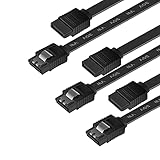
Blazing Fast SATA III Speed: Connect motherboards or host controllers to internal Serial ATA hard drives and DVD drives with this SATA cable. The SATA III cable supports transfer speeds up to 6Gb/s, maximizing SSD and HDD performance for fast OS boot-ups, game loading, RAID configuration, and large file backups.
Right-Angle Design & Locking Latch: The 90-degree SATA cable ensures secure connections in tight spaces, making it ideal for small form-factor cases and complex builds. Featuring a locking latch for a stable and reliable connection, the right angled SATA cable keeps your SSD, HDD, or optical drive securely linked even when moving or adjusting your PC.
Flexible and Durable Construction: Designed with a low-profile, flexible jacket, these SATA cables for hard drives enable efficient cable management and airflow optimization in your PC case. Includes 3 reusable cable ties to help you organize cables, and keep your build neat and clutter-free.
Cost-Effective 3-Pack: This 3-pack SATA 3 cables provides great value, offering spare or replacement cables for multiple installations, upgrades, or troubleshooting connectivity issues.
Broad Compatibility: This SATA data cable (also called SSD cable, HDD cable) works with SATA-equipped devices like 24x DVD-RW Serial-ATA Internal Optical Drives, Crucial MX100 BX100 MX200 SATA SSDs, Kingston 240GB SSD V300 SATA 3 SSDs, LG Electronics 14x Internal BDXL Blu-Ray Burners, Samsung 850 EVO SSDs, Seagate 3TB Desktop HDDs, WD Black Performance HDDs, and more. It’s also backward compatible with SATA I and SATA II devices.
For example, Supermicro documents a per-port BIOS option: “Set this feature to Enable for hot plug support, which allows you to replace a SATA drive without shutting down the system” (Supermicro manual). Conversely, the ASRock B75M-GL manual says hot plug is supported in AHCI mode but warns, “However, please note that it cannot perform Hot Plug if the OS has been installed into the SATA / SATA2 HDD” (ASRock B75M-GL manual). These examples show why the exact manual and port matter; they are not universal permission to hot-unplug a drive.
An occupied M.2 socket can disable specific SATA ports
RAID array member
Consult controller documentation before moving anything
Array layouts and controller expectations are configuration-specific
Computer running
Do not move the cable unless verified hot-plug support exists
Hot-plug is hardware-, firmware- and OS-dependent
What not to infer from a port change
A different connector does not by itself mean the drive is damaged or its data was erased.
A boot failure after the move does not automatically mean Windows or Linux must be reinstalled.
A motherboard with several SATA sockets does not guarantee that every socket is simultaneously usable.
Changing ports does not require switching AHCI to RAID, or vice versa.
When to restore the original connection
If the drive remains absent after checking power, cable seating, firmware detection and port-sharing notes, reconnect it to the original port to establish a known working baseline. If it works there, the alternate connector may be disabled or reserved. If it fails there too, investigate the cable, power, drive and controller separately rather than continuing to move ports.
Right Angle SATA connectors with metal locking latch.
Designed to connect internal Serial ATA hard disks, SSDs, and optical drives to motherboards and host controllers.
Fully compliant with the SATA III specification, allowing for data transfer speeds of up to 6 Gbit/s (600 MB/s).
Compatible with 2.5” SSDs, 3.5” HDDs, optical drives, RAID controllers, embedded computers and controllers.
PLEASE NOTE: This cable does not provide power. It is a data cable only. Drive needs to be powered separately.
The Bottom Line
Yes—on a powered-off computer, you can normally move a SATA data cable to another motherboard port. Verify the port map first, preserve the existing AHCI/RAID mode, check boot priority if it is the OS drive, and treat hot-plugging or RAID moves as board-specific exceptions.
Right Angle SATA connectors with metal locking latch.
$6.99
Product prices and availability are accurate as of the date/time indicated and are subject to change. Any price and availability information displayed on Amazon at the time of purchase will apply.