
iTechGuides is reader-supported. When you buy through links on our site, we may earn an affiliate commission. As an Amazon Associate I earn from qualifying purchases. Learn more
Sometimes—but first identify what the cable carries and who owns it. You may be able to install a homeowner-owned line on your property, but local code, permits, easements, cable specifications, and the route all matter. If it is a provider-owned internet, phone, or cable-TV drop, contact the provider before moving or burying it; its approved process may require its own crew or a customer-prepared trench.
Start by identifying the cable and its owner
“Cable line” can mean electrical wiring, coaxial cable, fiber, telephone wire, or Ethernet. It may be a private connection to an outbuilding, a utility service, or a service drop installed and maintained by an internet, phone, or cable-TV provider. These are not interchangeable: the cable type, installation method, rules, and responsibility for repairs depend on the particular line.
- Homeowner-owned run: For example, a connection you are adding between your house and a separate building. Confirm the cable is suitable for its intended use and that the route and installation comply with local requirements.
- Provider or utility line: Do not assume that a cable on your property is yours to move. Ask the provider or utility whether it owns the drop and what work it authorizes.
- Uncertain ownership: Check service records and contact the provider or utility before disturbing the line. Ownership and maintenance arrangements can vary by service and location.
For a homeowner-owned communications run, the choice between cable listed for direct burial and an approved raceway depends on the application, product instructions, and applicable code. A generic “burial cable” label alone does not establish that a product is right for your line or route.
Recommended Free Tools
Before trenching, arrange utility and private-line locates
In the United States, request a locate through 811 before excavation, including a small trench. New Mexico 811 advises, “You should always call 811, no matter how large or small your project or how deep you are digging.” Follow your local one-call center’s deadlines and instructions, and wait for the required responses and markings before digging.
#1 Best Overall

- Complete Accessories:3/4 liquid tight conduit, 25 ft flexible electrical conduit with 5 straight and 3 90-degree conduit connector fittings.Flexible electrical conduit length:25ft,,Id:0.813inch(20.6mm,Od:1.03 inch(26.4mm),thick: 2.5mm,fittings install directly onto conduit for waterproof joints
- Safety and Sturdiness:Ansgery liquid tight conduit 3/4 resists to corrosion,water,oil,abrasion,acid,metal shavings and rough environment;Resistance to pulling and crushing;Fully adaptable to outdoor environments such as direct sunlight,direct burial.Stays flexible in extreme hot and cold temperatures
- Premium Liquid-Tight Conduit:3/4 flexible conduit made from anti-oxidation virgin PVC.Smooth inside for easier wire pulling,no hazardous sharp edges or burrs.Integral rigid and flexible PVC construction will not damage conductors,and 50% lighter than metallic conduits.Costs less to install
- Effortless Installation:3/4 flex conduit fits is fast,length can be cut to size,only one person can complete the work in a few minutes.flexible conduit connector is safe to use and does not require any tools.You can simply tighten the dome sealing nut by pushing the conduit or pipe onto the ferrule
- Wide Applications:PVC electrical conduit has very good durable, pulling and squeezing;Flex conduit 3/4 widely used in HVAC equipment, machine tools,marine equipment,motors and controls,printing equipment,pumps, refrigeration equipment,transformer connections,outdoor lighting
A public locate may not include lines installed or owned privately. New Mexico 811 and OKIE811 warn that private facilities may not be marked; examples can include homeowner-installed services and other private systems such as sprinklers. Ask the one-call center what its locate covers. If your planned route could cross an unmarked private line, arrange a private locator or otherwise have the line identified before excavation.
Do not treat surface marks as a reliable indication of a facility’s depth. New Mexico 811 says depth varies and that locators do not provide a reliable depth for facilities. Its guidance calls for an 18-inch clearance between mechanical equipment’s cutting edge and the edge of a marked facility within the tolerance zone. That is New Mexico guidance, not a nationwide standard; follow the rules for your location and the instructions provided with your locate.
Rank #2

- Size: Inner diameter: 1/2", length: 120 feet, color: black. Our split loom is split and easy to put wires in.
- High Quality Material: our wire loom 1/2 inch is made of high quality polyethylene. The automotive wire looms are safer, excellent heat resistance can be used under-hood in a car,but away from exhaust manifold.
- Operating Temp: the electrical conduit temperature range -40F To 200F. Preventing and minimizing damage from electrical fires, or heating up of any cables or wires around your home.
- Wide Application: our wire loom cord protector can be used for computer leads, television cables and any other electronic device in and around your home. Great wire tubing for automotive, marine, industrial, office, home etc.
- Easy to Use: cut the length of the pipe to the size you want, then find the slit and put the wire in. Once the wire is insert, the slit will remain closed. This split loom tubing is perfect for indoor or outdoor wire cover.
Confirm the code, permit, and route before choosing a depth
There is no single burial depth that can safely be applied to every “cable line.” Required cover depends on the system, wiring method, location, and locally adopted rules. Check with your local building department or authority having jurisdiction about the current code edition, amendments, permits, and inspections. Also check the cable’s listing and installation instructions.
The 2015 International Residential Code provides a dated model-code example, not a universal DIY rule. Table E3803.1 includes 24 inches of minimum cover for direct-burial cable in locations not otherwise specified, while listing different requirements for certain raceways, protected installations, and low-voltage circuits. The locally adopted code and the details of your installation control.
Rank #3
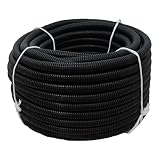
- HDPE offers greater rigidity and durability than LDPE and may be direct buried
- Constructed from HDPE, High density polyethylene, solvent and acid resistant.
- Polyethylene exterior is designed to absorb light to medium impact levels
- Prevents delicate cables and fibers from crush, cut and wear damage and deterioration
- Available in sizes from 1/2 inch to 2 inch in Black and Orange colors.
California’s Public Utilities Commission General Order 128 specifies 12 inches of cover for covered communications cable on sidewalks, parkways, and private property, and 18 inches in thoroughfares. Those figures apply to systems within the order’s scope in California; they are not general homeowner burial depths.
Before settling on a route, account for property boundaries, easements, public rights-of-way, driveways or other vehicle crossings, and areas likely to be dug up later. Ask the local authority and, where applicable, the cable owner whether the route is permitted and whether specific access, conduit, or restoration requirements apply.
Rank #4
- 𝐏𝐫𝐞𝐦𝐢𝐮𝐦 𝐋𝐢𝐪𝐮𝐢𝐝 𝐓𝐢𝐠𝐡𝐭 𝐂𝐨𝐧𝐝𝐮𝐢𝐭: 1/2 inch flexible conduit made from anti-oxidation virgin pvc.smooth inside for easier wire pulling,no hazardous sharp edges or burrs.integral rigid and flexible pvc construction will not damage conductors,and 50% lighter than metallic conduits.costs less to install
- 𝐒𝐚𝐟𝐞𝐭𝐲 𝐚𝐧𝐝 𝐒𝐭𝐮𝐫𝐝𝐢𝐧𝐞𝐬𝐬: Ansgery 1/2 inch liquid tight conduit resists to corrosion,water,oil,abrasion,acid,metal shavings and rough environment;resistance to pulling and crushing;fully adaptable to outdoor environments such as direct sunlight,direct burial.stays flexible in extreme hot and cold temperatures
- 𝐂𝐨𝐦𝐩𝐥𝐞𝐭𝐞 𝐀𝐜𝐜𝐞𝐬𝐬𝐨𝐫𝐢𝐞𝐬: 1/2 inch 25 ft flexible electrical conduit with 5 straight and 3 90-degree conduit connector fittings.Flexible electrical conduit length:25ft,id:1/2inch,od:0.83inch,thick:2.5 mm,fittings install directly onto conduit for waterproof joints
- 𝐄𝐟𝐟𝐨𝐫𝐭𝐥𝐞𝐬𝐬 𝐈𝐧𝐬𝐭𝐚𝐥𝐥𝐚𝐭𝐢𝐨𝐧: Liquid-tight conduit fits is fast,length can be cut to size,only one person can complete the work in a few minutes.Flexible conduit connector is safe to use and does not require any tools.You can simply tighten the dome sealing nut by pushing the conduit or pipe onto the ferrule
- 𝐖𝐢𝐝𝐞 𝐀𝐩𝐩𝐥𝐢𝐜𝐚𝐭𝐢𝐨𝐧𝐬: Pvc electrical conduit has very good durable, pulling and squeezing;Widely used in hvac equipment, machine tools,marine equipment,motors and controls,printing equipment,pumps, refrigeration equipment,transformer connections,outdoor lighting
Use a provider’s process for a provider-owned drop
Provider procedures vary, so ask your own provider whether it owns the line, who is responsible for burying or repairing it, and whether you may prepare a trench. Confirm the approved route, installation method, access requirements, permits, and any property agreement before doing work.
- CenturyLink’s wholesale overview describes a particular simple buried-service-wire workflow in which a customer may dig the trench and CenturyLink lays the wire; it also says a signed private-property agreement may be required. This is not a guarantee that the same arrangement is offered to every retail customer.
- AT&T’s support information describes coordination with utilities and crews that trench and install temporary or permanent cable.
- Rogers says it may install a temporary line and assign a contractor to bury a permanent one, subject to permits, locates, weather, and access. This is a Canadian provider example, not a process that applies elsewhere.
These examples illustrate why you should not independently bury, replace, or reroute a provider’s cable. Get the instructions for your service area directly from the provider.
Best Value

- SPECIFICATIONS:12/2AWG, 50 ft length; rated 600 volts, Durable Copper Construction Features two solid copper conductors with a PVC jacket
- DIRECT BURIAL: Allows direct underground installation without conduit, significantly simplifying installation and saving substantial piping costs and labor time
- UL Listed: Meets rigorous safety and quality standards for dependable use in a variety of environments
- Weatherproof & UV Resistant: The high-quality PVC jacket provides excellent protection against weather elements, making it waterproof, sunproof, snowproof and windproof, with an operating temperature range from -10℃ to 105℃, it maintains stable performance
- Indoor & Outdoor Use: Indoor for Wet or Corrosive Locations; Outdoor for outlets, landscape lighting, agricultural machinery, and other damp or direct-burial scenarios
Dig carefully and treat exposed cables as a serious hazard
Underground cable damage can cause fatal or serious injury. The UK Health and Safety Executive warns: “When underground cables are damaged, people can be killed and injured by electric shock, electrical arcs (causing an explosion), and flames.” Its advice is safety context, not a substitute for local rules: plan the work, obtain and review service plans, locate cables with suitable equipment, and excavate carefully.
When exposing an existing service, the HSE advises digging alongside it and exposing it horizontally; it also recommends insulated tools for hand digging near electric cables. Do not assume that an apparently low-voltage or communications line is safe to cut or move. If the line’s identity or condition is unclear, stop and contact the owner or a qualified professional.
Quick Recap
A practical decision checklist
- Identify the system and owner. Establish whether the line carries power or communications and whether it is yours, a utility’s, or a provider’s.
- Ask the authority and owner about requirements. Check local code, permits, inspections, easements, product instructions, and any provider-approved route or installation method.
- Request a locate. In the United States, contact 811 and follow the local process. Find out whether private lines are included; arrange private locating where needed.
- Choose the cable and method only after requirements are known. Confirm whether direct burial or a raceway is allowed for this application and what the product listing requires.
- Excavate only when authorized and marked. Follow local tolerance-zone rules and use careful methods around existing services. Stop if you encounter an unknown line.
Product prices and availability are accurate as of the date/time indicated and are subject to change. Any price and availability information displayed on Amazon at the time of purchase will apply.
The Tool Desk
Outbyte Driver Updater FREEScan for outdated or missing drivers - takes under a minuteDriver Scan →Outbyte PC Repair FREERepair Windows errors before they cause bigger problemsFix Now →
