
Quick wins for a faster PC:
Scan for outdated or missing drivers - takes under a minuteDriver Scan →Repair Windows errors before they cause bigger problemsFix Now →Fix the driver behind crashes, sound loss and screen glitchesFind Drivers →iTechGuides is reader-supported. When you buy through links on our site, we may earn an affiliate commission. As an Amazon Associate I earn from qualifying purchases. Learn more
Home construction can support demand for lumber and, indirectly, the logs timberland owners sell—but it does not guarantee stronger timberland REIT earnings or share returns. The latest available U.S. Census figures, for August 2026, are mixed: housing starts fell year over year even as permits rose, while completions dropped sharply. The link from construction to a REIT’s results also depends on regional markets, wood-product mix, costs, and other businesses.
What the latest U.S. housing data says
The latest Census new residential construction release available as of October 9, 2026, covers August. Its indicators point in different directions, and each measures a different stage or aspect of residential construction.

| Measure | August 2026 figure | Change |
|---|---|---|
| Privately owned housing starts | 1,275,000 at a seasonally adjusted annual rate | Down 2.6% from revised July and 1.2% from August 2025. Census gives margins of error of ±12.0% for the month-to-month comparison and ±10.8% year over year. |
| Single-family housing starts | 918,000 at a seasonally adjusted annual rate | Up 7.6% from revised July; the published month-to-month margin is ±14.0%, so treat the movement cautiously. |
| Privately owned housing units authorized by permits | 1,394,000 at a seasonally adjusted annual rate | Up 3.5% from August 2025 and down 2.7% from July. |
| Privately owned housing completions | 1,128,000 at a seasonally adjusted annual rate | Down 27.1% from August 2025. |
Figures and comparisons are from the U.S. Census Bureau’s August 2026 new residential construction release. A housing start is recorded when excavation begins for a building’s footings or foundation. It is not a completed home, and a national starts, permits, or completions series does not measure how much timber a particular company sells.
What’s actually slowing this PC down?
Pick the symptom - the matching free tool is one click away.
Residential construction spending offers another view, but it is not a count of homes or a direct measure of timber purchases. The Census Bureau estimated August residential construction spending at a seasonally adjusted annual rate of $882.3 billion, 1.1% above revised July. See the August 2026 construction spending release.
#1 Best Overall

How homebuilding could affect timberland REITs
The potential benefit runs through a supply chain: homebuilders use lumber, lumber mills buy logs, and timberland operators grow, manage, harvest, and sell timber. If residential construction lifts lumber demand and mill activity, demand for some logs may also improve. That connection is indirect; it does not mean more housing starts translate automatically into higher prices or sales for every timberland owner.
Rayonier’s Q1 2026 investor presentation says, “Grade products are largely sold to lumber mill customers that have direct exposure to residential construction activity.” The company also notes, “Pulp mills provide a base load of timber demand within many of our operating areas, particularly in the U.S. South.” These company statements describe channels of demand, not independent estimates of how much housing changes timber prices. The presentation is available from Rayonier’s investor materials.
Rank #2
Homebuilding is therefore one influence among several. Timber also goes to pulp and paper, packaging, and other wood-product markets. Regional supply, species, product grade, mill capacity, lumber prices, transport availability, and operating costs can all shape what a timberland company realizes from its harvest.
Why REIT results do not track housing starts one-for-one
Company reports illustrate how several factors can move results at once. In its Q2 2026 release, Rayonier said Southern Timber realized prices reflected its expanded geographic footprint and softer market conditions; costs and depletion also affected operating income. In Northwest Timber, higher sawtimber prices reflected geographic mix, including Idaho sawtimber, much of which is indexed to lumber prices. The company also reported improved lumber prices during the quarter amid import duties, mill curtailments, and trucking shortages. These are management’s explanations of its reported results, not proof that housing activity caused the changes. See Rayonier’s Q2 2026 results.
Rank #3
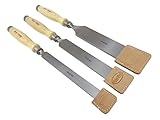
- This set of massive timer framing chisels are useful for large timber framing work when working on very deep mortises, where blade strength is required
- 3 piece set contains the following sizes: 1", 1-1/2" and 2"
- Comes with a 9 inch Ash handle and 10-1/2 inch blade. Overall length is 19-/2 inches.
- Forged from special Sheffield steel to ensure a perfect balance of toughness, edge retention and sharpness
- Come fitted with protective leather tip guard.
Business mix matters too. Rayonier describes itself as a land resources REIT with more than four million acres in the U.S. South and U.S. Northwest. Its business description also includes six sawmills, an industrial-grade plywood mill, residential and commercial real estate development, and rural land sales. Consolidated performance can therefore reflect more than timberland sales or housing-linked demand. Details appear in the company’s investor presentation and company materials.
What to examine when comparing timberland REITs
A construction-demand thesis is more useful when tested against each company’s actual exposures. Relevant comparison points include:
- Region and acreage: Timber markets and operating conditions differ between regions, so acreage totals alone do not show how exposed a company is to a particular market.
- Timber mix: Consider the balance of sawtimber and pulpwood, as well as species and product grades.
- Customers and pricing: Lumber-mill exposure may connect more directly to homebuilding than pulp and paper demand does; check whether log prices are tied to lumber prices.
- Other businesses: Wood-products manufacturing, land sales, development, and other activities can affect reported results independently of timber demand.
- Company-specific financial factors: Debt, capital allocation, costs, and operating constraints matter alongside demand.
The cited company materials describe operating and regional differences, but they do not establish a complete, current, like-for-like valuation comparison. A housing-demand argument alone cannot show whether a given REIT is attractively priced.
How to interpret the “underbuilt” housing thesis
Rayonier’s investor presentation uses the term “underbuilt” for housing and includes a chart drawing on Census and Fastmarkets material as well as company forecasts. That label is the company’s framing, not a Census finding. Weyerhaeuser’s June 2026 investor presentation lists expected housing demand and product pricing among forward-looking topics, while also identifying housing starts, mortgage financing availability, economic conditions, product demand, and prices as factors that could affect results. Those points are management outlooks and stated risks, not guarantees. See Weyerhaeuser’s investor presentations.
Best Value

- Coarse/Medium Blade (13" / 330 mm): Ideal for framing, treated lumber, laminates, logs, and timbers; perfect for heavy-duty cutting tasks in construction and tree work using a reliable hand saw design.
- Medium/Fine Blade (10-1/2" / 267 mm): Designed for precise cutting of plywood, particle board, molding, and 2x4s, ensuring clean and accurate results for carpentry and fine woodworking projects.
- Extra Fine Blade (8-3/8" / 213 mm): Best suited for cutting PVC and ABS pipes, flush cuts, particle board, and plywood, providing versatility for drywall installations and detailed woodwork.
- Double Edged Blade (10" / 254 mm): Perfect for intricate dovetail joints, moldings, particle board, flush cuts, and plywood, enhancing your toolkit with a compact hacksaw for precision tasks.
- Double Edged Mini Blade (5-1/2" / 140 mm): Ideal for detailed work such as dovetails, moldings, particle board, flush cuts, and plywood, offering a small and portable saw solution for on-the-go projects.
For context, compare any long-term housing thesis with current government data and the specific company’s operating disclosures. One month’s construction indicators cannot confirm a long-run housing shortfall or establish future REIT earnings.
Quick Recap
Product prices and availability are accurate as of the date/time indicated and are subject to change. Any price and availability information displayed on Amazon at the time of purchase will apply.

