
iTechGuides is reader-supported. When you buy through links on our site, we may earn an affiliate commission. As an Amazon Associate I earn from qualifying purchases. Learn more
Can electricity really grow on trees? Yes—but not as a tree acting like a power outlet. Experiments have harvested small electrical outputs from plant-associated bacteria, leaf motion or contact, rain droplets, and water moving through wood as it evaporates. Each method uses a different energy pathway, and the reported demonstrations do not establish trees as household power sources.
What “electricity from plants” can mean
The phrase covers several experimental technologies rather than one process. Some use compounds released by living plants as fuel for bacteria; others harvest mechanical contact, wind, or raindrops at a leaf. A wood device instead converts evaporation-driven water movement through microscopic channels into electrical output.
These distinctions matter: plant microbial fuel cells draw on plant-derived organic compounds, while leaf-based generators and wood devices harvest energy associated with motion or water transport. They are not all extracting electricity directly from photosynthesis or plant metabolism.
How plant microbial fuel cells generate electricity
Root-zone systems
Plants release organic compounds, including carbohydrates, into the area around their roots. In a plant microbial fuel cell (plant-MFC), electroactive bacteria oxidize these compounds. Electrodes collect the resulting electrical energy. Strik, Hamelers, Snel, and Buisman reported a reed-mannagrass proof of principle in 2008, with a maximum power density of 67 mW per square metre of anode surface area. That is a device measurement normalized to electrode area, not a whole-plant or whole-tree output figure. Wageningen University & Research’s record of the 2008 study also reports the authors’ estimate of potential production in Europe: 21 GJ per hectare per year (5,800 kWh per hectare per year). That figure is a projection, not a measured Europe-wide yield.
#1 Best Overall

- 【4 in 1 STEM Kit】These science kits contain a solar powered car, a solar powered fan, a wind powered car and a wooden plane. Each toy is individually packaged.Includes Magnetized Screwdriver and Detailed instructions make it much easier and convenient to assemble the models
- 【Family Stem Activities】This set of science experiments is a good way for parents and children to complete together, can also be used as a classroom STEM project
- 【Unique Gift Idea】Our stem kits designed for kids age 8-12 are cool stuff and very suitable for elementary students to show their talents in a science fair. Packaged in a beautiful gift box, these toys are great gifts for boys and girls for birthday and Christmas
- 【Easy To Assemble】Circuit connection is very simple, NO welding, suitable for kids to complete independently. Includes Magnetic Screwdriver and Detailed instructions make it much easier and convenient to assemble the models
- 【Learn By Playing】Encourage kids to build their own models and enjoy DIY science activities. By playing with these electric kit, children's curiosity and interest in physics will be stimulated, and they'll know how much fun it is to create a circuit by themselves
Stem-coupled systems
A 2020 conceptual prototype coupled microbial fuel cells to the stems of Pachira macrocarpa and Populus alba. The researchers reported operation for at least 40 days. Maximum power densities were 3.60 mW per square metre of anode area for P. macrocarpa and 7.61 mW per square metre for P. alba. The authors described a commensal relationship between the plants and anodic bacteria. These values use the same kind of area normalization as the 2008 result, but they come from a separate study and system. The study in Applied Energy presents the work as a prototype, not a ready-made generator.
How leaf-based generators harvest energy
Tapping, contact, and wind
Triboelectric nanogenerators (TENGs) produce electrical output through contact and separation between materials. In one 2024 single-electrode design, a natural leaf serves as the friction layer, while electrolytes inside the leaf function as an electrode layer. The researchers report that tapping a leaf lit 225 white LEDs. Their paper also describes an energy-management circuit that charges capacitors for low-power devices such as timers and temperature/humidity meters. As the corresponding author, Kun Zhang, put it: “Experiments have shown that the electricity generated by tapping on a leaf can light up 225 white LED lights.” The LED count belongs to that particular experimental device; it does not show that a bare leaf can keep 225 lamps lit continuously. The 2024 paper in Energy & Environmental Science describes the device and its circuit.
Rank #2

- 4 SETS WOODEN STEM KIT: These science kits contain a solar powered car, a solar powered plane, a wind powered car and an electric fan. Each toy is individually packaged. Kids will be proud of building their own models
- FAMILY BONDING TIME: Doing scientific experiments together is a good way for parents and children to build a great family relationship. Complete science projects with your kids as their friend and teacher, that’ll be an unforgettable and precious time
- UNIQUE GIFT IDEA: Our kits designed for kids age 8-12 are cool stuff for a budding inventor, very suitable for elementary students to show their talents in a science fair. Packaged in a beautiful gift box, these assembled electronic gadgets are perfect gifts for boys and girls for birthdays and Christmas
- LEARN BY PLAYING: Fun Projects! Encourage your kids to build their own model kit and enjoy DIY STEM activities. By playing with these electric toy kits, children's curiosity and interest in physics will be stimulated, and they'll know how much fun it is to create a simple model by themselves
- EASY TO ASSEMBLE: Circuit connection is very simple, NO welding, suitable for kids to complete independently. Includes detailed instructions make it much easier and convenient to assemble the models
A separate 2019 study made TENGs from leaves and leaf powder, as well as a wind-driven design. It reported fresh-leaf short-circuit current and voltage of up to 15 μA and 430 V. After surface modification, leaf-powder devices reached up to 60 μA and 1,000 V. The wind-driven device reported a maximum short-circuit current of 150 μA at 7 m/s wind and demonstrated an exit-light indicator. These are results from different configurations and conditions. Voltage alone does not tell how much useful energy a device can deliver: current, power, the connected load, and how long it runs also matter. The 2019 Nano Energy study reports the leaf, powder, and wind designs.
Free tools Windows power users keep installed
One-click scans. No signup required.
Rain-droplet harvesting
A 2020 fully biodegradable device used a leaf’s cuticle and conductive tissue together with water droplets to close an electrical circuit. The study tested five plant types and rainwater droplets. This is a leaf-and-water harvesting configuration, not evidence that a plant’s metabolism directly supplies the electricity. The University of Guelph’s account of the study describes the device.
Rank #3

- 6 COMPLETE SOLAR CAR STEM KITS FOR KIDS: Includes 6 individual Solar Car science kits for kids ages 8-12 with all parts and clear illustrated instructions. Perfect bulk stem toys for classroom group activities, science fairs, or party favors!
- ENCOURAGE STEM LEARNING: By building solar‑powered cars, kids can watch solar panels convert sunlight into kinetic energy, explore how basic circuits work, and discover the principles of gear transmission. This hand-on stem toys for ages 8-13 sparks curiosity in solar power and science engineering
- DEVELOPS MULTIPLE SKILLS: Assembling this STEM projects cultivates engineering thinking, creativity, hands-on ability, and problem-solving skills, while nurturing imagination and a lasting interest in science experiments. Perfect for classroom, homeschool, or weekend fun!
- EASY TO ASSEMBLE: No soldering, no special tools needed thanks to simple plug‑in circuit connections, kids can build independently. Step‑by‑step instructions make assembly quick and frustration‑free.
- DURABLE AND SAFE: Made of non-toxic plywood, smooth surface and rounded corner make your children safe when assembling these wood crafts. Ideal building kits for kids ages 8-12, and suitable for science classrooms in grade 2nd, 3rd, 4th and 5th.
How evaporation can generate electricity in wood
A 2020 wood nanogenerator used evaporation to draw electrolyte through the wood’s natural microchannels. That water movement creates a streaming potential and current. The authors reported 300 mV open-circuit voltage and 10 μA short-circuit current for a single device; five units connected in series powered a calculator demonstration. This is an evaporation-driven water-transport effect, not the bacterial chemistry used in plant-MFCs. The 2020 study in ACS Applied Materials & Interfaces describes the wood device.
How the reported results compare—and what they do not show
The examples below use different measures and test setups, so they cannot be ranked as if they were a common output test. Power density per anode area, open-circuit voltage, short-circuit current, and a powered-load demonstration describe different things.
Rank #4
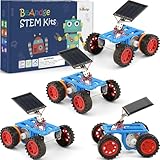
- SOLAR-POWERED SCIENCE FUN: Build 4 solar-powered toy cars that convert sunlight into motion! Each kit contains everything required, a mini screwdriver, and step-by-step instructions for hands-on STEM learning. Watch physics in action as solar energy drives the wheels—no batteries required! (Pack contains 4 cars, 4 manuals, 4 screwdriver)
- PERFECT FOR YOUNG ENGINEERS: Designed for kids ages 8-12 to explore robotics, engineering, and renewable energy. Ideal for school projects, STEM clubs, or family bonding. Younger builders (under 8) can participate with adult guidance, fostering teamwork and problem-solving skills
- BOOST CREATIVITY & CRITICAL THINKING: Combines science, technology, and crafts to spark curiosity. Enhances fine motor skills, logical reasoning, and environmental awareness through interactive play
- THOUGHTFUL GIFT FOR CURIOUS MINDS: Packaged in a colorful box, this STEM kit makes a unique birthday, holiday, or back-to-school gift. Parents and teachers love its educational value, while kids adore building and racing their creations
- DURABLE & SAFE MATERIALS: Made with non-toxic and premium materials. Weather-resistant components guarantee long-lasting durability for indoor and outdoor adventures
| Approach | Energy pathway | Reported result | Demonstrated example |
|---|---|---|---|
| Plant-MFC, reed-mannagrass (2008) | Bacteria oxidize plant-released organic compounds | 67 mW/m² of anode surface area; authors separately estimated 21 GJ/ha/year (5,800 kWh/ha/year) as potential European production | Proof of principle; the Europe-wide figure is an estimate, not a measured yield |
| Stem-coupled plant-MFCs (2020) | Plant-associated anodic bacteria | 3.60 mW/m² for P. macrocarpa and 7.61 mW/m² for P. alba, both per anode surface area; operation reported for at least 40 days | Conceptual prototype |
| Leaf TENG (2024) | Tapping/contact and separation at a leaf-based device | Researchers reported lighting 225 white LEDs; no directly comparable power-density figure is provided here | Capacitor charging and low-power meter applications described |
| Leaf and leaf-powder TENGs (2019) | Contact/separation; one design harvests wind-driven motion | Fresh-leaf devices: up to 15 μA and 430 V; modified leaf-powder devices: up to 60 μA and 1,000 V; wind design: 150 μA maximum short-circuit current at 7 m/s | Wind-driven exit-light indicator |
| Leaf water-droplet harvester (2020) | Water droplets close a circuit through leaf cuticle and conductive tissue | Tests involved five plant types and rainwater droplets; a comparable output figure is not stated in the cited account | Fully biodegradable device |
| Wood evaporation device (2020) | Evaporation moves electrolyte through wood microchannels | 300 mV open-circuit voltage and 10 μA short-circuit current for one device | Five devices in series powered a calculator |
There is no shared test protocol or harmonized efficiency figure in these studies, so their headline values do not establish which approach produces the most usable electricity. An LED count, a voltage reading, or a calculator demonstration is evidence that a particular prototype produced an effect under its test conditions—not a measurement of ordinary household supply.
What the demonstrations mean for practical use
The work points toward experimental energy harvesting for low-power or specialized applications, such as sensors, meters, indicators, or intermittent demonstrations. It does not establish a consumer tree-electricity generator, nor show that trees can power homes, charge phones, or replace solar panels. For those larger claims, the cited studies do not provide a demonstrated system or comparable, sustained household-scale output.
Quick Recap
Best Value

- This is a multi-functional learning kit,three power generation modes, energy conversion, circuit learning, and understanding of the conversion between sound, light and electricity.
- Solar power generation, using solar panels to convert the solar energy into electrical energy.
- Hand-cranked generator, kinetic energy is converted into electrical energy to light an LED or turn the fan
- The windmill generator,harness wind power and light an LED
- An excellent Family & Kids program,great for Primary and secondary schools projects,With Paper Instructions
Product prices and availability are accurate as of the date/time indicated and are subject to change. Any price and availability information displayed on Amazon at the time of purchase will apply.

