
iTechGuides is reader-supported. When you buy through links on our site, we may earn an affiliate commission. As an Amazon Associate I earn from qualifying purchases. Learn more
Yes—researchers at North Carolina State University demonstrated a proof-of-concept process that uses finely ground eggshells to make magnesium-based composite rods described as stronger and harder. The “95%” refers to the calcium carbonate content of the eggshells, not the amount of eggshell in the finished metal or the share of material successfully converted.
What the researchers made—and what “95%” means
NC State’s report says eggshells are 95% calcium carbonate, a calcium-rich material that can supply calcium during processing. The figure describes the eggshell composition; the report does not say that eggshells make up 95% of the composite or that the process converts 95% of its feedstock into product. NC State College of Engineering’s October 2, 2026 report describes the result as magnesium-based composite rods and calls the work a proof of concept.
The university says the resulting material is stronger and harder, but its public report gives no numerical strength or hardness comparison. It does not identify a conventional alloy benchmark or provide a percentage improvement, so the finding should be understood as a reported result rather than a quantified performance claim.
Recommended Free Tools
How eggshell powder becomes part of a magnesium rod
The team used friction stir extrusion. In the process described by NC State, a cylindrical magnesium block is drilled with evenly spaced holes and the holes are filled with finely ground eggshell powder. The block is placed inside a steel cylinder, then a rotating steel mandrel presses into it. The mandrel turns at 300 rotations per minute; friction and mixing promote reactions, while pressure pushes the material through an opening in the mandrel to form a rod. NC State’s process description gives that speed for the experimental setup.
#1 Best Overall

- 100g Magnesium Block: Convenient size for controlled testing and analysis.
- Tool Parts Compatible: Suitable for use in specialized equipment and tools.
- High Purity Mg99.95%: Ensures reliability for precise scientific experiments.
- Scientific Research Grade: Ideal for laboratory and experimental use.
- Magnesium Bar Ingot: Durable and easy to handle for various applications.
What happens to the eggshell calcium
NC State describes the calcium carbonate as converting into calcium oxide and calcium during processing, with formation of Mg2Ca, a magnesium-calcium phase. The study abstract reproduced in the university report also describes nanoscale fragmentation of calcium carbonate and interfacial reactions that form calcium oxide (CaO) and magnesium oxide (MgO). It attributes improved interfacial integrity and microstructural stability to refined grains and oxide formation in situ—that is, within the material as it is processed.
What the result does—and does not—establish
The work is an early manufacturing demonstration, not evidence that an eggshell-reinforced alloy is ready for commercial or safety-critical use. The report discusses magnesium alloys’ combination of strength and low weight and mentions fields such as electronics, aerospace, automotive and biomedical applications as context. It does not report application-specific testing, certifications or qualification for any of those uses.
Rank #2

- We are providing 1000 grams net weight Aluminum Magnesium alloy chunks raw material. Approx 2.2 Lbs.
- AlMg50 is known for its lightweight properties while with excellent corrosion resistance features;
- This kind alloy is widely used in automotive industry, aerospace industry, 3D printing application, welding application and marine engineering areas etc.
- This material is sold by weight and the shape will be randomly posted. But the quality is the same good.
The researchers’ abstract characterizes the approach as scalable and energy efficient, and the university describes potential advantages such as fewer steps and lower energy compared with conventional calcium additions. However, the public report supplies no quantified scale-up volume, energy use, avoided emissions, production cost or lifecycle analysis. Those advantages remain reported rationale, not measured comparative results in the release.
PC Slower Than It Used to Be?
A free scan shows the junk files, broken settings and background clutter dragging Windows down - then fixes them in one click.Free scan · Windows 10 & 11Outdated Drivers Are Slowing You Down
One free scan finds every outdated or missing driver and matches the right update for your exact hardware.Free scan · exact hardware matchThe paper, “Circular Manufacturing of Mg–Eggshell Composites: Transforming Biogenic Waste into Functional Reinforcements,” was published September 30, 2026, in the Journal of Magnesium and Alloys (DOI: 10.1016/j.jma.2026.102290). Bharat Gwalani, an NC State assistant professor of materials science and engineering, is the corresponding author; first author Aniruddha Malakar is described as a former NC State postdoctoral researcher who is now at Pacific Northwest National Laboratory. The work’s reported support includes the Office of Naval Research Global under grant N00014-23-1-2758 and Pacific Northwest National Laboratory. The journal article provides the published study record.
Quick Recap
Best Value
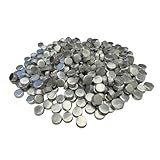
- Premium 6063 Aluminum Alloy – Magnesium-silicon composition for superior strength, corrosion resistance, and machinability.
- Industrial & DIY Ready – Ideal for casting, melting, alloying, CNC machining, and custom fabrication projects.
- Consistent Quality – Uniform pellet size and density for predictable melting behavior and smooth casting results.
- Corrosion-Resistant & Lightweight – Maintains structural integrity while resisting rust and oxidation, even in harsh environments.
- Versatile Applications – Perfect for industrial manufacturing, automotive parts, marine components, jewelry making, and prototypes.
Rank #4

- We provide high-quality NiMg20 alloy ingots. Net weight 100g
- Material content: 80% nickel, 20% magnesium.
- NiMg20 is a nickel magnesium alloy with a nickel content of 80% and a magnesium content of 20%
- Attention: Products are sold by weight, and the number and shape of blocks are random.
- It is an excellent gift for natural science and element enthusiasts.
Rank #3

- We are providing 100 grams net weight Aluminum Magnesium alloy chunks raw material. Approx 3.52 oz.
- AlMg50 is known for its lightweight properties while with excellent corrosion resistance features;
- This kind alloy is widely used in automotive industry, aerospace industry, 3D printing application, welding application and marine engineering areas etc.
- This material is sold by weight and the shape will be randomly posted. But the quality is the same good.
Product prices and availability are accurate as of the date/time indicated and are subject to change. Any price and availability information displayed on Amazon at the time of purchase will apply.
Independent reader supportYour contribution helps us test, update, and keep practical guides available for everyone.
