
iTechGuides is reader-supported. When you buy through links on our site, we may earn an affiliate commission. As an Amazon Associate I earn from qualifying purchases. Learn more
You can build a Russian Roulette game in which players and ordinary game logic cannot know the outcome before the trigger fires. You cannot make it literally unknown to all code, because whatever code draws the random result holds that result for a moment. The practical goal is to draw the outcome at trigger time, from a cryptographically secure generator, and to keep it out of every path that runs before the trigger. This article explains how to do that, where the design choices matter, and where the guarantee stops.
What the promise can honestly mean
The defensible claim is unpredictability before the draw. Once the trigger causes random bytes to be generated and mapped to an outcome, the executing system necessarily has that outcome. The question is whether anyone can obtain it or compute it beforehand. A design meets the promise when three things are true:
- The outcome is not computed early. No random value is created at page load, game start, or round setup.
- The outcome is not exposed early. It does not appear in the user interface, game state, logs, analytics events, or network messages before the trigger.
- The outcome is not practically predictable from what a player can observe. The generator is seeded from a strong entropy source, and no clock, counter, or small seed space can be used to reproduce the value.
Two common phrasings of the goal, “nobody knows the result” and “the result is truly random,” overstate what software can do. The first ignores the code that performs the draw. The second needs a qualifier: software generators are computationally unpredictable, not physically random, unless they draw from a hardware entropy source. Both points are covered below.
What’s actually slowing this PC down?
Pick the symptom - the matching free tool is one click away.
Choose where the draw happens
The most important design decision is which machine performs the draw and when. The three models below differ in who can read the result and whether the result can be checked afterward.
#1 Best Overall

- This is a 12-inch roulette wheel professional roulette wheel European roulette wheel made of medium density fiberboard wood; the rotor is made of solid aluminum, chrome plated tower.
- Turntable design: Retro cross spiral design, beautiful and atmospheric numbers are clearly visible, giving you a better entertainment experience.
- Dimensions: Approximately 30.5cm/12" in diameter, 8cm/3" in height.
- Simple and convenient: The turntable is easy to install and disassemble, convenient and clean.
- Leisure game: This roulette wheel spins easily and isfor family game night or club party.
| Model | When the outcome exists | Who can read it | Predictable before the trigger? | Verifiable afterward? | Abort or reset handling |
|---|---|---|---|---|---|
| Browser-only draw | When the trigger event runs in the page | The player, through developer tools and memory inspection | Yes, if the player can see or influence the generator state. Not defensible against the player who controls the machine. | No, unless a commitment is published (not applicable in this model without a server) | Not addressed by the code; a reload can restart the round unless state is stored elsewhere |
| Server-side draw at trigger | When the trigger request reaches the server | The server process only; the player sees the result only in the response | No, if the generator is cryptographically secure and nothing leaks earlier | Only by trusting the operator, unless a commitment is added | Must be defined in the rules, for example that a dropped connection still resolves the round |
| Commit-then-reveal | The outcome is generated and committed before the trigger; the commitment is shown to players | The server holds the outcome and nonce; players see only the commitment | No, the commitment hides the outcome, though the server knows it | Yes, after the reveal players can recompute the commitment | Requires an explicit rule for withheld reveals and restarts |
For anything with stakes, such as real money, prizes, or tournament results, a server-side draw is the minimum. A browser-only draw is acceptable only for a single-player game where the player has no incentive to cheat and nothing depends on the result beyond entertainment.
Build the draw in five steps
- Use the platform’s cryptographic random source. In Python, use the
secretsmodule, which draws from the operating system’s random source. In Node.js, usecrypto.randomInt()orcrypto.randomBytes()from thecryptomodule. In a browser, usecrypto.getRandomValues(). In Java, usejava.security.SecureRandom. Check the method names against the documentation for your runtime version before you rely on them. - Generate the outcome inside the trigger handler. The function that resolves the shot should be the first place the random value is requested. Do not call it when a round is created or a lobby opens.
- Keep the value out of state before the trigger. Do not store the outcome in a variable that the rendering layer, analytics code, or a serialized game object can read. Do not put it in a debug log.
- Map the random value without bias. Section 4 explains the method.
- Return or reveal only after resolution. The outcome should leave the draw function only in the response that resolves the trigger, or in the reveal step of a commitment scheme.
Map random values to chambers without bias
A revolver with six chambers has an outcome space of six. A common mistake is to draw a random byte from 0 to 255 and take it modulo 6. Because 256 is not a multiple of 6, the values 0 through 3 occur slightly more often than 4 and 5. The bias is small, but it is systematic, and it means the outcome distribution is not the one the game advertises.
Rank #2

- Designed for ages 17+, this unhinged card game is perfect for those who enjoy dark humor, strategic gameplay, and a bit of friendly betrayal. Ideal for adult game nights, college parties, or pre-gaming.
- Whether you’re at a party, on a road trip, camping, or enjoying a night of drinks with friends, This is your go-to game for outrageous fun.
- Includes 56 hilariously inappropriate cards featuring original artwork by The Oatmeal that were too horrible to put in the original card game.
- Our Story: From the creators of the internet sensation The Oatmeal, Exploding Kittens started as a Kickstarter phenomenon and has since exploded into a global hit. We blend absurd humor with strategic gameplay, making our games a blast—just ask our millions of fans worldwide.
- Our Story: From the creators of the internet sensation The Oatmeal, Exploding Kittens started as a Kickstarter phenomenon and has since exploded into a global hit. We blend absurd humor with strategic gameplay, making our games a blast—just ask our millions of fans worldwide.
The standard fix is rejection sampling. Accept only the values below the largest multiple of the outcome count that fits in the byte range. For six chambers, 252 is the largest multiple of 6 at or below 256, so bytes from 252 to 255 are discarded and drawn again:
import secrets

CHAMBERS = 6

def draw_chamber() -> int:
    # secrets.randbelow() uses rejection sampling internally,
    # so the result is uniform over 0..5.
    return secrets.randbelow(CHAMBERS)
If your language offers only raw bytes, implement the same rule by hand: draw a byte, return value % 6 when the value is below 252, and draw again otherwise. Either way, the mapping is applied once, inside the draw function, and nowhere else.
Rank #3
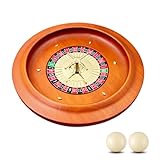
- Thrilling Gameplay: Experience classic risky Russian roulette with dummy rounds—spin the wheel and test your luck
- Premium Craftsmanship: Handmade solid wood set with smooth wheel and table, recreating authentic casino ambiance
- Social Fun: Gather friends for a suspenseful night of entertainment that strengthens bonds
- Flexible Rules: Adult-focused game exploring risk/mortality themes; customize additional gameplay with friends
- Ideal Gift: Perfect for birthdays, Father’s Day, New Year, Christmas—great holiday present choice
Add verifiability with commit, then reveal
Secrecy before the draw and verifiability after the draw are separate goals. A server-side draw keeps the outcome secret but gives players no way to check it. A commitment scheme adds the check, with some new failure modes.
- Commit. Before the trigger, generate the outcome and a random nonce of at least 128 bits. Publish a commitment, such as a SHA-256 hash of the outcome concatenated with the nonce. Players can see the hash but cannot derive the outcome from it.
- Trigger. When the trigger fires, the server resolves the round using the committed outcome. It does not generate a new one.
- Reveal. After resolution, publish the outcome and nonce. Anyone can recompute the hash and compare it with the commitment published earlier.
- Write the abort rules before the first round. A NIST paper on commitment-based protocols describes a participant who withholds the reveal, or who triggers a reset after seeing an unfavorable prospective result. Your rules should state what happens if a reveal is missing, if a connection drops after the trigger, and whether a round can be restarted. A common approach is to settle any round with a published commitment on a timeout, and to forbid restarts once a commitment is public.
Commit-then-reveal proves that the outcome was fixed before the trigger. It does not prove that the outcome was generated from a good random source, so it should be combined with the generator choices in the earlier sections.
Rank #4

- IUP OH! sushi game
- Easy to use
- BRAND : IUP
- Item condition new
Common failure modes
- Non-cryptographic generators. Functions such as
Math.random()in JavaScript orrandom.random()in Python are not designed for security use. Their outputs can be predicted once enough values are observed or the state is recovered. - Clock-based seeding. Seeding from the current time, or from a process ID, leaves a small search space. An attacker who knows roughly when the round started can try the candidate seeds.
- Early exposure. The result appears in a WebSocket message, a server-rendered page, a progress animation’s data attribute, or a log line before the trigger. Check every message sent to the client before the trigger.
- Predraw state. A round object created at lobby time that contains a pre-generated outcome, even if the field is hidden in the interface, is exposed to anyone who can read the object.
- Modulo bias. Using
%on raw random bytes skews the distribution toward lower outcomes. - Restart after a bad draw. If the player can reload the page and receive a new outcome, the result was not fixed by the trigger.
What “truly random” means here
Software random generators fall into two categories. A deterministic random bit generator produces a stream of bits from an internal state and a seed. A pseudorandom generator is deterministic once its state is known, so its security depends on keeping that state secret and seeding it from an unpredictable source. NIST’s SP 800-90 series separates the deterministic generators from the entropy sources that seed them. A physical entropy source, such as a hardware noise generator, is a different thing.
NIST’s guidance on random-generator security strength relies on measuring unpredictability with min-entropy. NIST IR 8427 (2023) describes a full-entropy assumption for the SP 800-90 series of at least 1−ε entropy per bit, with ε at most 2^-32. That number belongs to the standard’s assumption about entropy sources. It is not a probability for any game outcome, and it is not a guarantee about a particular implementation.
Best Value

- 8 Powerups: when you need a little extra help use powerups to get the bigger bingo wins!
- Daily extra goodies and loyalty prizes are already prepared so start Bingo Mastery today with your family and friends!
- Play with up to 4 cards at once! Play fun addictive mini games that bring bling and blitz.
- Travel around the world and win Bingo Tournaments like no other!
- Countless Achievements, daily tasks, minigames are in store for you which will give you plenty of rewards.
Statistical testing does not establish security. RFC 4086, by Donald Eastlake, John Schiller, and Steve Crocker, states: “Statistically tested randomness in the traditional sense is NOT the same as the unpredictability required for security use.” A generator can pass statistical tests and still be predictable, so do not rely on test results alone to justify a fairness claim.
Standards to check before you make a claim
If you describe your draw as compliant with a standard, check the current version of that standard. NIST’s overview of the SP 800-90 series notes that SP 800-90A is being revised to align with SP 800-90C. Compliance depends on the publication version, the platform, and the jurisdiction where the game is offered. Avoid labels such as “certified,” “true random,” or “provably fair” unless you can document the runtime, the entropy source, the threat model, and the protocol for a specific build.
For a single-player browser game, the design goal is a draw that the player cannot influence or predict from the page. For a game with stakes, the design goal is a server-side draw with a committed outcome, a published reveal procedure, and written rules for aborts.
Free tools Windows power users keep installed
One-click scans. No signup required.
Quick Recap
Product prices and availability are accurate as of the date/time indicated and are subject to change. Any price and availability information displayed on Amazon at the time of purchase will apply.

