
The Tool Desk
Outbyte Driver Updater FREEFix the driver behind crashes, sound loss and screen glitchesFind Drivers →Outbyte PC Repair FREEClear out junk files and repair common Windows errorsFree Scan →iTechGuides is reader-supported. When you buy through links on our site, we may earn an affiliate commission. As an Amazon Associate I earn from qualifying purchases. Learn more
You can build an Arduino dust monitor with the Sharp GP2Y1010AU0F by powering the sensor, pulsing its infrared LED, and sampling its analog output at the right time. The result is useful for observing relative dust levels, but it is not automatically a validated PM2.5 measurement or a device for health decisions.
What the GP2Y1010AU0F measures
The GP2Y1010AU0F uses an infrared emitter and phototransistor to detect light reflected by airborne dust. Sharp says it is particularly effective at detecting very fine particles such as cigarette smoke; its datasheet also describes distinguishing smoke from house dust by the output pulse pattern. This is an optical dust sensor with an analog-voltage output, not a digital counter that identifies and counts individual particles. See Sharp’s GP2Y1010AU0F datasheet.
Sharp’s current product specification lists a 4.5–5.5 V operating supply, typical current of 11 mA, sensitivity of 0.5±0.15 V per 0.1 mg/m³, and precision of ±30%. Its stated reference detection concentration is 0–1,500 µg/m³, based on the TSI 8530. These are manufacturer specifications, not a performance guarantee for a completed DIY monitor. Consult Sharp’s dust sensor specifications.
Parts and wiring
Use an Arduino UNO-style 5 V setup as a starting point, plus the sensor, a 150 Ω resistor, a 220 µF capacitor, jumper wires, and a breadboard or other suitable connections. Sharp’s datasheet shows the resistor and capacitor in its recommended application circuit. DFRobot’s UNO example provides this wiring arrangement; verify the pin names and circuit against the revision of the sensor you have.
#1 Best Overall

- Sharp GP2Y1010AU0F onboard, detecting fine particle larger than 0.8?m in diameter, even like the cigarette smoke
- Low power consumption, analog voltage output, the output level is linear with dust density
- Embedded voltage boost circuit to support wide range of power supply
- A simple Air Monitor
- Sensitivity : 0.5V/(100μg/m3)
| Sensor connection | UNO example |
|---|---|
| Vcc | 5 V |
| Vled | 5 V through a 150 Ω resistor |
| LED-GND and S-GND | Ground |
| LED control | Digital pin 2 |
| Vo (analog output) | A0 |
Follow the manufacturer’s application circuit for the sensor revision in hand, including the 220 µF capacitor shown there. The table summarizes DFRobot’s Arduino wiring example; Sharp’s datasheet is the reference for the device’s electrical and timing requirements.
The 5 V arrangement is for the UNO example, not a universal instruction for every microcontroller. Some boards have lower analog-input limits. Check the board’s allowable input voltage and ADC reference, and scale the sensor output if needed before connecting it.
Rank #2

- GP2Y1014AU0F Compact Optical Dust Sensor Compatible GP2Y1010AU0F GP2Y1010AUOF Smoke Particle Sensor With Cable
Drive the LED and sample on time
The sensor needs a short LED-on interval synchronized with the analog reading. Sharp specifies a pulse cycle of 10±1 ms, a pulse width of 0.32±0.02 ms, and a sampling point 0.28 ms after turn-on. The datasheet’s application circuit uses a 150 Ω resistor and a 220 µF capacitor.
DFRobot’s example sketch switches the LED on, samples after 280 µs, waits another 40 µs, switches the LED off, and then waits 9,680 µs before repeating. That sequence follows a 10 ms cycle. Use the DFRobot Arduino example as a concrete reference, while checking that its circuit and pin assignments match your build. The timing diagram and circuit in Sharp’s datasheet define the sensor’s requirements.
Rank #3

- 1PCS GP2Y1014AU0F Compact Optical Sensor Compatible GP2Y1010AU0F GP2Y1010AUOF Particle Sensor With Cable
Turn the analog reading into a useful observation
Read the ADC value from A0 during the specified sampling window, then convert counts to voltage using the actual board’s ADC reference voltage. For an N-bit ADC with a reference of Vref, the basic conversion is approximately voltage = ADC_count × Vref / (2N − 1). Use the resolution and reference applicable to your specific board rather than assuming every Arduino-compatible device behaves like a UNO.
To estimate dust concentration, you also need a calibration that applies to the sensor and build. A voltage-to-concentration formula in an example sketch is not, by itself, evidence of traceable PM2.5 accuracy. Sharp’s broad ±30% precision specification and reference concentration do not validate the accuracy of a homemade instrument. Unless the completed monitor has been independently validated, describe its output as an indicative dust reading or dust trend, not a regulatory PM2.5 result.
Rank #4
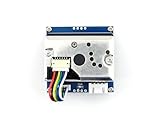
- Sharp GP2Y1010AU0F onboard, detecting fine particle larger than 0.8μm in diameter, even like the cigarette smoke
- Low power consumption, analog voltage output, the output level is linear with dust density
- Embedded voltage boost circuit to support wide range of power supply
- Sensitivity : 0.5V/(100μg/m3) Measurement range : 500μg/m3 Power : 2.5V~5.5V Operating current : 20mA(max) Operating temperature : -10℃~65℃
Keep the sensor unobstructed
Keep the sensor openings clear so air can reach the optical sensing area. Sharp warns against cleaning the device because cleaning may leave it outside its specified characteristics. If the sensor appears dusty, do not assume that cleaning it will restore accurate readings; follow the handling guidance in the datasheet.
Quick wins for a faster PC:
Clear out junk files and repair common Windows errorsFree Scan →Scan for outdated or missing drivers - takes under a minuteDriver Scan →Repair Windows errors before they cause bigger problemsFix Now →When another sensor type may be a better fit
Sharp’s product catalog distinguishes this analog dust sensor from other sensor families, including a UART model whose feature description says PM2.5 or larger can be discriminated. The interface alone does not establish that a sensor is suitable for a particular measurement. When comparing options, check the particle-size claims, stated precision, calibration or validation evidence, and the extra wiring and software complexity. See Sharp’s sensor catalog.
Quick Recap
Product prices and availability are accurate as of the date/time indicated and are subject to change. Any price and availability information displayed on Amazon at the time of purchase will apply.

