
Do these 3 things before closing this tab:
1Repair Windows errors before they cause bigger problems2Fix the driver behind crashes, sound loss and screen glitches3Clear out junk files and repair common Windows errorsiTechGuides is reader-supported. When you buy through links on our site, we may earn an affiliate commission. As an Amazon Associate I earn from qualifying purchases. Learn more
Yes—selected budget graphics cards can now make 1440p gaming a realistic target, but it is not a free upgrade from 1080p. Results depend on the game, quality settings, frame-rate goal, card variant, and local price. The change is best understood as a wider range of entry-level GPUs being considered for 1440p, not as a guarantee that every inexpensive card will run every game smoothly at that resolution.
Why 1440p asks more of a budget GPU
At 2560 × 1440, a GPU must render more pixels per frame than it does at 1920 × 1080. That added workload can lower frame rates, particularly in demanding games or at high quality settings. Whether the difference matters depends on what you play and the performance you want: a card may be comfortable in one game and struggle in another.
Compare results at the resolution and settings you intend to use, rather than relying on a headline FPS number. AMD’s Radeon comparison tool lets readers compare vendor-published performance figures across 1080p, 1440p, and 4K in selected games and settings. Treat those as AMD’s own figures, and check the test footnotes before comparing them with independent reviews. The “up to” figures on AMD’s RX 6000 product page are not guarantees of typical performance in every game.
Recommended Free Tools
How the roughly $300 class has shifted
Launch MSRPs provide one limited way to compare generations. They are not current street prices, and the figures below do not come from one common benchmark test, so they cannot establish a performance-per-dollar trend by themselves.
#1 Best Overall

- QHD Resolution (2560 x 1440) has 1.7 times the pixel density of Full HD for incredibly detailed pinsharp images
- HDR10 provides brighter highlights and nuanced shadow for added depth - making every scene feel more vivid and realistic
- The 180Hz refresh rate minimizes lag for gameplay with ultra-smooth action. Plus, the 1ms response time helps capture your moves in real-time, allowing you to react fast for gaming precision
- AMD FreeSync reduces choppiness, screen lag and image tearing, ensuring that your fast-paced, complex in-game action is stable with minimal stutter
- Ergonomic stand allows for tilt, pivot and height adjustments to maximize gaming comfort
| Graphics card | Release | Launch MSRP | Memory detail established here |
|---|---|---|---|
| Radeon RX 5600 XT | January 2020 | $279 | Not stated in the cited comparison |
| Radeon RX 7600 | January 2024 | $329 | Not stated in the cited comparison |
| Radeon RX 9060 XT 8GB | June 2025 | $299 | 8GB |
TechSpot’s comparison notes that a $300 budget still bought an 8GB graphics card in 2025. That is a useful counterweight to the idea that the entry tier has simply become future-proof: memory capacity and model variant still deserve attention. The listed MSRPs do not tell you what a card costs or is available for in your region today. TechSpot’s GPU reviews and comparisons provide the source context for these launch figures.
What current budget recommendations show
Intel Arc B580
Tom’s Guide’s 2026 graphics-card guide lists the Intel Arc B580 at $249/£239, with 12GB of GDDR6 and stated power consumption of 190W, and considers it a strong 1080p and 1440p option in its tested context. Those are guide-listed figures and an editorial judgment, not a live offer or a promise for every game. Check the guide’s test results, settings, local price, and stock before treating it as a candidate. Tom’s Guide’s graphics-card guide
Rank #2
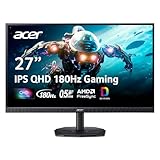
- Quality Visuals: The KG271U 27" IPS monitor with 2560 x 1440 QHD resolution in a 16:9 aspect ratio presents stunning, high-quality images with excellent detail. The zero-frame design does away with the thick frames found on conventional monitors freeing up precious screen space.
- AMD FreeSync Technology: Say “goodbye” to stuttering and tearing. With AMD FreeSync, the monitor’s frames are synced with the graphics card’s frames, which eliminates screen tearing and provide the smoothest gaming experience.
- Up to 180Hz: The 180Hz refresh rate speeds up the frames per second to deliver an ultra-smooth 2D motion scene. With a rapid refresh rate of up to 180Hz, Acer Gaming Monitors shorten the time it takes for frame rendering, lower input lag and provide gamers an excellent in-game experience.
- Responsive!!: Up to 0.5ms GTG (Gray to Gray) response time enhanced gamers’ in-game experience. No matter the fast-moving action or any dramatic transitions will be all rendered smoothly without the annoying effects of smearing or ghosting with KG271U Gaming Monitor.
- New Depths of Color Accuracy: is monitor is ideal for color-critical projects producing accurate colors, supporting DCI-P3 95%. An amazing monitor for graphic designers, photographers, and film editors.
Radeon RX 9060 XT variants
TechRadar’s 2026 budget guide describes both the 8GB and 16GB RX 9060 XT versions as solid 1440p options. The difference in memory capacity makes the exact version important; a recommendation for one configuration should not automatically be applied to the other. As with the B580, the guide’s conclusion depends on its test suite and the market conditions when it was prepared. TechRadar’s budget graphics-card guide
What’s actually slowing this PC down?
Pick the symptom - the matching free tool is one click away.
These reviews make 1440p a credible target for some lower-cost cards, not a universal winner between models. They do not provide a single shared benchmark suite that establishes which card is faster across all games. Check independent results for games you care about and compare like with like: resolution, graphics quality, ray tracing, and whether upscaling or frame generation is enabled. TechRadar also notes market pressure from AI-hardware demand, while Tom’s Guide reports that rising prices had pushed some cards once considered budget choices toward the mid-range. Their listings and rankings can age quickly.
Rank #3

- 27-inch 2560 x 1440 HDR gaming monitor with ultrafast 180Hz refresh rate designed for professional gamers and immersive gameplay
- ASUS Fast IPS technology enables a 1ms response time (GTG) for sharp gaming visuals with high frame rates
- ASUS Extreme Low Motion Blur Sync (ELMB SYNC) technology enables ELMB together with variable refresh rate, eliminating ghosting and tearing for sharp gaming visuals with high frame rates.
- DisplayWidget Center enables easy OSD access and monitor settings adjustments with a mouse.
- USB Type-C hub supports video transmission in DisplayPort signal; can serve as a USB hub, meaning that you can connect your device to your wired peripherals with clutter-free set-up
Choose a resolution around your games and priorities
When 1080p makes more sense
- You want to spend less overall or prioritize higher refresh rates in the games you play.
- Your preferred budget card’s 1440p results fall short of your frame-rate target at acceptable settings.
- You already have a 1080p display and do not want the added cost of replacing it.
When 1440p is worth targeting
- You value the extra resolution and have checked performance in your actual games.
- You are comfortable adjusting quality settings or using upscaling where a game and card support it.
- Your graphics-card budget and, if needed, display budget fit the upgrade together.
Keep native rendering distinct from feature-assisted output when evaluating performance. A result that uses upscaling or frame generation is not directly equivalent to native rendering at the same resolution. Also look beyond average FPS: 1% lows or frame-time consistency, when a review publishes them, can help show whether play feels steady.
Independent reader supportYour contribution helps us test, update, and keep practical guides available for everyone.Check the whole upgrade before buying
A graphics card is only one part of a 1440p setup. If you do not already own a 1440p display, include its cost and intended refresh rate in the budget; the available evidence supports considering the monitor category, but does not establish a particular model or price. For the graphics card itself, verify the exact memory variant and power requirements against your system. Tom’s Hardware flags power needs as a concern for some inexpensive cards; its Arc A750 testing also identifies Resizable BAR and platform support as considerations for older systems. Tom’s Hardware’s Arc A750 review
Rank #4

- High-Resolution QHD Gaming Display: 27-inch QHD (2560 x 1440) gaming monitor with 180Hz refresh rate designed for professional gamers and immersive gameplay
- ASUS Extreme Low Motion Blur Sync Technology: ELMB Sync technology enables ELMB and variable-refresh-rate technologies to work simultaneously to eliminate ghosting and tearing for sharp gaming visuals with high frame rates
- Advanced Synchronization Technologies: FreeSync Premium, G-Sync compatible and AdaptiveSync technology delivers a seamless, tear-free gaming experience by enabling VRR (variable refresh rate) by default
- High Dynamic Range Support: HDR technology supports HDR-10 format to enhance bright and dark areas for improved visual depth and contrast
- Package Contents: DisplayPort cable, L-shaped Screwdriver, Power cord, Power adapter, Quick start guide, Warranty Card
- Pick your games. Use review results for titles you actually play, not an unrelated aggregate.
- Set the target. Decide on resolution, quality settings, and desired frame rate before choosing a card.
- Compare the test conditions. Check whether ray tracing is enabled and whether upscaling or frame generation contributes to the reported result; look at 1% lows when available.
- Confirm the exact card. Check the model variant, VRAM capacity, published power requirements, and compatibility with your PSU and platform.
- Check your local total. Compare current card price and availability in your region, then add a 1440p monitor if you need one.
The practical shift is that selected budget cards now appear in credible 1440p recommendations. The buying decision still comes down to matching a specific card and its test results to your games, settings, system, and total budget.
Quick Recap
Best Value

- 27” QHD IPS DISPLAY: Enjoy stunning detail and vibrant color with a 2560x1440 Quad HD resolution on a 27-inch IPS panel, offering wide viewing angles and precise image quality.
- 240HZ REFRESH RATE & 0.3MS RESPONSE TIME: Take competitive gaming to the next level with a blazing-fast 240Hz refresh rate (via DisplayPort) and ultra-responsive 0.3ms MPRT for minimal blur and maximum clarity.
- ADAPTIVE-SYNC SUPPORT: Say goodbye to screen tearing and input lag with Adaptive-Sync for fluid, uninterrupted performance across both AMD and NVIDIA GPUs.
- TILT ADJUSTMENT: Customize your setup with -3° to +21° tilt range for ergonomic positioning.
- ENHANCED GAMING FEATURES: Includes Shadow Control, Game Mode presets, and a user-friendly graphical OSD menu for fast and intuitive performance tuning.
Product prices and availability are accurate as of the date/time indicated and are subject to change. Any price and availability information displayed on Amazon at the time of purchase will apply.

