
iTechGuides is reader-supported. When you buy through links on our site, we may earn an affiliate commission. As an Amazon Associate I earn from qualifying purchases. Learn more
A teenager found the footprint in a Brisbane quarry in 1958. More than six decades later, researchers identified it as a dinosaur track about 230 million years old—the oldest confirmed dinosaur fossil reported from Australia. Its shape points to a likely early sauropodomorph, but it cannot identify a particular species.
Who found the footprint, and where?
Bruce Runnegar was a teenager when he and school friends visited Petrie’s Quarry in Albion, Brisbane, in 1958. He kept a slab bearing a footprint about 18.5 centimetres (7 inches) long. During his later academic career, he reportedly showed the specimen to students. In 2021, he contacted University of Queensland paleontologist Anthony Romilio to document it, according to Sci.News.
The quarry was in the Aspley Formation. Urban development has since made the original site inaccessible. Popular Science reports that the fossil is now at Queensland Museum for ongoing research; that does not establish whether it is currently on public display.
Why is it called Australia’s oldest dinosaur fossil?
The footprint dates to about 230 million years ago, during the Carnian stage of the Late Triassic. The study describes it as Australia’s oldest known or confirmed dinosaur fossil—a trace fossil, rather than a bone. It is not the oldest fossil of any kind in Australia. The find also places dinosaur evidence in the Brisbane region earlier than previously recognized.
#1 Best Overall

- Fantastic Grallator Dinosaur Footprint track Fossil Replica
- Great classroom resource for earth science
- Great dinosaur gift
- 7" x 6"
- Sturdy and lightweight
The paper by Anthony Romilio and Bruce Runnegar, “Earliest Australian dinosaur: ichnofossils from the Carnian Aspley Formation of Brisbane, Queensland, Australia,” was published online in Alcheringa on February 1, 2026 (DOI: 10.1080/03115518.2025.2607630).
What does the track reveal about the dinosaur?
The print has three forward-pointing toes and a fan-shaped outline, with only weak dominance by the central toe. The study’s reported 3D modeling and morphometric analysis found similarities to Evazoum, an ichnogenus— a classification for fossil tracks—associated elsewhere with early sauropodomorph dinosaurs.
Rank #2
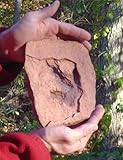
- Grallator Dinosaur Footprint, cast from the original fossil
- Cast from the the fossil from Chinle Formation, Late Triassic, 210 MYA
- Made of durable, lightweight resin
- Dimensions: 6" x 7"
- Makes a great dinosaur gift!
That resemblance supports the interpretation that the trackmaker was likely an early sauropodomorph, or another small, bipedal dinosaur. A footprint is not enough to identify a named species, and the evidence does not establish the animal’s exact identity.
Quick wins for a faster PC:
Repair Windows errors before they cause bigger problemsFix Now →Scan for outdated or missing drivers - takes under a minuteDriver Scan →How large and fast might the trackmaker have been?
The study’s estimates, as reported in Sci.News, infer an animal from the footprint rather than measuring a skeleton. The accessible summary gives the following figures:
Rank #3
- Three-Item Fossil Set – Includes one Velociraptor claw replica, one Mosasaur tooth (B-grade), and one genuine small ammonite fossil
- Educational and Collectible – A great hands-on way to explore prehistoric life and paleontology
- Genuine Fossils Included – Both the Mosasaur tooth and ammonite are real fossil specimens
- Realistic Replica Claw – Velociraptor claw cast features high quality texture and curvature
- Ready for Display or Teaching – Great for collectors, educators, or science-themed gifts
- Footprint length: 18.5 centimetres (7 inches).
- Estimated hip height: about 78 centimetres (31 inches).
- Estimated mass: roughly 144 kilograms.
- Theoretical maximum running speed: about 60 kilometres per hour (37 miles per hour), calculated using scaling equations.
Hip height, mass and speed are model-based estimates, not direct measurements. The speed is a theoretical maximum, not evidence that the animal actually ran at that pace. These figures are reported in the Sci.News summary; they should be read as the study’s estimates, not as independently verified measurements.
What is the separate groove, and what remains uncertain?
A separate slab preserves a shallow linear groove about 13 centimetres (5 inches) long. It could resemble a tail-drag trace, but the interpretation is uncertain: the groove is no longer in its original setting and has no associated hand or foot impressions. It cannot securely establish that a dinosaur’s tail made it.
Rank #4

- Step into Prehistory: This Toob contains 10 expertly hand-painted mini figurines of ancient fossils, including a Dinosaur Footprint, Giant Crab, Ammonite, Raptor Claw, Fossilized Frog, Trilobite, T-Rex Tooth, Fossilized Fish, Dinosaur Skin, and a Sea Scorpion.
- Ignite Curiosity and Learning: The ancient fossils Toob can inspire children's interest in paleontology, encouraging educational exploration and discovery.
- Premium Quality and Detail: Each figurine is meticulously crafted with precise details, made from durable materials to withstand endless excavation adventures.
- Safe and Suitable for Children: Our products are non-toxic and BPA free, ensuring the safety of children during play. Suitable for children aged 3 years and older.
- Perfect Size for Little Hands: This Fossil Toob measures 1.5 inches long, 1.5 inches wide, and 12.8 inches tall, slightly larger than a standard American ruler. The figurines inside range from 1.25 to 3.75 inches tall, perfect for young paleontologists.
The study summary reports no dinosaur skeletal remains from the Aspley Formation. The footprint is the direct dinosaur evidence described from that formation and period. The track shape offers clues about the animal, but without associated bones it cannot settle its species or all details of its anatomy.
Free tools Windows power users keep installed
One-click scans. No signup required.
How did the discovery stay unknown for so long?
Runnegar preserved the slab after finding it, even though he and his friends could not have known its eventual significance. He later brought it to Romilio’s attention for documentation. Romilio said, “Without the foresight to preserve this material, Brisbane’s dinosaur history would still be completely unknown,” according to Popular Science.
The discovery illustrates why a trace fossil can matter even without dinosaur bones: a preserved track records an animal’s presence in a place and time. Here, decades between collection and analysis did not change the fossil, but they changed what researchers could establish about Brisbane’s ancient past.
Quick Recap
Product prices and availability are accurate as of the date/time indicated and are subject to change. Any price and availability information displayed on Amazon at the time of purchase will apply.

