
iTechGuides is reader-supported. When you buy through links on our site, we may earn an affiliate commission. As an Amazon Associate I earn from qualifying purchases. Learn more
Biometric authentication can make some bank sign-ins and identity checks easier, but a fingerprint or face match is not a complete security system. In the United States, it is best understood as one possible part of layered, risk-based authentication: banks choose controls according to the risks, and customers should have a secure non-biometric way to access and recover their accounts.
What biometric authentication means for a bank account
Biometrics use a physical or behavioral characteristic—such as a fingerprint or face—to help determine whether someone is the enrolled user. In authentication terminology, this is the “something you are” factor. It is different from a password (“something you know”) or a physical authenticator (“something you have”).
A biometric check may be one part of a digital sign-in flow, but it should not be treated as a standalone security program. NIST’s current digital identity guidance, SP 800-63B-4, published August 1, 2025, limits biometric use to authentication paired with a physical authenticator, calls for protection of biometric data, and requires a non-biometric alternative. NIST’s guidance is principally for government digital identity systems; it is a technical reference, not a bank-specific rule that automatically binds every US institution.
Quick wins for a faster PC:
Fix the driver behind crashes, sound loss and screen glitchesFind Drivers →Clear out junk files and repair common Windows errorsFree Scan →For banks, the broader risk-management framework comes from the FFIEC’s 2021 guidance on authentication and access. It applies to customers, employees, third parties, and systems. It says institutions should assess risk and use layered controls; when a risk assessment finds single-factor authentication with layered security inadequate, multi-factor authentication (MFA) or controls of equivalent strength combined with other layers can more effectively mitigate authentication risks. It does not mandate a particular biometric or vendor.
#1 Best Overall
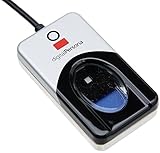
- Target Applications - Desktop PC security, Mobile PCs, Custom applications
- Indoor, home and office use
- Blue LED - soft, cool blue glow fits into any environment; doesn't compete in low light environments
- Small form factor - conserves valuable desk space
- Rugged construction - high-quality metal casing weighted to resist unintentional movement
Where banks may use biometrics
Customer sign-in
A bank may offer a fingerprint or face check in a mobile or other digital sign-in flow. The precise method depends on the institution and device. A biometric prompt is not necessarily the whole authentication process: the device or another physical authenticator may provide the possession factor alongside the biometric.
Step-up checks for higher-risk activity
An institution may require stronger authentication for a higher-risk session, payment, or access request. The FFIEC framework supports risk-based selection and layered controls, rather than prescribing biometrics for any particular transaction. A biometric check is one option an institution might include in such a flow.
Validating an access device
Regulation E provides a narrower, specific example. In its interpretation of 12 CFR § 1005.5, the CFPB lists a photograph or fingerprint as possible reasonable means of verifying identity when validating an access device. The same interpretation says a consumer is not liable for unauthorized transfers if the institution fails to verify identity correctly and an imposter succeeds in validating the device. This is not a general requirement to use a fingerprint for routine bank logins. See the CFPB’s Regulation E § 1005.5 interpretation.
Rank #2

- New replacement old Red Logo Digital persona URU4500, HID , USB reader. Original HID Brand
- Small form factor
- Metal Casing resists unintentional movement.
- SuperiorRed "Flash" indicates that a fingerprint image has been captured, 512 dpi / 8-bit grayscale (256 gray levels) ESD resistance
- Encrypted fingerprint data
Employee, third-party, and system access
Financial institutions also manage access for staff, contractors, service providers, and systems. The FFIEC guidance covers these settings as well as customer access. Whether a biometric is suitable depends on the institution’s assessment, the access involved, and the controls around the system.
Identity proofing during account opening
A face comparison used to check someone’s identity during onboarding is not the same thing as a biometric sign-in by an already enrolled account holder. Identity proofing establishes or checks an identity; authentication checks whether a person is the account holder or authorized user. NIST treats proofing and authentication in separate volumes of its SP 800-63 series.
What customers may gain—and what is not established
A face or fingerprint check may be more convenient than entering a password in some situations. The FFIEC notes that authentication methods differ in usability and convenience, but that does not establish a measured convenience gain for US bank customers as a whole.
Rank #3

- High-quality metal casing
- Soft, cool blue glow fits into any environment
- Small form factor
- Works well with dry, moist, or rough fingerprints
Biometrics can contribute one factor in an MFA design. That can be useful when the institution pairs the biometric with an appropriate physical authenticator and other risk controls. A biometric alone does not replace the broader authentication program, secure account recovery, or protections around the device and account.
There is no defensible US banking figure in the reviewed official sources for biometric adoption, customer preference, fraud reduction, or cost savings. The CFPB National Age-Friendly Banking Survey Data page describes a nationally representative survey of adults with bank or credit-union accounts, but its landing page does not report biometric-specific results. Automated identity checks may reduce friction in some workflows, but the available sources do not quantify that effect for US banks.
How biometric methods and implementations differ
“Biometrics” is not one uniform technology. A useful comparison considers the modality, the sensor and anti-spoofing controls, accuracy across relevant groups, where data is processed or stored, and the fallback path.
Rank #4

- Certified to Microsoft’s highest fingerprint security standards (ESS & SDCP) for robust, hardware-isolated authentication. Supports next-gen Windows features, including Copilot Recall and Windows Hello with ESS support.
- Windows Hello ready for fast, password free fingerprint login to Windows and Microsoft 365 accounts
- On device fingerprint storage keeps biometric data securely within the key. Supports privacy regulations (GDPR, BIPA, CCPA) through on device biometric processing; TAA compliant.
- Reliable wired USB fingerprint authentication with USB C and USB A compatibility for desktop PCs.
- Consistent, all condition 360° fingerprint recognition.
| Approach | What to evaluate | Important qualification |
|---|---|---|
| Fingerprint | Sensor integrity, presentation-attack detection (PAD), accuracy across relevant groups, and protection of any stored template. | NIST SP 800-63B-4 says PAD should be implemented for fingerprint systems. That recommendation does not establish that every bank or device implements it effectively. |
| Face | Presentation-attack detection, sensor and processing trust, performance across relevant groups, and whether an alternative sign-in is available. | NIST SP 800-63B-4 says PAD shall be implemented for facial recognition. A “liveness” label alone does not demonstrate an effective implementation. |
| Iris | Sensor integrity, PAD, accuracy, data protection, and a usable fallback. | NIST SP 800-63B-4 says PAD should be implemented for iris systems. |
| Voice comparison | Whether the method is appropriate for the authentication context and what alternatives are offered. | Voice comparison shall not be used in the authentication guidance covered by NIST SP 800-63B-4. |
| Behavioral pattern | What behavior is evaluated, how it is protected, how the system handles changes or uncertainty, and how a customer can use another method. | The reviewed guidance does not establish a single bank-wide implementation or performance level for behavioral biometrics. |
These are evaluation questions, not a ranking of the methods. The institution’s implementation and operating conditions matter; a modality name by itself cannot show how well a system resists attacks or performs for a particular user.
Security risks, privacy, and the controls that matter
Spoofing and presentation attacks
An attacker may try to fool a biometric sensor with a photograph, artificial fingerprint, replayed signal, or another presentation attack. NIST’s modality-specific PAD guidance is one way to frame the question, but sensor integrity, trustworthy biometric processing, and deployment testing also matter. A product’s claim that it has “liveness detection” is not, on its own, proof that its controls are effective.
What’s actually slowing this PC down?
Pick the symptom - the matching free tool is one click away.
Biometrics are not secrets
NIST states: “Biometric characteristics do not constitute secrets.” A face or fingerprint may be captured or obtained without a person’s consent, and—unlike a password—an exposed characteristic cannot simply be replaced. Secure storage, restricted access, and protection of biometric templates are therefore important design priorities.
Best Value
![ineo USB Fingerprint Reader for Windows 10/11, Windows Hello, One-Touch Login & Screen Lock, Plug & Play, Password-Free, 5ft Cable [Not for Mac]](https://m.media-amazon.com/images/I/41dBey3dy0L._SL160_.jpg)
- BIOMETRIC SECURITY: USB fingerprint reader provides advanced biometric authentication to secure your computer and protect sensitive data with your unique fingerprint.
- ONE-TOUCH COMPUTER LOCK: Instantly lock your Windows computer with a single touch using the Win + L shortcut, providing quick security when stepping away from your desk.
- FAST AND ACCURATE SCANNING: High-precision optical sensor delivers reliable fingerprint recognition with quick response time for seamless login and authentication.
- PLUG AND PLAY CONVENIENCE: Simple USB connection with easy setup process allows you to start using fingerprint security within minutes without complex installation.
- COMPACT DESIGN: Sleek and portable biometric scanner features a space-saving footprint that fits comfortably on any desk without cluttering your workspace.
False matches and false non-matches
A false match accepts someone other than the enrolled user; a false non-match rejects a legitimate user. NIST SP 800-63B-4 sets a false match rate (FMR) of one in 10,000 or better for all demographic groups and says systems should demonstrate a false non-match rate (FNMR) below 5%. For presentation-attack testing, NIST recommends that deployment testing demonstrate an impostor attack presentation accept rate below 0.07. These are NIST guideline thresholds and recommendations, not measured results for US banks or proof that any particular bank system meets them.
Performance should be evaluated across relevant demographic groups and actual operating conditions. A system’s average result can conceal differences that affect some users more than others.
Privacy and data architecture
Where and how biometric data is processed affects privacy risk. Local matching may reduce the need to retain biometric data centrally, while centralized verification raises additional privacy concerns. Neither label alone settles the question: institutions should consider data minimization, template protection, retention, and access controls.
Recommended Free Tools
There is no single privacy-law answer for every biometric banking scenario. The CFPB’s November 12, 2024 report on state consumer privacy laws and financial data describes gaps that can arise when state privacy laws exempt some institutions covered by the Gramm-Leach-Bliley Act (GLBA) or Fair Credit Reporting Act (FCRA). State biometric privacy laws and their application vary; the cited report is not a state-by-state analysis of biometric banking requirements.
Accessibility, choice, and recovery
Some people may have difficulty presenting a face or fingerprint, lack a device with the necessary sensor, or prefer not to submit biometric data. NIST says, “An alternative non-biometric authentication option SHALL always be provided to the subscriber.” A practical design also needs support and account-recovery routes for a failed biometric, a lost device, or a user who cannot use the sensor. The cited guidance does not establish one recovery process that every bank must use, so customers should check their institution’s process before relying on a biometric sign-in.
Independent reader supportYour contribution helps us test, update, and keep practical guides available for everyone.What US guidance and rules do—and do not—require
- FFIEC guidance: The August 11, 2021 document is risk-management guidance for access to financial institution services and systems. It supports risk assessment and layered authentication; it is not a blanket biometric mandate or an endorsement of a particular product.
- NIST technical guidance: SP 800-63B-4, published August 1, 2025, is the current technical reference cited here and supersedes the older SP 800-63B revision. Its biometric controls are useful benchmarks, but its principal scope is government digital identity systems, not a bank-specific binding regulation.
- Regulation E: The photo and fingerprint examples in § 1005.5 relate to validating an access device. They should not be expanded into a universal routine-login requirement.
- CFPB Circular 2022-04: The CFPB says inadequate authentication, password management, or software-update practices may cause substantial injury, and that inadequate security can be an unfair practice even without an intrusion. Its circular identifies MFA among protective approaches. Check the circular’s current legal status and applicability before treating it as binding on a particular institution. Read the CFPB Circular 2022-04.
How to decide whether to use your bank’s biometric sign-in
- Check what the bank supports. Use the bank’s official app or website instructions to confirm whether your account, device, and operating system support the biometric option. The available official sources do not provide a cross-bank compatibility list.
- Understand what the prompt is doing. Check whether the biometric is part of a sign-in flow tied to your device or another physical authenticator, rather than assuming the face or fingerprint is the only protection.
- Keep a non-biometric route available. Confirm how to sign in if the sensor fails, you cannot use it, or you choose not to provide biometric data.
- Review recovery before you need it. Find the bank’s steps for a lost or replaced device and for account recovery. A fallback should not quietly reduce the account to a weak authentication process.
- Use the method that fits your situation. Convenience is a legitimate consideration, but so are accessibility, privacy preferences, device security, and the quality of the institution’s alternatives.
Long-term opportunities
Risk-adaptive authentication can let institutions apply stronger controls to higher-risk sessions or transactions instead of relying on one factor for every situation. Better demographic testing, PAD evaluation, and transparent performance criteria can make biometric deployments easier to assess. Privacy-conscious designs can minimize centralized retention and protect templates, while preserving an accessible non-biometric path. Better identity proofing and recovery may also reduce friction, but those are goals rather than established banking-wide outcomes: the available official sources do not show a measured aggregate reduction in US bank fraud or operating cost attributable to biometrics.
Quick Recap
Product prices and availability are accurate as of the date/time indicated and are subject to change. Any price and availability information displayed on Amazon at the time of purchase will apply.

