
iTechGuides is reader-supported. When you buy through links on our site, we may earn an affiliate commission. As an Amazon Associate I earn from qualifying purchases. Learn more
The Panasonic KX-TGM450S is the best all-around cordless phone for many vision-impaired individuals who also have hearing loss because it combines a talking keypad, talking Caller ID, large backlit controls, up to 50 dB voice amplification, Slow Talk, power backup, and expansion to six handsets. Users who cannot see the keypad should prioritize verified voice feedback over large print alone.
The right choice depends on whether the user has low vision, little or no usable vision, hearing loss, or a combination of these needs. A “senior-friendly” phone with big buttons may be excellent for someone with residual vision but still unusable by a person who cannot identify the keys.
Key takeaways
- The Panasonic KX-TGM450S is the strongest feature-rich choice for combined vision and hearing impairment, with manufacturer-listed amplification up to 50 dB, a 112 dB ringer, talking keypad and Caller ID, power backup, and expansion to six handsets.
- The Serene CL-60 is the most voice-focused specialist option in this shortlist because it announces keypad presses and Caller ID, but its official page showed “Sale Sold Out” when reviewed.
- Large printed numbers, backlighting, and a large display support low vision but do not make a phone fully usable without sight.
- AT&T’s CRL32202 and CRL32102 announce Caller ID and provide large controls, but the reviewed product information does not confirm that either model announces every pressed digit.
- Amplification figures such as “up to 50 dB” are maximum manufacturer claims and are not standardized measurements of speech clarity across brands.
- A cordless phone normally needs household power, so users who need outage resilience should keep a compatible corded phone or choose a model with documented power-backup behavior.
Best cordless phones for vision-impaired individuals at a glance
The best cordless phones for vision-impaired individuals fall into two different categories: voice-first phones for people who cannot reliably see the keypad, and large-print amplified phones for people with useful residual vision. The table separates those categories instead of treating every “senior phone” as equally accessible.
| Best for | Model | Talking keypad | Talking Caller ID | Visual controls | Advertised voice amplification | Handset or expansion information | Price seen | Main limitation |
|---|---|---|---|---|---|---|---|---|
| Feature-rich combined vision and hearing support | Panasonic KX-TGM450S | Yes | Yes | Large backlit buttons, LCD, LED ringers | Up to 50 dB | Expands to six handsets | $183.99 sale price | More complex and expensive than a basic phone |
| Advanced amplified phone with mobile pairing | Panasonic KX-TGM430B | Yes | Yes | Large backlit keypad and display, LED ringers | Up to 40 dB | Expands to six handsets; pairs with up to two cell phones | $183.99 on the product page reviewed | Bluetooth features may add unnecessary setup |
| Voice confirmation and severe hearing loss | Serene CL-60 | Yes | Yes | Large buttons | 50+ dB | Check current accessory and handset information | $139.95; official page showed sold out | Availability was uncertain when reviewed |
| Lower-cost mainstream two-handset system | AT&T CRL32202 | Not confirmed by reviewed listing | Yes | Big buttons and HD audio controls | Not stated in the dossier | Two handsets | $76.95 | Not a confirmed voice-first solution for blindness |
| Home-wide coverage and optional SOS features | VTech CareLine SN5127/SN5147 | Not confirmed by standard product information | Product family features Caller ID | Big buttons and large display | Up to 50 dB Audio Assist | Accessory handsets; some bundles include an SOS pendant | $114.95–$202.75 depending on configuration | Many model and bundle combinations; talking keypad is not established |
| Low vision with high-contrast controls | Clarity D704 | No voice-first operation established | Visual Caller ID display | Backlit keypad, high-contrast display, visual ring indicator | Up to 35 dB | Up to five handsets; ten speed-dial buttons | Current direct price not established | Requires useful residual vision |
| Low vision with an answering machine | Clarity D712 | No voice-first operation established | Visual Caller ID display | Backlit keypad, high-contrast numbers, contoured keys | Up to 30 dB | Answering machine included | Check current availability | Less amplification and voice accessibility than specialist models |
Features and prices come from the manufacturers’ product information: Panasonic KX-TGM450S, Panasonic KX-TGM430B, Serene CL-60, AT&T senior cordless phones, VTech CareLine, and Clarity’s low-vision phone range. Prices are snapshots observed on August 16, 2026, and should be rechecked before purchase.
#1 Best Overall

- Easy to Use Cordless Phone System with Two Cordless Handsets: With a large 2.1”display, big buttons, and many other features, KX-TGU4 is designed to make it easy to stay in touch with your loved ones
- Contact your Loved Ones with the Push of a Button: Favorites Key flashes to notify you of incoming and missed calls, so you can quickly and easily contact your loved ones by just pressing the key; register up to 3 contacts
- Built-in Flashlight for Help in the Dark or in an Emergency: Flashlight function comes in handy during nighttime trips to the bathroom, and is easily findable if help is needed
- Advanced Call Blocking: Automated Call Block pre-blocks robocalls; Telemarketing Call Block lets you to block announced callers; block up to 1,000 with 1-touch Call Block Button on the handset
- Understand Every Word with Volume Boost: No more asking people to repeat themselves -- every word will be loud and clear with Volume Boost, which amplifies up to +12 dB
Which phone is best for a person with low vision?
People with low vision who can still read large, high-contrast controls should start with backlighting, display contrast, tactile orientation, and one-touch dialing rather than maximum amplification. The Clarity D704, Clarity D712, AT&T CRL32202, VTech CareLine systems, and Panasonic amplified models all address some of these visual needs.
The Clarity D704 is the most specifically low-vision-oriented choice in this shortlist. Clarity lists up to 35 dB amplification, four tone settings, a large high-contrast Caller ID display, ten speed-dial buttons, a 100-name-and-number phonebook, a backlit keypad and display, visual ring indication, and expansion to five handsets. The Clarity D712 adds an answering machine but lists up to 30 dB amplification and similarly emphasizes high-contrast, backlit, contoured controls.
AT&T’s CRL32202 is a less expensive two-handset alternative with big buttons, Caller ID announce, HD audio, equalizer controls, and handset speakerphones. The single-base CRL32102 adds a cordless answering system and was listed at $54.95. AT&T’s listing does not establish talking keypad confirmation, so these models are better suited to low vision than to users who cannot see the keypad.
Which cordless phone is best for someone who is blind?
Someone who cannot reliably see the keypad should choose a phone with a verified talking keypad, talking Caller ID, predictable physical controls, and preferably audible status or menu feedback. A large display or oversized printed number is not enough because those features still require vision.
The Panasonic KX-TGM450S is the best overall candidate when blindness or severe low vision occurs alongside hearing loss. Panasonic lists a talking keypad and phonebook, talking Caller ID, large backlit buttons, bright LED ringers, nine speed-dial positions, Slow Talk, six tone settings, noise reduction, up to 50 dB voice amplification, a 112 dB ringer, call blocking for up to 250 numbers, power backup, and expansion to six handsets. Panasonic lists the product at $183.99 sale price, with a regular price of $203.99, on the product page reviewed.
The Panasonic KX-TGM450S is an editorial best overall pick, not a guarantee that every menu is fully spoken or that every user will find the setup accessible. Initial configuration, contact programming, language selection, and handset registration may require assistance.
The Serene CL-60 is the most compelling specialist alternative when spoken feedback is the priority. Serene lists a talking keypad, talking Caller ID, large buttons, 50+ dB amplification, digital tone control, DECT 6.0 technology, and English/French Caller ID announcements. The official product page showed a $139.95 price but also displayed “Sale Sold Out,” so availability must be confirmed before treating the CL-60 as a readily purchasable option.
Rank #2

- Easy to Use Cordless Home Phones with Two Handsets: With a large 2.1” display, big buttons, and many other features, KX-TGU4 is designed to make it easy to stay in touch with your loved ones
- Contact your Loved Ones with a Button: Favorites Key flashes to notify you of incoming and missed calls, so you can quickly and easily contact your loved ones by just pressing the key; register up to 3 contacts in these cordless house phones
- Built-in Flashlight for Help in the Dark or in an Emergency: Flashlight function built into these cordless phones comes in handy during nighttime trips to the bathroom, and is easily findable if help is needed
- Advanced Call Blocking: Automated Call Block pre-blocks robocalls; Telemarketing Call Block lets you block announced callers; block up to 1,000 with 1-touch Call Block Button on the wireless home phone
- Understand Every Word with Volume Boost: No more asking people to repeat themselves; with this cordless phone for seniors every word will be loud and clear with Volume Boost, which amplifies up to +12 dB
Massachusetts’ official equipment-distribution information also identifies the Geemarc AmpliVOICE50 as offering talk-back button repetition and talking Caller ID. That evidence makes the Geemarc relevant for blind or low-vision users, but the state listing is not a current nationwide retail ranking and availability depends on the applicable program or seller. See the Massachusetts phones-for-blind-or-low-vision equipment information.
What is the difference between a large-button phone and a talking phone?
A large-button phone improves visual and sometimes tactile access; a talking phone provides audible confirmation that does not depend on reading the keypad. For a blind user, talking functions usually matter more than the size of the printed numbers.
| Feature | Value for low vision | Value for blindness | What to verify |
|---|---|---|---|
| Large printed numbers | High | Low | Contrast, size, spacing, and glare |
| Backlit keypad | High | Low | Whether the light stays on long enough to dial |
| Large Caller ID display | High | Low | Text size and contrast |
| Visual ring indicator | High for users with residual vision | Low | Brightness and location of the indicator |
| Tactile marker on the 5 key | Useful | Highly useful | Confirm the marker and key layout in the manual |
| Talking keypad | Helpful | Essential or highly valuable | Whether the phone announces every pressed digit |
| Talking Caller ID | Helpful | Highly valuable | Whether it announces numbers, stored names, or both |
| One-touch dialing | Helpful | Highly valuable | Whether buttons can be identified by touch or voice feedback |
| Photo buttons | Helpful for some users | Limited unless tactilely identified | Whether the user can distinguish each button without sight |
| Slow Talk | Useful for hearing difficulty | Useful only with hearing difficulty | Whether speech remains clear at the selected setting |
“Senior-friendly,” “big button,” and “large display” labels describe a broad audience and do not prove that a phone speaks digits, menus, answering-machine controls, or call status. A blind user should ask specifically whether the exact model has talking keypad confirmation and audible menu prompts.
How much amplification does a vision-impaired user need?
No universal amplification number determines which phone will be easiest to understand. Manufacturers use maximum advertised figures under their own testing conditions, and a higher headline number can produce distortion rather than clearer speech.
What’s actually slowing this PC down?
Pick the symptom - the matching free tool is one click away.
| Model | Manufacturer-listed voice amplification | Other audio features |
|---|---|---|
| Panasonic KX-TGM430B | Up to 40 dB | Six tone settings, Slow Talk, noise reduction, up to 100 dB ringer |
| Panasonic KX-TGM450S | Up to 50 dB | Six tone settings, Slow Talk, noise reduction, up to 112 dB ringer |
| Serene CL-60 | 50+ dB | Digital tone control, talking Caller ID and keypad |
| VTech CareLine SN5127/SN5147 | Up to 50 dB Audio Assist | Up to 90 dB ringer, full-duplex speakerphone |
| Clarity D704 | Up to 35 dB | Four tone settings, speakerphone |
| Clarity D712 | Up to 30 dB | Four tone settings, answering machine |
These specifications are manufacturer-listed maximums from Panasonic, Panasonic, Serene, VTech, and Clarity. The figures are not independent tests performed under identical conditions.
For a user who finds maximum volume harsh, lower the amplification and try a different tone or equalizer setting. Slow Talk may improve comprehension by slowing the other caller’s speech, while speakerphone mode may help one person and make background noise worse for another. Hearing-aid users should also test the phone with the hearing aid’s telephone or telecoil mode when applicable.
What are the best cordless phones for multiple rooms?
The Panasonic KX-TGM450S, Panasonic KX-TGM430B, and VTech CareLine systems are the strongest choices when the household needs accessible phones in bedrooms, kitchens, and living areas.
Rank #3

- UNSURPASSED RANGE: Experience the best in long-range coverage and clarity, provided by a unique antenna design and advances in noise-filtering technology
- ANSWERING SYSTEM: This reliable cordless system includes a digital answering machine that can record up to 22 minutes of incoming messages, outgoing announcements and memos, and a voice-guide for easier set up
- SMART CALL BLOCKER & CALLER ID ANNOUNCE: Say goodbye to unwanted calls. Robocalls on your landline are automatically blocked from ever ringing through - even the first time. You can also permanently blacklist any number you want with one touch on the dedicated key on the handset. The call block directory can store up to 1,000 name and number entries. Plus, the handset announces the name of the caller, so you can decide to answer the call or block it - screening calls has never been easier
- LARGE 2-INCH SCREEN, BIG TEXT, LIGHTED KEY PAD: High-contrast text on the extra-large 2 inch screen makes it easy to read incoming caller ID or call history records. Plus, the enlarged font and extra-large and lighted handset keypad allows for easy dialing in low-light conditions. This feature is helpful for those who are visually impaired
- HANDSET SPEAKERPHONE, AUDIO ASSIST, INTERCOM: This cordless system has built-in full-duplex speakerphone on handset allowing both ends to speak - and be heard - at the same time for conversations that are more true to life. Also designed with useful features like Audio Assist and handset intercom to help make your daily communications enjoyable
Panasonic lists expansion to six handsets for both the KX-TGM450S and KX-TGM430B. The Panasonic systems also support Link2Cell pairing with up to two cell phones, allowing compatible mobile calls to route through the cordless handsets. Mobile pairing is useful when a household has stopped paying for a traditional landline, but pairing and configuration may require sighted assistance.
The Tool Desk
Outbyte Driver Updater FREEScan for outdated or missing drivers - takes under a minuteDriver Scan →Outbyte PC Repair FREEClear out junk files and repair common Windows errorsFree Scan →VTech CareLine focuses on home-wide coverage through accessory handsets and bundles. The SN5127/SN5147 family includes big buttons, a large display, up to 50 dB Audio Assist, up to a 90 dB ringer, full-duplex speakerphone, and Smart Call Blocker. Some bundles include a wearable SOS pendant. Prices seen on VTech’s official store ranged from $114.95 for an SN5147 base system to $202.75 for a bundle with additional handsets and an SOS pendant.
Check the exact model number before purchasing accessories. VTech identifies SN5107 handsets as requiring an SN5127 or SN5147 series phone; accessory handsets are not automatically interchangeable across a brand’s entire product line.
Which phone is best for call blocking and emergency features?
The VTech CareLine family is the strongest shortlist choice for call blocking and optional wearable emergency assistance, while the Panasonic KX-TGM450S offers extensive call blocking and power-backup features.
Panasonic lists call blocking for up to 250 numbers on the KX-TGM450S and KX-TGM430B, along with nine speed-dial positions. VTech describes Smart Call Blocker and configurations that can support up to 1,000 blocked numbers or directory entries depending on the model and setup. A wearable SOS pendant appears only with certain VTech bundles, so the pendant should not be assumed to be included with every SN5127 or SN5147 package.
Quick wins for a faster PC:
Scan for outdated or missing drivers - takes under a minuteDriver Scan →Clear out junk files and repair common Windows errorsFree Scan →Fix the driver behind crashes, sound loss and screen glitchesFind Drivers →Emergency planning should not depend on a single cordless phone. Program important contacts into speed dial, mark or memorize the emergency-call sequence, test the speakerphone, and make sure the user can answer and end a call without looking. A medical alert system, home security system, or emergency service may have additional compatibility requirements.
Are cordless phones reliable during a power outage?
Most cordless-phone bases and charging docks require household electricity, so a cordless phone is not automatically usable during an outage. The Panasonic KX-TGM430B and KX-TGM450S list power backup, but the manufacturer information supplied here does not establish a universal backup duration or guarantee that every function remains available.
Rank #4

- INTERFERENCE-FREE DECT 6.0 SOUND — DECT 6.0 technology delivers clear, private calls up to 1,000 ft — no static, no interference from Wi-Fi or other home devices.
- LARGE BACKLIT DISPLAY & BIG BUTTONS — The 2" high-contrast white display and oversized lighted keypad make it easy to read caller ID and dial accurately in any lighting — day or night
- CALLER ID & FULL DUPLEX SPEAKERPHONE — Stores up to 50 calls with name, number, time, and date. Full-duplex speakerphone lets both sides of the conversation speak freely at the same time — no cutting out
- QUIET MODE & ECO MODE — Silence the ringer on the handset and base on demand with Quiet Mode. ECO Mode reduces wireless transmission power when the handset is close to the base, extending battery life
- WORKS WITH YOUR PHONE SERVICE — Compatible with traditional landline, cable phone, and VoIP services including Ooma, Vonage, and Google Voice. Up to 10 hrs talk time / 7-day standby per charge
For resilience, keep a basic corded phone if the telephone service can power it during an outage, or use an appropriate battery backup for the phone and the provider’s VoIP, fiber, or cable equipment. A mobile phone with sufficient charge is another backup. Confirm whether the provider’s equipment also needs backup power; a cordless phone’s own backup cannot keep an unpowered VoIP adapter or fiber terminal working.
A corded phone is often the better primary choice when outage resilience matters more than carrying the handset around the home. AT&T and Clarity list corded large-button and amplified alternatives, including models with speakerphones, extra-loud ringers, and visual indicators. See AT&T’s corded senior-phone range and Clarity’s amplified-phone range.
Windows Errors? Fix Them Before They Spread
Repair common Windows errors and clear accumulated junk for a smoother, more stable PC - no reinstall needed.Free scan · no reinstallCrashes, No Sound, or Screen Glitches?
Random freezes, missing sound and display glitches usually trace back to one bad driver. Find and replace yours safely.Free scan · under a minuteHow do you choose by the user’s actual needs?
| User situation | Prioritize | Shortlist | What to avoid |
|---|---|---|---|
| Can read large print but struggles with small buttons | High contrast, backlighting, tactile 5 key, large display, speed dial | Clarity D704/D712, AT&T CRL32202, VTech CareLine | Small glossy keys and menu-heavy designs |
| Cannot read the keypad | Talking keypad, tactile layout, one-touch dialing, audible Caller ID | Panasonic KX-TGM450S, Panasonic KX-TGM430B, Serene CL-60, Clarity XLC8 if available | Phones advertised only with big print or large displays |
| Blind and hard of hearing | Talking controls, amplification, tone control, Slow Talk, hearing-aid support, loud ringer | Panasonic KX-TGM450S, Serene CL-60, Panasonic KX-TGM430B | Choosing solely by ringer volume or solely by dB rating |
| Needs a phone in several rooms | Included and maximum handsets, compatible chargers, handset finder | Panasonic systems, VTech CareLine | Assuming any same-brand accessory handset will work |
| Uses cable, fiber, or VoIP telephone service | Provider compatibility, Caller ID behavior, backup power | Any model only after service confirmation | Assuming DECT 6.0 guarantees compatibility |
| Needs outage and emergency backup | Power backup, corded fallback, charged mobile phone, tested emergency dialing | Panasonic with power backup plus a separate fallback phone | Relying on a cordless base without testing outage behavior |
What should you check before buying?
- Identify the access requirement. Decide whether the user needs visual enlargement, audible digit confirmation, tactile controls, hearing amplification, or all four.
- Confirm the telephone service. Ask the provider whether the phone will work with a traditional landline, cable-company digital voice, fiber telephone service, DSL service, or a telephone adapter. Also confirm Caller ID and call-waiting support.
- Verify the exact model’s talking functions. “Caller ID announce” does not necessarily mean “talking keypad.” Check whether the phone announces each pressed digit, phonebook entries, menus, and answering-machine controls.
- Check language settings. Serene identifies English/French voice functionality. Do not assume Spanish or another language is supported unless the exact model’s documentation says so.
- Confirm hearing-aid and amplification behavior. Check compatibility for the exact model, then test speech clarity at several volume and tone settings instead of using the maximum dB claim as the only criterion.
- Check expansion compatibility. Match accessory handsets to the exact base model. VTech SN5107, for example, is associated with SN5127 or SN5147 systems.
- Plan the setup. Arrange help to program contacts, enable talking features, choose the language, register extra handsets, pair Bluetooth devices, and test the answering machine if necessary.
- Test independently. The user should practice answering, ending, placing a call, using speakerphone, retrieving messages, identifying the ringer, and calling an emergency contact without relying on sight.
How do you troubleshoot a phone that is accessible on paper but difficult in practice?
The phone is loud but speech is unclear
Lower the amplification slightly, change the tone or equalizer setting, enable Slow Talk, and compare handset audio with speakerphone audio. Check the hearing aid’s telephone or telecoil mode and move the base away from likely interference sources such as a Wi-Fi router or television.
Talking Caller ID does not announce a caller
Confirm that Caller ID service is included and enabled on the telephone line, that the phone’s audible Caller ID setting is on, and that the ringer or a special privacy mode is not muted. Some callers do not transmit usable Caller ID information, and some phones announce numbers but not stored contact names.
The user cannot identify important buttons
Use raised tactile markers, memorized button positions, one-touch dialing, and a consistent handset orientation. An orientation-and-mobility or low-vision specialist can help create a reliable tactile layout. A talking keypad is preferable to relying only on printed labels for a user who cannot see.
The base loses power
Use the documented power-backup feature if the model has one, keep a compatible corded phone or charged accessible mobile phone available, and check whether the telephone provider’s VoIP or fiber equipment also needs backup power.
The phone does not work with the home telephone service
Ask the provider whether the service supports the phone’s Caller ID, call waiting, answering-machine arrangement, and telephone connector. DECT 6.0 describes the cordless radio technology; DECT 6.0 does not guarantee compatibility with every VoIP, cable, fiber, PBX, medical-alert, or home-security system.
Best Value
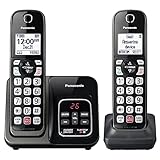
- Advanced Call Blocking: Automated Call Block pre-blocks robocalls; Telemarketing Call Block lets you block announced callers; block 1,000 more with 1-touch Call Block Button on the cordless phones with answering machine
- 2-Way Recording Telephone Landline Phones: Never miss important details again--record your telephone conversations to replay later; the announcement of “Start Recording” on this wireless home phone effectively deters suspicious callers
- One-Ring Scam Alert Cordless House Phone: Landline phones for home protects you from one-ring scams by displaying a confirmation screen when returning a one-ring call
- Reliable Connection with Panasonic Phones: Panasonic cordless home phone continues to connect families and friends all over the globe, offering reliable connection and intuitive design, proudly built on a legacy of Japanese innovation and craftsmanship
- Easy to Find & Use: Illuminated keypad with large characters of our landline phone with answering machine is findable even in the dark; speed dial gives you 1-touch access to your most-dialed numbers; wall-mountable design keeps home phones reliably close
When is a corded phone or accessible mobile phone better?
A corded accessible phone is better when the user values fixed placement and potential outage resilience over mobility. A corded phone can be placed beside the bed or in a primary living area, while a cordless system is more convenient when the user moves between rooms.
An accessible smartphone with VoiceOver or TalkBack may provide more complete speech-based access than a conventional home phone, especially for contacts, messaging, and cellular calling. The trade-offs are touch-screen gestures, charging, cellular coverage, account setup, and a different learning curve. A smartphone should be considered an alternative category rather than assumed to be easier.
State equipment-distribution programs may provide or subsidize specialist telephones for eligible residents. Massachusetts’ program information lists phones for blind or low-vision users, including Geemarc and Serene models, but eligibility, inventory, and subsidies vary by state. Check the relevant state program rather than assuming that Massachusetts’ offerings apply nationally.
Recommended Free Tools
Frequently Asked Questions
Do big-button cordless phones speak the numbers pressed?
Big-button cordless phones do not necessarily speak the numbers pressed. A large keypad helps a user with residual vision, but a blind user should verify that the exact model has a talking keypad or talk-back digit confirmation; AT&T’s reviewed senior-phone listing confirms Caller ID announce for its CRL models but does not establish talking keypad operation.
Does talking Caller ID require a telephone-service subscription?
Talking Caller ID generally requires Caller ID service from the telephone provider, and the feature must be enabled on the phone. The phone may announce only a number when the caller does not transmit usable information, and stored-name announcements depend on the model and contact setup.
Can an amplified cordless phone work with a hearing aid?
An amplified cordless phone may work with a hearing aid when the exact model supports the relevant hearing-aid or telecoil mode, but compatibility should be verified for that model. Test tone, volume, handset, and speakerphone settings because maximum amplification can introduce distortion.
Can these cordless phones work with VoIP?
Many cordless phones can work through a compatible VoIP telephone adapter, but DECT 6.0 alone does not guarantee compatibility. Confirm support for the provider’s adapter, Caller ID, call waiting, answering-machine functions, and backup power before buying.
Do these 3 things before closing this tab:
1Fix the driver behind crashes, sound loss and screen glitches2Repair Windows errors before they cause bigger problems3Scan for outdated or missing drivers - takes under a minuteAre accessible phones available through government programs?
Some state equipment-distribution programs provide or subsidize accessible phones for eligible residents. Massachusetts’ official information lists phones for blind or low-vision users, but eligibility, funding, models, and inventory vary by state.
The Bottom Line
For a user who cannot see the keypad and also needs hearing support, start with the Panasonic KX-TGM450S or the Serene CL-60 if the Serene model is available. For low vision without a need for spoken digit confirmation, the Clarity D704/D712, AT&T CRL32202, and VTech CareLine systems offer more practical large-control designs. Before purchasing, verify talking functions, telephone-service compatibility, accessory-handset support, language settings, and outage planning.
Quick Recap
Product prices and availability are accurate as of the date/time indicated and are subject to change. Any price and availability information displayed on Amazon at the time of purchase will apply.

