
iTechGuides is reader-supported. When you buy through links on our site, we may earn an affiliate commission. As an Amazon Associate I earn from qualifying purchases. Learn more
Short answer: the ASUS ROG Maximus VIII Impact remains an unusually capable Mini-ITX board for a used Skylake or BIOS-verified Kaby Lake build, especially if you value overclocking controls, strong audio, Wi-Fi and diagnostic features. It is rarely a sensible foundation for a new 2026 system, however. Its age, single expansion slot, two-DIMM limit, U.2-focused storage and awkward cooler clearance mean a complete, tested board must be priced well below a modern platform.
ASUS documents the board as an Intel Z170, LGA1151 Mini-ITX motherboard for 6th-generation processors. See the official product page and user manual.
What the Maximus VIII Impact is
The ASUS ROG Maximus VIII Impact is a premium, 17 × 17 cm Mini-ITX motherboard from the 2015-era Z170 generation. It uses the LGA1151 socket and was designed primarily for Intel Skylake Core, Pentium and Celeron processors. It is not the Maximus VI or VII Impact (Z87/Z97), the later Maximus IX Impact (Z270), or AMD’s Crosshair VIII Impact.
Its defining design choice is a group of vertical daughterboards mounted on the small PCB. That arrangement fits enthusiast-grade power delivery, audio and connectivity into a Mini-ITX footprint, but it also makes the board larger in practical clearance terms than a flat Mini-ITX layout suggests.
#1 Best Overall

- supports multiple types of CPUs and is equipped with advanced chipsets. It has fast data processing speed and can easily handle multitasking and complex calculations, providing a stable performance core for your computer.
- equipped with a variety of interfaces, including multiple USB interfaces, high-speed SATA interfaces, and high-performance network card interfaces, which can easily connect various external devices and achieve efficient data transfer.
- Supporting high-speed memory, the dual channel design further improves memory read and write speed, making the system more responsive and capable of running large games and professional software with ease.
- The motherboard adopts high-quality electronic components and advanced manufacturing processes, with excellent heat dissipation performance, effectively reducing motherboard temperature, ensuring long-term stable operation, and extending service life. Supports multiple operating systems, whether it is Windows series or Linux system, it can be perfectly compatible to meet the usage habits and needs of different users.
- Choose our computer motherboard to upgrade your computer and embark on an efficient and stable computing journey!
Specifications at a glance
| Feature | Maximus VIII Impact |
|---|---|
| Chipset and socket | Intel Z170; LGA1151 |
| Intended processors | 6th-generation Intel Core, Pentium and Celeron (Skylake) |
| Form factor | Mini-ITX, approximately 17 × 17 cm |
| Memory | Two DDR4 DIMM slots, dual-channel, Intel XMP |
| Advertised memory ceiling | DDR4-4133+ through overclocking; actual results depend on CPU, DIMMs and BIOS |
| Expansion | One PCIe 3.0 x16 slot |
| Storage connectors | Four SATA 6Gb/s ports and one U.2 connector |
| Networking | Intel I219-V Gigabit Ethernet and 802.11ac Wi-Fi with advertised MU-MIMO |
| Rear USB | USB 3.1 Type-A and Type-C, plus USB 3.0 ports |
| Audio | SupremeFX Impact III module with ESS ES9023P DAC and headphone amplification |
| Controls | Q-Code display, power/reset, Clear CMOS, BIOS FlashBack and probe points |
| Graphics | CPU-dependent integrated-video outputs plus the PCIe x16 slot |
ASUS’s DDR4-4133-plus figure is an overclocked target, not a plug-and-play guarantee for every memory kit. Likewise, the ASUS product page documents 802.11ac rather than Wi-Fi 6 or Wi-Fi 6E.
CPU compatibility: what is official
Skylake
Officially documented pairings include the Core i7-6700K/6700, Core i5-6600K/6600/6500-class chips, Core i3-6100-class processors, and compatible Pentium and Celeron models. A K-series Skylake CPU is the natural match because Z170 exposes multiplier overclocking controls.
Kaby Lake
The socket is shared with 7th-generation Kaby Lake processors, but support depends on the installed BIOS. Before buying, check the board’s exact BIOS revision and the ASUS CPU-support information. If an update is needed, perform it with a supported Skylake CPU installed, or require the seller to demonstrate the intended Kaby Lake processor working.
Recommended Free Tools
Coffee Lake and modified solutions
Physical LGA1151 similarity does not make 8th- or 9th-generation Coffee Lake CPUs officially compatible. Modified BIOSes and socket modifications are experimental projects, not normal support and not a safe buying assumption.
Memory configuration
There are only two DDR4 slots, so use a matched two-module kit for dual-channel operation. High-frequency profiles rely on Intel XMP and memory overclocking; stability depends on the processor’s memory controller, module density, BIOS training, voltage and timings. If a rated setting fails, a lower stable speed is preferable to repeated memory errors.
Storage: U.2 instead of a normal onboard M.2 socket
The board provides four SATA 6Gb/s ports and a U.2 connector. Independent coverage from PC Perspective and TechSpot identifies the lack of a conventional onboard M.2 SSD socket.
Rank #2

- Extreme Engine DIGI+
- SupremeFX 2015
- USB 3.1 Type A & C Onboard
- Sonic Sense Amp
- Lighting Control
This distinction matters: Z170 supports the M.2 protocol at the platform level, but this motherboard’s physical storage layout is centered on U.2 and SATA. A modern M.2 NVMe drive therefore requires a U.2-to-M.2 adapter or a PCIe adapter card. The latter consumes the only x16 slot, potentially preventing use of a graphics card. SATA M.2 adapters remain limited by SATA bandwidth. U.2 was technically attractive at launch, but compatible consumer drives are now uncommon, a limitation also noted by Bit-Tech.
Expansion and graphics
One PCIe 3.0 x16 slot supports a single graphics card. There is no separate slot for a capture card, sound card, storage adapter or add-in network device. This makes the onboard U.2 connector particularly useful in a gaming build: an NVMe adapter should not have to compete with the GPU for the slot.
Power delivery and overclocking
ASUS’s Impact Power III design places substantial digitally controlled power circuitry on a vertical module. Power/reset buttons, Clear CMOS, a diagnostic display, probe points, BIOS FlashBack and LN2-oriented controls give the board a bench-testing feature set unusual for Mini-ITX.
Historical reviews demonstrate potential rather than a guarantee. AnandTech reached 4.8 GHz at 1.375 V in its test configuration, while PC Perspective reported a 4.7 GHz result with multi-hour stability under its methodology. Silicon quality, cooling, BIOS and the condition of a used board all vary.
Do not copy review voltages blindly. Small cases can accumulate CPU and VRM heat, and the vertical power module can obstruct large tower coolers. KitGuru’s discussion of non-K overclocking describes an unsupported Intel configuration, not a recommended feature.
Do these 3 things before closing this tab:
1Scan for outdated or missing drivers - takes under a minute2Repair Windows errors before they cause bigger problems3Fix the driver behind crashes, sound loss and screen glitchesAudio, networking and connectivity
SupremeFX Impact III
The separate audio module uses an ESS ES9023P DAC, Nichicon capacitors, a de-pop relay and Sonic SenseAmp impedance detection. ASUS rates the headphone output at 2 Vrms and lists headset support from 32 to 600 ohms. AnandTech’s historical test suite found the implementation particularly strong among the boards it compared; that is not a current universal ranking.
Rank #3

- Designed for 9th 8th Generation Intel Core processors maximize connectivity, speed with Dual M. 2, USB 3. 1 Gen 2, onboard 802. 11AC Wi-Fi and ASUS optimum II for better DRAM overclocking stability
- Revamped 5-way Optimization overclocks Intelligently based on smart prediction and thermal telemetry while FanXpert 4 delivers dynamic system cooling
- Aura Sync RGB lighting with addressable headers features a nearly endless spectrum of colors with the ability to synchronize effects across an ever-expanding ecosystem of AURA Sync enabled products
- Pre-mounted I/O shield ensures streamlined installation and represents ROG's attention to detail and quality
Ethernet and Wi-Fi
An Intel I219-V controller provides Gigabit Ethernet, while the integrated wireless module is 802.11ac with advertised MU-MIMO. GameFirst and LANGuard-related software features were bundled, but they do not change the underlying network standards.
BIOS controls and recovery
The UEFI offers EZ and Advanced modes, XMP, Q-Fan tuning, EZ Tuning Wizard, profiles, Secure Erase, SMART information and CrashFree BIOS recovery. The board-specific manual identifies M8I.CAP as the filename required for BIOS FlashBack.
- For a normal update, enter UEFI, open ASUS EZ Flash, select the correct BIOS file from a supported USB drive and keep power connected until completion.
- For FlashBack, use the exact Maximus VIII Impact file, rename it to
M8I.CAP, place it on the manual-specified USB port and follow the board’s power and button procedure. Wait for the indicator to stop flashing. - After a failed update, disconnect AC, clear CMOS, remove unnecessary hardware, retry with a simple FAT32 USB drive and verify the filename. Repeatedly interrupting the process can turn a recoverable problem into a defective board.
Case and cooler compatibility
A case can support Mini-ITX dimensions and still fail with this motherboard. Check clearance around the vertical VRM/power board, SupremeFX module, DIMM area, graphics-card backplate, 8-pin CPU cable and front-panel access. Low-profile coolers or compact liquid layouts are often easier than large tower coolers. ASUS describes extensive compatibility testing, while PC Perspective observed interference between the power daughterboard and an NH-D15-class cooler.
Quick wins for a faster PC:
Repair Windows errors before they cause bigger problemsFix Now →Scan for outdated or missing drivers - takes under a minuteDriver Scan →Clear out junk files and repair common Windows errorsFree Scan →- Confirm the cooler’s orientation and fan position, not just its socket list.
- Check RAM height against the cooler and the second DIMM slot.
- Verify that the case side panel clears the vertical modules.
- Leave room to route the CPU power lead without pressing against the daughterboard.
What performance to expect in 2026
The board can still anchor a capable 6th-generation gaming machine, a BIOS-verified Kaby Lake upgrade, a compact workstation or an enthusiast test bench. Results depend mainly on the installed CPU, GPU, memory and storage, not the motherboard alone.
It is a poor foundation for a new system that requires current CPUs, PCIe 4.0/5.0, modern Wi-Fi, several NVMe drives, multiple add-in cards or long platform support. Compare the complete cost of CPU, memory, cooler and storage—not just a used board listing—with a current Mini-ITX or Micro-ATX platform.
Used-market inspection checklist
Require clear evidence before paying a premium:
- Photographs of the socket pins, vertical power board and SupremeFX module.
- The Wi-Fi module, antennas, I/O shield, U.2 cable or adapter and proprietary screws where applicable.
- A successful POST with Q-Code behavior shown.
- Both DIMM slots, all SATA ports, Ethernet, Wi-Fi, audio output and headset detection tested.
- The installed BIOS version and a demonstration of FlashBack if recovery matters to you.
- No corrosion, liquid damage or burnt power components.
- Original packaging and accessories, which can materially improve practical value.
If the board will not POST
- Disconnect AC and clear CMOS.
- Use only the CPU, cooler, one DIMM and a display output; test each module and slot.
- Confirm the 8-pin CPU power connector and graphics seating.
- Read the Q-Code, then try the correct FlashBack file.
- If CPU or memory remains undetected, inspect the LGA socket under magnification for bent pins and treat the board as potentially defective.
Buy, reuse or avoid?
Reuse it
Reuse is sensible when you already own a compatible Skylake or Kaby Lake CPU, DDR4 and a case that clears the vertical hardware. The premium audio, Wi-Fi and diagnostic controls can save add-in cards in a compact build.
Rank #4
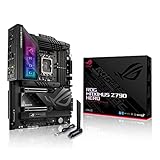
- Intel LGA 1700 socket: Ready for 14th, 13th and 12th Gen Intel Core processors and Windows 11, support PCIe 5.0 and DDR5
- Intelligent Control: ASUS-exclusive tools including AI Overclocking, AI Cooling II, AI Networking(GameFirst VI) and Two-Way AI Noise-Cancelation for easy configuration
- Robust Power Solution: 20+1 teamed power stages rated for 90 A, ProCool II power connectors, MicroFine alloy chokes and premium metallic capacitors
- Optimized Thermal Design: VRM heatsinks plus integrated aluminum I/O cover, high-conductivity thermal pad, triple M.2 heatsinks and dual with embedded backplates, and ROG Water-Cooling Zone
- High-performance Networking: Onboard WiFi 6E,Bluetooth V5.2, Intel 2.5Gb Ethernet, and ASUS LANGaurd
Buy used
Buy only a complete, tested example at a price that reflects its age and adapter requirements. A cheap bare board missing the audio module, Wi-Fi card, antenna, I/O shield or storage cables may be worse value than a costlier complete unit.
Free tools Windows power users keep installed
One-click scans. No signup required.
Buy new for a fresh build
Generally no. A modern platform is the better choice when you need current CPU support, an onboard M.2 socket, newer PCIe and USB standards, or an upgrade path.
Alternatives by priority
- Lower cost: a cheaper Z170 Mini-ITX board if premium audio, extreme VRM controls and onboard diagnostics are unnecessary.
- Easier Kaby Lake setup: a later Z270 Mini-ITX board with the appropriate factory BIOS.
- Modern features: a current Intel or AMD Mini-ITX platform with contemporary Wi-Fi, PCIe and M.2 support.
- More expansion: Micro-ATX, which usually provides additional slots and simpler cooler and storage layouts.
Frequently Asked Questions
Does the Maximus VIII Impact have an M.2 slot?
No conventional onboard M.2 SSD socket is provided. Storage uses four SATA ports and U.2; an M.2 NVMe drive needs an adapter.
Will an 8th-generation Core i7 work?
Not through official support. Coffee Lake compatibility should not be assumed from the shared LGA1151 socket.
Is DDR4-4133 guaranteed?
No. ASUS advertises it as an overclocked maximum; CPU, DIMM quality, BIOS and timings determine the result.
The Tool Desk
Outbyte Driver Updater FREEFix the driver behind crashes, sound loss and screen glitchesFind Drivers →Outbyte PC Repair FREERepair Windows errors before they cause bigger problemsFix Now →Quick Recap
Product prices and availability are accurate as of the date/time indicated and are subject to change. Any price and availability information displayed on Amazon at the time of purchase will apply.

