
iTechGuides is reader-supported. When you buy through links on our site, we may earn an affiliate commission. As an Amazon Associate I earn from qualifying purchases. Learn more
A 2018 laboratory study showed that engineered tungsten trioxide could use infrared light to drive a reaction that split carbon dioxide into carbon monoxide and oxygen. It did not convert half of all sunlight into fuel: “almost 50%” describes the infrared share of solar energy in the study’s framing, not the catalyst’s efficiency.
Can artificial photosynthesis use infrared light?
Yes, in this specific laboratory demonstration. Liang Liang and co-authors reported in Joule on May 16, 2018, that ultrathin, oxygen-deficient cubic tungsten trioxide (WO3) layers drove carbon dioxide overall splitting under infrared light at room temperature. The authors described the reaction as occurring on a single material and without sacrificial reductants. The Joule article record and summary describe the result; it is a study of a catalyst, not a consumer device or commercial solar-fuel system.
The phrase “almost 50%” refers to the study’s characterization of infrared light’s share of solar energy. It is not a reported conversion efficiency, fuel yield, or the fraction of sunlight captured by the experiment. Solar energy in a wavelength band is not the same as energy successfully converted into chemical fuel.
The Tool Desk
Outbyte PC Repair FREEClear out junk files and repair common Windows errorsFree Scan →Outbyte Driver Updater FREEScan for outdated or missing drivers - takes under a minuteDriver Scan →How can infrared light split carbon dioxide?
The challenge is that infrared photons carry relatively little energy. The Joule article gives a theoretical requirement of 1.35 eV for splitting CO2 overall into carbon monoxide (CO) and oxygen (O2). It also describes a conventional limitation: infrared light above 920 nm cannot simultaneously trigger both half-reactions. The material design was intended to let the catalyst use lower-energy photons in steps while preserving the redox capability required for the reaction. The study summary provides these energy figures and the reaction context.
#1 Best Overall

- Horizon puts renewable energy technology into the hands of our future scientists
- Solar Hydrogen Education Kit generates clean energy using the sun
- Renewable hydrogen is created using only solar energy and water
- Combining cutting-edge science, education and fun for all!
- Includes fuel cell, small electric motor, propeller blade, experiment manual and assembly guide
What does an intermediate band do in a photocatalyst?
The researchers created oxygen vacancies—missing oxygen atoms—in ultrathin cubic WO3 layers. At a critical vacancy density, those defects produced an intermediate band within the material’s electronic structure. That band provides an additional route for absorbing lower-energy light, which was central to the authors’ strategy for using infrared light without giving up the redox capability needed for the reaction.
The journal summary says the authors examined the band using valence-band, photoluminescence, UV-vis-NIR, and infrared-reflectance measurements. This supports the proposed material design; it does not, by itself, establish a practical device efficiency or a commercial operating lifetime.
Rank #2

- Horizon puts renewable energy technology into the hands of our future scientists
- Designed to demonstrate the workings of a complete clean energy system
- Build your own miniature renewable energy system for experimentation
- Learn the system step-by-step, configure and visualize from start to finish
- Includes miniature wind turbine kit, a solar photovoltaic panel, an electrolyzer, a PEM fuel cell, and hydrogen storage system
What did the experiment produce, and how long did it operate?
The reported products were CO and O2. Water served as a proton source and mediated electron transfer in the reaction context described by the paper. The authors reported that the oxygen-deficient WO3 atomic layers continued catalytic activity without deactivation after three days. That is a laboratory observation over the reported period, not evidence of long-term industrial durability.
Is artificial photosynthesis commercially available?
The sources describing this result do not establish a present-day commercial system, consumer product, or purchasable device based on the catalyst. A contemporary Chemistry World report said conversion-efficiency improvements would be needed before commercial use. The available sources do not give a conversion-efficiency or scale-up figure, so the 2018 demonstration should be understood as a promising materials result rather than evidence of commercial readiness.
Rank #3
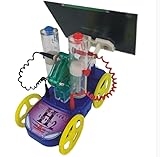
- Hydrogen Fuel Cell and Solar Power Generate Car
Why the result matters—and what it does not show
The work addressed a real design tension: materials that absorb lower-energy infrared light can lack the redox potentials needed for photocatalytic reactions such as carbon dioxide reduction. In the Chemistry World report, University of Queensland researcher Lianzhou Wang, who was not involved in the study, described that limitation and praised the intermediate-band approach while calling for more mechanistic study.
University of Science and Technology of China researcher Yi Xie told Chemistry World: “Since the first report of carbon dioxide photoreduction in 1978, IR light constituting almost 50% of the solar energy has never been utilised to drive carbon dioxide reduction to fuels.” This is Xie’s statement in that 2018 report, not an independently verified universal account of the field’s history.
Rank #4

- Hydrogen Fuel Cell and Solar Power Generate Car
The practical takeaway is narrow but significant: the study demonstrated an infrared-driven carbon dioxide-splitting reaction using engineered WO3 in the laboratory. It did not establish that artificial photosynthesis now captures half of sunlight efficiently, that it produces fuel at commercial scale, or that a commercial device is available.
Quick wins for a faster PC:
Scan for outdated or missing drivers - takes under a minuteDriver Scan →Clear out junk files and repair common Windows errorsFree Scan →Fix the driver behind crashes, sound loss and screen glitchesFind Drivers →Quick Recap
Best Value

- Package Includes: The experiment set contains all the necessary materials to conduct a variety of experiments that demonstrate the theorem's practical applications, ensuring use in classroom or home settings
- Material: Crafted from pp material, this physical experimental equipment is designed to withstand regular use in educational settings, ensuring durability and reliability
- Ideal for DIY Science Projects: Suitable for DIY science projects and experiments, this kit encourages students learning and engagement
- Product Size: This hydrogen fuel demonstrator is compact enough to fit comfortably on a desk or lab table while still being large enough to clearly display its functions
- Educational Tool: This hydrogen fuel demonstrator serves as a educational instrument, making it ideal for classroom demonstrations and learning experiences, making it ideal for high school chemical experiments or science enthusiasts interested in renewable energy technologies
Product prices and availability are accurate as of the date/time indicated and are subject to change. Any price and availability information displayed on Amazon at the time of purchase will apply.

