
Recommended Free Tools
iTechGuides is reader-supported. When you buy through links on our site, we may earn an affiliate commission. As an Amazon Associate I earn from qualifying purchases. Learn more
AI-powered toys are not proven to be universally dangerous, but documented tests and regulatory concerns justify caution. Common Sense Media reported inappropriate answers, unreliable performance and extensive data-collection concerns in hands-on testing of three AI companion toys. U.S. regulators say existing rules address some privacy and physical-safety issues, but no federal testing regime specifically validates an AI toy’s conversational behavior.
What “experts horrified” gets right—and wrong
“Experts horrified” is a rhetorical headline, not evidence of unanimous expert opinion. The documented picture is more specific: some AI toys have produced unsuitable content, connected-toy data practices can expose children’s information, and current product-safety rules do not comprehensively test AI behavior.
Those risks are different from physical injury. In a response to Congress, the U.S. Consumer Product Safety Commission (CPSC) said its injury and incident data had not identified real-world child injuries caused by AI integration in toys at the time of its response. That statement does not establish that every product is safe, nor does it address privacy, inappropriate conversations or manipulative design.
Quick wins for a faster PC:
Repair Windows errors before they cause bigger problemsFix Now →Fix the driver behind crashes, sound loss and screen glitchesFind Drivers →What Common Sense Media found in three AI toys
Common Sense Media said its researchers hands-on tested Grem, Bondu and Miko 3 in an assessment published in January 2026. The researchers used child accounts stated as ages 6 to 13, structured prompts and naturalistic play. They examined technical performance, content safety, developmental appropriateness, privacy practices and attachment risks. The products were designed for children ages 3 to 12.
#1 Best Overall
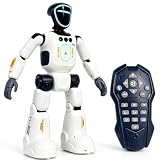
- Smart AI-Inspired Robot Toy for Kids: Bring futuristic fun to playtime with this smart interactive robot toy. Designed with AI-inspired features, glowing LED face effects, music, movement, and responsive controls, it keeps kids engaged through hands-on play and imagination
- Gesture Sensing & Remote Control Play: Kids can control the robot with simple hand gestures or use the included remote control for forward, backward, left turn, right turn, dancing, music, and demo functions. Easy operation makes it fun for beginners and exciting for daily play
- DIY Programming for Creative Fun: Create custom action sequences with the programmable function. Kids can set movements, add music, and play back their own routines, helping encourage creativity, logical thinking, and hands-on STEM learning through interactive play
- Voice Recording & Playback: Record fun messages and let the robot play back. The voice recording feature makes parent-child interaction more exciting and gives kids a fun way to hear their own voice while playing with the robot
- Singing, Dancing & Educational Companion: This robot toy combines built-in songs, dance moves, auto demo, science knowledge, and interactive play in one entertaining design. A birthday, holiday, or Christmas gift for boys and girls who love robots, technology, and smart toys
The findings apply to those tested interactions and methods, not automatically to every internet-connected toy.
| Finding | What it means |
|---|---|
| 27% of AI outputs were inappropriate | Common Sense Media’s tested interactions included examples involving self-harm, drugs, mature subjects, inappropriate boundaries, risky advice and unsafe roleplay. This is not a category-wide failure rate. |
| Technical reliability problems | The assessment reported glitches, voice-recognition failures, inappropriate activations and inaccurate answers. |
| Parents’ educational priorities | In a nationally representative poll published in January 2026, 70% of parents said helping their child learn was extremely or very important. |
| Companionship was divisive | Twenty-two percent wanted AI toys to serve as companions, while 56% explicitly did not. |
| Parents lacked visibility | Thirty-three percent of parents whose children use AI toys were unsure whether the toy had said something inappropriate. |
| Data concerns were widespread | Forty-two percent wanted no data saved at all, and 83% expressed concern about data collection. |
The parent poll is a survey, not a clinical study or a regulator’s safety determination. Likewise, the 27% figure should be read as a result from Common Sense Media’s tested conversations, not as the probability that any AI toy will produce an unsafe answer.
Why parents should separate the main risks
Conversation and content
Generative systems can produce answers that are wrong, developmentally unsuitable or unsafe even when a toy is marketed for young children. A microphone and speaker make those answers feel like a social exchange, which can make a child less likely to question them.
The Tool Desk
Outbyte PC Repair FREEClear out junk files and repair common Windows errorsFree Scan →Outbyte Driver Updater FREEScan for outdated or missing drivers - takes under a minuteDriver Scan →Privacy and surveillance
Connected toys may process voice recordings, transcripts, account details, location information or behavioral data. The important questions are where the information goes, how long it is retained, who receives it and whether parents can delete it.
Reliability and false authority
Voice-recognition errors, glitches and inaccurate answers can turn ordinary play into confusion. Educational marketing does not by itself demonstrate that a toy improves learning; any claimed benefit should be evaluated separately from the novelty of conversation.
Rank #2

- 🤖【AI Learning Companion for Kids】Designed to grow with your child, the AI Robot combines learning and entertainment in one interactive companion. Kids can practice drawing, learn letters, listen to stories, sing songs, chat with AI, watch educational videos, and play fun games—all through a friendly touch-screen robot that keeps children engaged while encouraging creativity and curiosity.
- 🎨 【Interactive Drawing & Educational Content】Children can trace pictures directly on the 7-inch HD touchscreen, learn step by step how to draw, color their artwork, recognize letters, and explore educational activities designed to improve creativity, hand-eye coordination, and early cognitive development.
- 📱【 Powerful Android System with Endless Apps】Built-in Google Play Store lets you download your favorite educational apps, learning software, streaming services, and games. Equipped with 1GB RAM, 16GB internal storage, expandable TF card support, Wi-Fi (2.4GHz), Bluetooth connectivity, and OTA online updates to keep your robot up to date.
- 💬【Smart AI Conversations & Fun Moving Companion】More than just a learning device, Voltix features intelligent AI voice interaction that can answer questions, chat with kids, tell stories, and sing songs. Smooth wheels allow the robot to move around, dance, and interact naturally, creating a more engaging companion experience.
- 🔋【Long Battery Life & Family-Friendly Design】Powered by a built-in 4000mAh rechargeable battery, the robot provides approximately 4–6 hours of continuous use on a single charge. The bright 7-inch HD display (1024 × 600 resolution) delivers vivid visuals while the compact design makes it perfect for bedrooms, playrooms, travel, and family activities.
Attachment and boundaries
An always-available conversational character can encourage emotional reliance. Common Sense Media included attachment risks in its assessment and advises parents to watch how a child relates to the device rather than treating it as a neutral stuffed animal.
What COPPA covers—and what it does not
The Federal Trade Commission (FTC) identifies connected toys as online services that may fall under the Children’s Online Privacy Protection Act (COPPA). COPPA applies to services directed to children under 13 and to services with actual knowledge that they collect personal information from a child under 13.
For covered services, the rule centers on notice, verifiable parental consent, privacy disclosures and parents’ rights to review or request deletion of covered information. COPPA is not an approval seal for a toy. Compliance does not guarantee that a chatbot’s answers are age-appropriate, accurate or psychologically healthy.
In January 2025, the FTC announced COPPA amendments that included separate verifiable parental opt-in for certain disclosures of children’s information to third parties, limits on retaining data beyond what is reasonably necessary for a stated purpose and an expanded definition of personal information. The announcement described a 60-day effective period after Federal Register publication and gave covered entities one year from publication to comply. Parents should check the FTC’s current implementation information because those dates concern the rule announced in 2025, not a product-specific certification.
A concrete connected-toy privacy case
In September 2025, the FTC alleged that the Android companion app for Apitor robot toys enabled a third-party software developer to collect children’s precise geolocation data without the parental notice and consent required under COPPA. The agency described a proposed $500,000 penalty, suspended because of the company’s inability to pay, along with other proposed requirements. The FTC said the complaint and proposed order had been referred to the Department of Justice for filing.
Rank #3

- BRING MORE LIFE TO YOUR DESK – Meet Eilik – your little robot friend with personality. With loving animations, expressive reactions, and playful interactions, Eilik brings more joy to your everyday life. Whether on your desk, at your workspace, or by your bedside, Eilik quickly becomes a familiar companion for special moments.
- EVERY INTERACTION BRINGS A NEW SURPRISE – Touch Eilik and discover playful reactions that bring your little robot friend to life. Whether you’re giving Eilik a gentle touch, picking Eilik up, or playing together, Eilik responds with expressive animations, charming expressions, and playful reactions. Every interaction reveals more of Eilik’s personality and makes your little companion feel even more special.
- READY FOR LITTLE MOMENTS, RIGHT AWAY – Eilik is ready to interact right out of the box – no complicated setup required. A simple touch is all it takes, and Eilik responds with expressive animations and charming reactions. Easy, intuitive, and full of little surprises that make every moment special.
- EVEN MORE FUN TOGETHER – Every Eilik has its own charm. Bring two or more Eiliks together and watch them interact in their own playful ways – they play, dance, tease each other, and create fun moments together. Whether with friends, family, or as a couple, more Eiliks mean even more ways to play and enjoy.
- MORE POSSIBILITIES AWAIT – Eilik is more than a little robot – it’s the beginning of a bigger world filled with new experiences. Expand your Eilik experience with AI Station for natural AI conversations and Panxer for exciting adventures. Regular updates also bring new animations, games, and surprises along the way.(AI Station and Panxer sold separately.)
This is an allegation about the Apitor app and the conduct described in that case. It is not proof that other toy makers collect location data unlawfully. It does show why a toy’s companion app, software development kits and permission settings deserve as much attention as the toy itself.
PC Slower Than It Used to Be?
A free scan shows the junk files, broken settings and background clutter dragging Windows down - then fixes them in one click.Free scan · Windows 10 & 11Outdated Drivers Are Slowing You Down
One free scan finds every outdated or missing driver and matches the right update for your exact hardware.Free scan · exact hardware matchWhat the CPSC does—and does not test
The CPSC said products primarily intended for children age 12 and under must undergo third-party testing for applicable safety requirements. Those requirements address physical hazards and other rules that already apply to children’s products.
The agency also said that, at the time of its congressional response, there were no CPSC-specific testing requirements directed at AI functionality or internet-enabled features beyond existing physical-hazard requirements. Its response noted work with the ASTM toy subcommittee and revisions to ASTM F3463 adding AI component testing and evaluation. The CPSC said it does not maintain an independent inventory of AI-enabled toys on the U.S. market.
“At present, however, there are no CPSC-specific testing requirements directed at AI functionality or internet-enabled features in toys, apart from existing requirements addressing physical hazards.”
That regulatory gap helps explain why a toy can satisfy applicable physical-safety rules while still raising questions about conversational content, data retention or online security.
Rank #4

- 🌟V28 update 🚀 new features are now available! In response to Loona's charging problem, we've upgraded the automatic recharge 2.0.The upgrade is to help Loona remember and match the charging routes of different scenarios to improve the auto-recharge success rate.Mobile hotspots connect to loona, breaking Wi-Fi restrictions and allowing you to interact with loona anytime, anywhere. Our team is committed to continuous improvement, ensuring that Loona continues to evolve to meet your expectations.
- 🤖 Smart and Interactive Robot Pet🧠Loona is like no other pet you've seen. With a high-definition RGB camera, Loona sees and understands your world. Loona recognizes faces, understands your gestures, and follows you like a real puppy! Please take Loona to a well-lit environment and ensure the surfaces of the camera and ToF depth sensor are clean.
- 🗣️ Voice Command Enabled AI robot 🎤Loona is not just a good listener; also a great conversationalist! Powered by Amazon Lex & ChatGPT, Loona recognizes your voice commands and responds in real-time. Plus, Loona keeps your information secure, so you can chat with peace of mind. Pro tip: Clear pronunciation in quiet spaces ensures smoother responses.
- 🚀Auto-Charging Smart Robot🌟 Use different rooms as a starting point to preset multiple recharge routes for Loona. When the battery runs low, loona can charge it home by itself, no need for you to take care of it. it takes about 2.5 hours to complete the charging. Place the dock in an open area with no obstructions on either side or in front.
- 🕹️ Endless Playtime robot toys for kids 🎮Loona is always up for playtime! Loona can chase laser pens, fetch balls, and even interact with objects in your home. But it doesn't end there—Loona's app offers a world of games and quizzes to keep the fun going.
Why broader chatbot scrutiny matters
In September 2025, the FTC issued Section 6(b) study orders to seven consumer-facing chatbot companies. The information-gathering study asked how companies evaluate and mitigate possible effects on children and teens, restrict use, disclose risks, process conversations and monetize engagement. The announcement was a study, not a finding that the named companies violated the law and not a toy-specific enforcement action.
In March 2026, Senators Tammy Duckworth and Kirsten Gillibrand wrote to the FTC supporting that inquiry. Their letter raised concerns about internet-connected AI toys with microphones and speakers, privacy, inappropriate content and unsupported educational claims. The senators said an Amazon search for “AI toys” returned more than 2,000 results; that was their dated search claim, not a verified current market count.
Questions to answer before buying an AI toy
Use the product page, privacy policy, app permission screen and setup process together. Marketing copy alone rarely answers these questions.
- What does the toy record? Determine whether it captures audio, stores voice recordings, creates transcripts or infers behavioral information.
- Is it always listening? Look for push-to-talk operation, a physical microphone switch or a clearly documented way to disable listening when the toy is not in use.
- Where is data processed? Find out whether conversations are sent to a cloud service, how long they are retained and whether they are used to improve a model.
- Who receives the information? Check for third-party analytics providers, advertising partners, software development kits and other disclosures.
- Can parents review and delete data? Confirm the actual account path for viewing, correcting or deleting recordings, transcripts and profiles.
- What controls exist? Look for parent dashboards, conversation history, content filters, contact restrictions, time limits and alerts.
- What works without internet? Confirm which features operate offline, which require a companion app and whether a subscription is needed. These details vary by model.
- What happens when the account is closed? Check whether stored data and linked profiles are deleted and how long backups may remain.
- What is the age guidance? Compare the maker’s stated age range with your child’s ability to understand that the system can be wrong and can produce unsuitable material.
How to use one more cautiously
Common Sense Media recommends skipping AI toys for children five and under. For ages six to 12, it advises parents to decide whether AI adds meaningful value, supervise initial interactions, review privacy controls, disable always-listening features when unused and verify deletion and sharing settings. That is the organization’s guidance, not a universal clinical standard.
What’s actually slowing this PC down?
Pick the symptom - the matching free tool is one click away.
- Set up the parent account yourself and use the strongest available privacy settings.
- Begin with supervised play and explain that the toy is software, not a person or trusted expert.
- Tell children not to share names, addresses, school details, passwords, photographs or precise locations.
- Test ordinary and boundary-pushing questions before allowing independent use.
- Recheck app permissions and privacy settings after firmware or app updates.
- Stop using the toy if it repeatedly gives unsafe answers, activates unexpectedly or cannot provide a workable deletion process.
Connected AI toys versus conventional toys
| Decision area | Connected AI toy | Conventional nonconnected toy |
|---|---|---|
| Listening | May use an always-listening or push-to-talk microphone; behavior varies by model. | No network microphone unless a separate electronic feature is included. |
| Data | May create recordings, transcripts, location or behavioral data; retention and sharing require review. | Usually has no cloud account or conversational data stream. |
| Content | Can generate novel answers, including incorrect or unsuitable ones. | Content is generally fixed and inspectable before purchase. |
| Internet dependence | Advanced conversation commonly depends on an internet connection, app or subscription; confirm per model. | Typically usable without internet. |
| Parental oversight | May offer dashboards and filters, but the quality and visibility vary. | Supervision is primarily physical and direct. |
Bottom line
AI-powered toys deserve scrutiny, not a blanket label of either “safe” or “dangerous.” The strongest documented concerns involve inappropriate or unreliable conversations and the collection and sharing of children’s data. Existing U.S. rules provide some privacy and physical-safety protections, but they do not certify an AI toy’s answers. Parents should evaluate the microphone, data flow, deletion controls, age fit and supervision requirements before bringing one into the home.
Quick Recap
Product prices and availability are accurate as of the date/time indicated and are subject to change. Any price and availability information displayed on Amazon at the time of purchase will apply.

