
The Tool Desk
Outbyte Driver Updater FREEFix the driver behind crashes, sound loss and screen glitchesFind Drivers →Outbyte PC Repair FREEClear out junk files and repair common Windows errorsFree Scan →iTechGuides is reader-supported. When you buy through links on our site, we may earn an affiliate commission. As an Amazon Associate I earn from qualifying purchases. Learn more
The Arduino MKR Vidor 4000 is a compact maker board that pairs an Intel Cyclone 10CL016 FPGA with an Arm Cortex-M0 SAMD21 microcontroller. That combination suits projects needing programmable logic as well as Arduino-style control—not just ordinary sensor-and-output builds. Arduino currently labels the board End of Life, so check availability and condition before planning a project around buying one.
What makes the MKR Vidor 4000 different?
Arduino describes it as the only MKR-family board with an FPGA. The SAMD21 runs the microcontroller side of a project, while the Cyclone 10CL016 provides programmable logic that can be configured for hardware-oriented tasks. They are distinct parts of one board, so an FPGA project involves more than writing a typical Arduino sketch.
The board also includes a NINA-W102 Wi-Fi/Bluetooth module, a Micro HDMI connector, a MIPI camera connector and an ECC508 security chip. Arduino notes that the camera connection can be used for QR-code projects. These interfaces make the board a specialized option for experiments combining logic, connectivity, video output or camera input; their presence alone does not make every peripheral feature available through a simple sketch.
What projects suit this board?
Consider the Vidor when a project has a concrete reason to use configurable hardware alongside a microcontroller—for example, exploring FPGA logic in a maker build or combining a camera-oriented experiment with microcontroller control. Arduino’s product page provides tutorials, while the VidorFPGA repository contains FPGA IP blocks and project material for people working with FPGA development.
#1 Best Overall

- This kit includes PH2.0mm 2/3/4/5/6/7/8/9/10 pin connector, 90pcs pre-crimped wire, Heat shrinkable tube and 1pcs tweezers. It is Perfectly Compatible with JST-PH2.0 connector
- Widely used for circuit boards, Lipo battery, balance lead, circuit boards, speakers, monitors, household appliances, LED lighting, copiers, FAX machines, medical equipment, computers, electronic toys.
- Suitable for Arduino mkr1010, MKR ZERO and MKR VIDOR 4000 lipo socket and tiny drone, tiny whoop, JRC H36 H67 Upgrading Blade Inductrix, E010 E013, and KingKong Tiny drone
- This set of connectors is easy to assemble, no crimping tool needed, just plug the pin to the housing
- The pre-crimped cable is 24AWG soft silicone wire and 16cm(6.3inch) length.
For a project centered only on conventional microcontroller inputs and outputs, the FPGA may add workflow and setup demands without serving a clear purpose. Decide first whether your design actually needs programmable logic, and whether you are prepared to work with the relevant FPGA tools as well as the Arduino environment.
Where to find pin mapping and electrical limits
Use the official MKR Vidor 4000 full pinout and datasheet before wiring. The pinout distinguishes functions according to whether the board is programmed with the SAMD or FPGA, so there is not one universal mapping that applies without regard to configuration.
Rank #2
![Arduino MKR MEM Shield [ASX00008] - Memory Expansion Shield for Arduino MKR Boards | Add SRAM, Flash, & EEPROM Storage for IoT & Data Logging Projects](https://m.media-amazon.com/images/I/41NK--Ba0hL._SL160_.jpg)
- Expand Storage Capacity for Arduino MKR Projects: The Arduino MKR MEM Shield [ASX00008] is a memory expansion board designed specifically for Arduino MKR series boards, providing additional storage for your projects. Whether you need more SRAM, Flash, or EEPROM memory, this shield adds the capacity needed for more complex data logging, IoT devices, and embedded systems that require high-performance storage without compromising on speed or reliability.
- The Arduino MKR MEM Shield offers versatile memory options, including SRAM for temporary data storage and buffering, Flash Memory for high-speed, non-volatile storage of large datasets and program files, and EEPROM for storing small persistent data, such as settings and calibration values. These three memory types provide the flexibility needed for applications such as IoT data storage, logging, firmware updates, and configuration management, making it ideal for advanced projects.
- Seamless Integration with Arduino MKR Boards: The MKR MEM Shield is fully compatible with Arduino MKR boards, including the MKR Zero, MKR Wi-Fi 1010, and MKR GSM 1400. It connects directly to the MKR board through the SPI interface, offering a simple and secure way to add memory without additional complex wiring. The shield is easy to install and provides a direct, efficient connection to increase the functionality of your MKR-based projects.
- Ideal for IoT & Data Logging Applications: With the Arduino MKR MEM Shield, you can enhance your IoT and embedded systems projects by adding more storage capacity for data logging, sensor data collection, and remote monitoring. Whether you're building a weather station, environmental sensor network, or tracking system, the additional memory lets you store large datasets locally, reduce latency, and manage data efficiently, even in low-power environments.
- Arduino IDE Support & Easy Development: The Arduino MKR MEM Shield is fully supported by the Arduino IDE, with built-in libraries and examples that make it easy to integrate memory functions into your projects. Whether you're programming in C++ or using Arduino's intuitive libraries, the shield simplifies the process of managing memory, allowing you to focus on your project's core functionality without worrying about memory limitations.
Pay particular attention to the electrical limits. Arduino’s pinout gives limits that vary by pin group, programming mode and FPGA I/O standard; its diagram includes a 7 mA maximum per pin in one context, FPGA I/O-standard-dependent 2 mA or 4 mA limits, and group-level sink limits. Those figures are not interchangeable or a single board-wide rating. Check the specific pin and configuration in the diagram and datasheet before connecting a load.
What’s actually slowing this PC down?
Pick the symptom - the matching free tool is one click away.
The product page also provides schematics and Fritzing files, alongside the pinout and datasheet. These resources are useful for checking board connections and planning a physical layout.
Rank #3

- Product Type: 2MB Flash & microSD Interface
- Family: MKR
What software and setup does FPGA work require?
Building FPGA images
The VidorFPGA repository states that building MKRVIDOR4000 FPGA images requires Quartus II 18.0 Lite or Standard. Treat this as the repository’s stated prerequisite, not a guarantee of compatibility with every current computer or software setup; check the repository’s current instructions before installing tools or starting a new build.
The repository describes several programming approaches, including integrating an FPGA image with Arduino code. It cautions that direct JTAG RAM programming needs care because the SAMD21 can contend for JTAG outside bootloader mode. Follow the repository’s procedure for the method you choose rather than treating direct JTAG programming as a routine upload step.
Rank #4
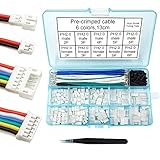
- This kit includes female and male PH2.0mm 2/3/4/5/6 pin connector, 90pcs pre-crimped wire, Heat shrinkable tube and 1pcs tweezers. It is Perfectly Compatible with JST-PH2.0 connector
- Widely used for circuit boards, Lipo battery, balance lead, circuit boards, speakers, monitors, household appliances, LED lighting, copiers, FAX machines, medical equipment, computers, electronic toys.
- Suitable for Arduino mkr1010, MKR ZERO and MKR VIDOR 4000 lipo socket and tiny drone, tiny whoop, JRC H36 H67 Upgrading Blade Inductrix, E010 E013, and KingKong Tiny drone
- This set of connectors is easy to assemble, no crimping tool needed, just plug the pin to the housing
- The pre-crimped cable is 24AWG soft silicone wire and 13cm(5.2inch) length.
SAMD21 projects in PlatformIO
For projects focused on the microcontroller, PlatformIO documents the board identifier mkrvidor4000 and MCU setting samd21g18a. PlatformIO also says this board lacks an onboard debug probe and is not ready for debugging in its environment. That limitation is specific to PlatformIO; it should not be read as a statement about every development environment.
What to check before choosing or buying one
Arduino’s product documentation marks the MKR Vidor 4000 End of Life. The cited documentation does not establish current stock or price. If you find a listing, verify availability at the time of purchase, the item’s condition and which accessories are included.
- Need for an FPGA: Identify what programmable logic contributes to your design before committing to the extra FPGA workflow.
- Interfaces: Confirm that the camera, HDMI or wireless capabilities you need are supported by the specific project and its software.
- Development workflow: Check the SAMD21 setup separately from FPGA image development, and confirm the FPGA tool prerequisite against current instructions.
- Documentation: Make sure the official pinout, datasheet and project material cover the pins and functions your build needs.
- Lifecycle: Treat the End of Life label as a practical constraint when considering availability and future project plans.
The Arduino MKR family shares a common pinout intended to make it easier to move among wireless protocols, and Arduino describes a broad ecosystem of MKR add-ons. That is family-level context, not confirmation that every add-on works with every Vidor feature or avoids pin conflicts. Check a specific accessory’s requirements and pin use before relying on it.
Quick Recap
Product prices and availability are accurate as of the date/time indicated and are subject to change. Any price and availability information displayed on Amazon at the time of purchase will apply.

