
Free tools Windows power users keep installed
One-click scans. No signup required.
iTechGuides is reader-supported. When you buy through links on our site, we may earn an affiliate commission. As an Amazon Associate I earn from qualifying purchases. Learn more
The Apple MacBook Pro 16-inch (A3403) is the M4 Pro model, built for people who benefit from a large, high-quality display, strong CPU performance and a broad selection of built-in ports. Its 16.2-inch screen, long battery life in published tests, and Thunderbolt 5 connectivity are compelling for demanding creative and technical work. The trade-offs are substantial: it weighs 4.7 pounds, costs more than a typical laptop, and its best configuration depends on how much memory and storage your work actually needs.
What A3403 means—and which MacBook Pro this review covers
A3403 is the model identifier ENERGY STAR assigns to the 16-inch MacBook Pro with M4 Pro. Its US certification record lists a 14-core CPU and a 24 GB memory configuration; the record gives availability and certification dates of October 15 and October 21, 2025, respectively. Those are dates in the certification record, not a universal launch date. ENERGY STAR’s record is a useful way to distinguish this M4 Pro family from 16-inch MacBook Pro configurations with M4 Max.
Configuration matters when interpreting review results. Apple lists the M4 Pro with 24 GB of unified memory, configurable to 48 GB, and a 512 GB SSD, configurable to 1 TB, 2 TB or 4 TB. Tom’s Guide’s review lists a 24 GB/512 GB starting configuration but tested a 48 GB/2 TB system; Macworld also tested an upgraded 48 GB/2 TB unit, with nano-texture glass. Apple’s 16-inch 2024 technical specifications provide the family’s configuration details.
Recommended Free Tools
Is the 16-inch MacBook Pro M4 Pro worth it?
It is easiest to justify when your work regularly uses the large display, the M4 Pro’s CPU performance, or the built-in ports—especially for creative production, software development, and other sustained work. The laptop combines a spacious screen with a 100-watt-hour battery and ports that can reduce the need for a dock. If your daily tasks are mostly browsing, email and light office work, the 16-inch size and Pro-tier cost may buy more than you need.
#1 Best Overall

- SUPERCHARGED BY M4 PRO OR M4 MAX — The 16-inch MacBook Pro with the M4 Pro or M4 Max chip gives you outrageous performance in a powerhouse laptop built for Apple Intelligence.* With all-day battery life and a breathtaking Liquid Retina XDR display with up to 1600 nits peak brightness, it’s pro in every way.*
- CHAMPION CHIPS — The M4 Pro chip blazes through demanding tasks like compiling millions of lines of code. M4 Max can handle the most challenging workflows, like rendering intricate 3D content.
- BUILT FOR APPLE INTELLIGENCE—Apple Intelligence is the personal intelligence system that helps you write, express yourself, and get things done effortlessly. With groundbreaking privacy protections, it gives you peace of mind that no one else can access your data—not even Apple.*
- ALL-DAY BATTERY LIFE — MacBook Pro delivers the same exceptional performance whether it’s running on battery or plugged in.
- APPS FLY WITH APPLE SILICON — All your favorites, including Microsoft 365 and Adobe Creative Cloud, run lightning fast in macOS.*
The main practical compromise is portability. Tom’s Guide lists the M4 Pro model at 4.7 pounds. That is a significant carry weight for a laptop you plan to transport every day, even if the large display is valuable at a desk or on location. Consider how often you will move it, not just how much screen space you want.
There is no universally best memory or storage configuration established by these reviews. Match the purchase to your workload: memory matters when you keep demanding applications and large projects open together, while SSD capacity matters when you work with large local media or project files. Compare the total local price of configurations with the same memory, storage and display finish rather than comparing a base model with an upgraded review unit.
How good is the 16.2-inch display?
Apple specifies a 16.2-inch Liquid Retina XDR display with a native resolution of 3456 × 2234, ProMotion up to 120Hz, P3 wide color, True Tone and support for one billion colors. The combination offers generous workspace for timelines, code, documents and side-by-side windows, while the high refresh rate supports smoother scrolling and motion.
Rank #2
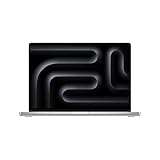
- SUPERCHARGED BY M4 PRO OR M4 MAX — The 16-inch MacBook Pro with the M4 Pro or M4 Max chip gives you outrageous performance in a powerhouse laptop built for Apple Intelligence.* With all-day battery life and a breathtaking Liquid Retina XDR display with up to 1600 nits peak brightness, it’s pro in every way.*
- CHAMPION CHIPS — The M4 Pro chip blazes through demanding tasks like compiling millions of lines of code. M4 Max can handle the most challenging workflows, like rendering intricate 3D content.
- BUILT FOR APPLE INTELLIGENCE—Apple Intelligence is the personal intelligence system that helps you write, express yourself, and get things done effortlessly. With groundbreaking privacy protections, it gives you peace of mind that no one else can access your data—not even Apple.*
- ALL-DAY BATTERY LIFE — MacBook Pro delivers the same exceptional performance whether it’s running on battery or plugged in.
- APPS FLY WITH APPLE SILICON — All your favorites, including Microsoft 365 and Adobe Creative Cloud, run lightning fast in macOS.*
Macworld reports that its reviewed model reached 1,000 nits sustained XDR brightness, 1,600 nits peak HDR brightness and 1,000 nits SDR brightness. Those are that outlet’s measurements for its review unit, not a promise that every screen will produce identical results. Macworld’s review also evaluates the optional nano-texture finish.
Glossy glass or nano-texture?
Nano-texture is worth considering if reflections are a recurring problem in a bright workspace. Macworld found that it reduced reflections and glare, but also reported less vivid colors and less deep blacks than glossy glass. Choose it for the viewing environment rather than assuming it is an across-the-board display upgrade; glossy glass is the better fit if contrast and color appearance matter more than reflection control.
How fast is the M4 Pro in real work?
Macworld tested a 14-core CPU/20-core GPU M4 Pro with 48 GB of unified memory and a 2 TB SSD. In its Geekbench and Cinebench CPU multicore tests, the M4 Pro matched the M3 Max; Macworld also noted the M3 Max produced substantially stronger GPU results. In Macworld’s iMovie 4K ProRes export test, the M4 Pro improved performance by 22% over the M3 Pro. These are results from specific benchmarks and a specific upgraded system, not guarantees for every application or configuration.
Rank #3

- FAST RUNS IN THE FAMILY — The 16-inch MacBook Pro with the M5 Pro or M5 Max chip brings next-generation speed and powerful on-device AI to personal, professional, and creative tasks. With all-day battery life, double the starting storage,* and a breathtaking Liquid Retina XDR display, it’s pro in every way.*
- BUCKLE UP — Along with a next-generation CPU, faster unified memory, and up to 2x faster SSD storage,* M5 Pro and M5 Max feature a more powerful GPU with a Neural Accelerator built into each core, delivering faster AI performance and on-device training capabilities. So you can blaze through demanding workloads at mind-bending speeds.
- BUILT FOR AI — Apple silicon, and every major component that powers it, is designed to run demanding on-device AI workloads like LLM inference and training. And Apple Intelligence helps you write, express yourself, and get things done effortlessly with groundbreaking privacy protections at every step.*
- ALL-DAY BATTERY LIFE — MacBook Pro delivers the same exceptional performance whether it’s running on battery or plugged in.*
- MACOS RUNS APPS FAST — All your go-to apps run lightning fast in macOS, including built-in apps like FaceTime and Messages. Plus, built-in virus protection and free software updates help keep your Mac running smoothly and securely.
The distinction between CPU and GPU performance is important. The M4 Pro can be a strong choice for processor-heavy work without being the right fit for every graphics-intensive workflow. Consider M4 Max only if your software makes sustained use of additional GPU capacity, your project needs exceed the M4 Pro’s available memory options, or you need more external display support. A higher tier is not automatically worthwhile for general productivity or work that does not use its additional resources.
Do these 3 things before closing this tab:
1Clear out junk files and repair common Windows errors2Fix the driver behind crashes, sound loss and screen glitches3Repair Windows errors before they cause bigger problemsHow long does the 16-inch MacBook Pro M4 Pro battery last?
Apple rates the M4 Pro model for up to 24 hours of video streaming or up to 17 hours of wireless web use, with a 100-watt-hour battery. These are Apple’s workload-specific estimates, not a prediction for mixed daily use. Tom’s Guide measured 20 hours and 46 minutes on its 14-core CPU/20-core GPU review system with 48 GB of memory and a 2 TB SSD. That is one outlet’s test result under its own protocol; actual runtime varies with workload, display brightness, settings and configuration.
What ports does the MacBook Pro A3403 have?
Apple lists three Thunderbolt 5 USB-C ports, HDMI, an SDXC card slot, a 3.5 mm headphone jack and MagSafe 3. The Thunderbolt 5 ports support charging, DisplayPort, Thunderbolt 5 up to 120 Gbps and USB 4 up to 120 Gbps. MagSafe provides a dedicated charging connection, while the other ports let many users connect displays, storage and SD cards without first adding a hub.
Rank #4

- SUPERCHARGED BY M4 PRO OR M4 MAX — The 16-inch MacBook Pro with the M4 Pro or M4 Max chip gives you outrageous performance in a powerhouse laptop built for Apple Intelligence.* With all-day battery life and a breathtaking Liquid Retina XDR display with up to 1600 nits peak brightness, it’s pro in every way.*
- CHAMPION CHIPS — The M4 Pro chip blazes through demanding tasks like compiling millions of lines of code. M4 Max can handle the most challenging workflows, like rendering intricate 3D content.
- BUILT FOR APPLE INTELLIGENCE—Apple Intelligence is the personal intelligence system that helps you write, express yourself, and get things done effortlessly. With groundbreaking privacy protections, it gives you peace of mind that no one else can access your data—not even Apple.*
- ALL-DAY BATTERY LIFE — MacBook Pro delivers the same exceptional performance whether it’s running on battery or plugged in.
- APPS FLY WITH APPLE SILICON — All your favorites, including Microsoft 365 and Adobe Creative Cloud, run lightning fast in macOS.*
Apple documents these external-display combinations for M4 Pro:
- Two displays, each up to 6K at 60Hz over Thunderbolt.
- One Thunderbolt display up to 6K at 60Hz plus one HDMI display up to 4K at 144Hz.
- One display connected over HDMI, up to 8K at 60Hz or 4K at 240Hz.
The last option is the maximum listed for a single HDMI display; it should not be read as support for two displays at those HDMI maximums. If your setup depends on multiple monitors, confirm that the exact resolutions and refresh rates you need match one of Apple’s supported combinations. A compatible Thunderbolt 5 cable may be useful for a high-bandwidth display or storage workflow, but it is an optional accessory, not an included part of the computer.
What’s actually slowing this PC down?
Pick the symptom - the matching free tool is one click away.
How does it compare with M4 Max and a smaller laptop?
Choose between M4 Pro and M4 Max based on the work the machine must do, rather than on the tier name alone. For workloads that lean on CPU performance, the Macworld results show why the M4 Pro can be compelling; for GPU-heavy tasks, Macworld found the M3 Max’s GPU results substantially stronger than those of its M4 Pro test system. Apple’s external-display limits also differ by chip configuration, so check the supported setup if you need more than the M4 Pro combinations listed above.
Best Value

- Apple M4 Max chip delivers exceptional performance for advanced workflows, including AI development, 3D rendering, video production, software engineering, and professional content creation.
- 48GB unified memory enables seamless multitasking and efficient handling of large datasets, complex projects, virtual machines, and resource-intensive applications.
- 1TB SSD storage provides ultra-fast boot times, rapid file access, and ample space for professional software, media libraries, and large project files.
- 16-inch Liquid Retina XDR display features exceptional brightness, deep contrast, P3 wide color, and remarkable detail for color-critical creative and professional work.
- Advanced camera, studio-quality microphones, and immersive six-speaker audio system enhance video conferencing, content creation, and entertainment experiences.
A smaller laptop is the more natural alternative if carrying weight and working in tight spaces matter more than a large built-in canvas. The 16-inch model makes more sense when its screen can replace some external-monitor use or provide room for detailed creative work while traveling. Compare the actual models and configurations available in your region; the cited review-era prices do not establish current pricing.
What did the reviewed configurations cost?
Tom’s Guide listed US review-time prices of $2,499 for a 24 GB/512 GB M4 Pro starting configuration and $3,499 for the 48 GB/2 TB configuration it tested. These are historical prices from that review, not current offers or a guide to prices in other countries. Check Apple or local retailers for current availability and pricing, and compare systems with matching memory, storage and display finish.
Verdict: who should buy the 16-inch M4 Pro?
The 16-inch MacBook Pro M4 Pro is a strong fit for demanding work that benefits from its large XDR display, CPU capability, battery capacity and built-in connectivity. Its value is less clear if you rarely use those strengths: the 4.7-pound weight, high cost and need to choose memory and storage carefully make it a poor default for every laptop buyer. Buy it for the workload and workspace it serves, not simply because it is the largest or most powerful option you can configure.
Quick Recap
Product prices and availability are accurate as of the date/time indicated and are subject to change. Any price and availability information displayed on Amazon at the time of purchase will apply.

