
iTechGuides is reader-supported. When you buy through links on our site, we may earn an affiliate commission. As an Amazon Associate I earn from qualifying purchases. Learn more
If your TV finds only some of the channels you expect, or a scan drops stations that used to appear, the fix usually starts with free checks: select the antenna input, rescan, inspect the cable, and reposition the antenna. If those steps do not restore the channels, the cause is most often one of six things: the wrong input or a stale channel list, an antenna that does not cover the station’s VHF or UHF band, poor placement, a damaged cable or splitter, terrain and buildings or interference, or a station that has changed its frequency, transmitter location, or power. An antenna cannot guarantee every channel at every address, and it cannot unlock premium subscription channels.
Start with the checks that cost nothing
Work through these in order before you buy or move any hardware. Each step takes a few minutes and tells you which of the six causes below applies.
| # | Preview | Product | Price | |
|---|---|---|---|---|
| 1 |
|
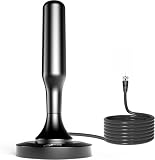
HIDB TV Antenna for Smart TV Indoor, Digital TV Antenna for Local Channels | $18.03 | Buy on Amazon |
| 2 |

|
DAANT TV Antenna Indoor Long Range | $18.99 | Buy on Amazon |
- Select the antenna input. Press Input or Source on the remote and choose the option labeled Antenna, Air, or Broadcast. The wording varies by brand. If none appears, check the TV’s manual for the menu that switches between cable and over-the-air reception.
- Run a full channel scan. Look for Auto Scan, Autotune, or Channel Search in the channel or setup menu. Run it with the antenna in its final position, because a scan records what the signal is at that moment.
- Inspect the coaxial connections. Tighten the F-connectors at the wall or antenna and at the TV by hand. Look for kinks, corrosion, or chewed or damaged cable.
- Check the signal meter if your TV has one. Some models show signal strength on the antenna setup or scan screen. Move the antenna in small increments while watching the readout, then rescan at the best position.
The six causes
1. The TV is on the wrong input or has a stale channel list
A TV set to a cable or streaming input will never show over-the-air stations, and a channel list built before a move or a station change will be out of date. The FCC and TV Answers both recommend rescanning after you move the antenna or after a station changes frequency. A scan is free, but it only reports what the antenna can already receive. It cannot improve a signal the setup cannot pick up.
The Tool Desk
Outbyte PC Repair FREEClear out junk files and repair common Windows errorsFree Scan →Outbyte Driver Updater FREEScan for outdated or missing drivers - takes under a minuteDriver Scan →2. The antenna does not cover the station’s band
Broadcast stations use the VHF band (channels 2 to 13) or the UHF band (channels 14 to 51), as the FCC defines them. The FCC warns that some products marketed as “HDTV antennas” perform poorly on VHF, so a label does not confirm band coverage. Check which band your local stations use before you buy. Also note that the number on screen is often a virtual channel, which can differ from the physical channel the station transmits on. The station’s website or the FCC’s reception tool will show the actual channel.
#1 Best Overall
- 𝗡𝗲𝘃𝗲𝗿 𝗣𝗮𝘆 𝗠𝗼𝗻𝘁𝗵𝗹𝘆 𝗕𝗶𝗹𝗹: Watching local channels with this HD digital tv antenna for smart tv indoor 4K, you can watch crystal HDTV channels without cable service and enjoy local tv channels.
- 𝗜𝗻𝗱𝘂𝘀𝘁𝗿𝘆 𝗟𝗲𝗮𝗱𝗶𝗻𝗴 𝗧𝗲𝗰𝗵𝗻𝗼𝗹𝗼𝗴𝘆: This digital indoor tv antenna for local channels is made of eco-friendly flame-retardant dual PC soft material (not ordinary PVC), providing moisture resistance and lightning protection for indoor use.
- 𝗢𝗺𝗶𝗻𝗶-𝗱𝗶𝗿𝗲𝗰𝘁𝗶𝗼𝗻𝗮𝗹 𝗥𝗲𝗰𝗲𝗽𝘁𝗶𝗼𝗻 & 𝗠𝗮𝗴𝗻𝗲𝘁𝗶𝗰 𝗕𝗮𝘀𝗲: The indoor HDTV antenna brings omini-directional Reception; Whether hd digital tv antenna indoor is installed on the TV stand or on the table, you can receive the crystal clear picture
- 𝗖𝗼𝗺𝗽𝗮𝗰𝘁 𝗮𝗻𝗱 𝘀𝗺𝗮𝗹𝗹 𝗗𝗲𝘀𝗶𝗴𝗻: The indoor antenna for tv without cable features a compact and slim design, making it easy to hide without taking up space. The lightweight build allows you to move it conveniently and adapt to different living environments effortlessly.
- 𝗡𝗼𝘁𝗲 𝗮𝗻𝗱 𝗖𝘂𝘀𝘁𝗼𝗺𝗲𝗿 𝗦𝗲𝗿𝘃𝗶𝗰𝗲 : Read the manual first, set up your TV properly, and scan for channels. 𝐅𝐨𝐫 𝐨𝐩𝐭𝐢𝐦𝐚𝐥 𝐫𝐞𝐜𝐞𝐩𝐭𝐢𝐨𝐧, 𝐭𝐞𝐬𝐭 𝐛𝐨𝐭𝐡 𝐯𝐞𝐫𝐭𝐢𝐜𝐚𝐥 𝐚𝐧𝐝 𝐡𝐨𝐫𝐢𝐳𝐨𝐧𝐭𝐚𝐥 𝐩𝐥𝐚𝐜𝐞𝐦𝐞𝐧𝐭. Mount the antenna high, near a window facing local broadcast towers (Check "dtv gov maps" for available channels), to avoid obstacles and interference. Actual Reception depends on location, terrain, and weather, always re-scan for channels after moving the antenna. If you have any issues, please contact us. We will provide professional service and a satisfactory solution for you.
3. The antenna is poorly placed or aimed
Placement changes reception more than most people expect. The FCC’s consumer advisory states plainly: “The location of an indoor antenna is key.” In practice, try a higher spot near a window, keep the antenna away from electronics and metal, and point it toward the transmitters. Indoor results can differ substantially from one room to another because signals bounce off walls and furniture, which creates multipath interference. If indoor placement fails at a distant or weak location, the FCC notes that a rooftop antenna may be needed in some cases. Rescan after every move.
4. The cable, connector, or splitter is limiting the signal
A damaged cable or loose connector can weaken or block channels that a good connection would receive. In a multi-TV setup, a passive splitter divides the signal among outputs and lowers the level at each one. TV Answers describes an active, powered splitter as an option for some long-range or multi-TV installations. It is a conditional fix. It can help one case and do nothing for another, and it should follow the connection checks above, not replace them.
5. Terrain, buildings, foliage, or interference
Over-the-air signals travel in a largely straight line. Bob Weller, National Association of Broadcasters Vice President of Spectrum Policy, put it this way in a TV Answers Q&A: “Airwaves generally travel along the ‘line of sight,’ so, any blockage, whether it’s a building or a mountain, reduces the signal.” Trees, hills, and nearby structures therefore matter, and weak fringe reception is the most vulnerable to them.
Do these 3 things before closing this tab:
1Repair Windows errors before they cause bigger problems2Scan for outdated or missing drivers - takes under a minute3Clear out junk files and repair common Windows errorsTwo other effects are common. Reflections off buildings can cause ghosting, which shows up as a faint duplicate image. Co-channel interference, where a competing signal uses the same channel, or atmospheric conditions can also distort reception. Changing the antenna’s direction or location may help with the first two. Atmospheric problems are often temporary and usually cannot be corrected at home.
The FCC’s Digital TV Reception Maps are a useful starting point. Their predictions assume an outdoor antenna mounted 30 feet above ground. The FCC states that actual signal varies with terrain, buildings, trees, weather, and equipment. A “good” prediction for a rooftop antenna does not promise the same result on a windowsill, and a poor prediction does not rule out a usable indoor result at a nearby spot. Treat the map as an estimate for choosing a location.
Rank #2
- Enjoy More Tv antenna for Local Channels: Get more channels by antenna for smart TV, receive local broadcasting, ABC, CBS, NBC, CPS, FOX, CW, ION, UMAS, etc.
- HD Antenna for TV: Our digital TV antenna indoor adopts an upgraded Smart IC Chip, receives TV broadcasts including 4K, UHD and 1080 HDTV for the hd picture.
- 16FT Coax Cable: Coaxial cable is composed of a solid center conductor, dielectric insulation, three aluminum shielding layers, and a durable outer layer. so that you will never lose signal or suffer distortion even in bad weather.
- Compatibility and Usage Tips: Not suitable for older analog televisions; supports smart TVs and digital TVs. For optimal signal reception, try placing the antenna near a window or in other locations, and test both vertical and horizontal orientations.
- Easy to Install: Plug the coaxial cable from your digital indoor HDTV antenna into the ANT/IN connector on the back of your TV, point the TV antenna toward your local TV tower and scan for channels. (Check "dtv gov maps" for available channels).
6. The station has changed its frequency, transmitter location, or power
Stations sometimes change the frequency they broadcast on, move their transmitter, or reduce power, and the change can drop a channel from your scan even though your equipment is unchanged. TV Answers advises viewers who still cannot receive a station to check its website or contact it directly, since a service change may be temporary. Before you blame the antenna, check whether the station itself is off air. The advice in the TV Answers and FCC pages cited here was published in 2020 and 2021 and may not reflect the most recent frequency changes, so confirm current information with the station.
Independent reader supportYour contribution helps us test, update, and keep practical guides available for everyone.When you are ready to change hardware
Hardware is the last step, not the first. Compare candidate antennas on four points:
What’s actually slowing this PC down?
Pick the symptom - the matching free tool is one click away.
- VHF and UHF coverage. Confirm both bands, since your local stations may use either.
- Placement. Indoor, attic, and outdoor antennas have different exposure to the signal. Choose based on where you can realistically put it.
- Direction and predicted signal. Use the stations’ direction and the FCC reception predictions to decide how the antenna must be aimed.
- One TV or several. A single-TV setup and a shared multi-TV setup have different signal budgets and may need a different splitter.
Avoid choosing by advertised range or channel count. No antenna can promise a fixed number of channels at every address, and an amplifier is not a universal fix for weak reception.
What an antenna cannot do
An over-the-air antenna receives free broadcast stations. It does not provide premium subscription channels. The Federal Trade Commission’s consumer alert of March 15, 2021 stated: “But an OTA antenna won’t get you free ‘premium’ channels, which you can only get from cable, satellite, or online content services.” If a missing channel is a premium network, that is a subscription issue rather than a reception problem.
A reception problem can also come from the station side, so rescanning and checking the station’s status remain the right first steps even after you have ruled out your equipment.
Quick Recap
Product prices and availability are accurate as of the date/time indicated and are subject to change. Any price and availability information displayed on Amazon at the time of purchase will apply.
Quick wins for a faster PC:
Repair Windows errors before they cause bigger problemsFix Now →Scan for outdated or missing drivers - takes under a minuteDriver Scan →Clear out junk files and repair common Windows errorsFree Scan →
