
iTechGuides is reader-supported. When you buy through links on our site, we may earn an affiliate commission. As an Amazon Associate I earn from qualifying purchases. Learn more
Usually no. The Antec SX840 is documented around 80 mm fans: two supplied rear fans and two optional front positions. A 92 mm fan is not a documented drop-in replacement. Treat it as a custom case modification only after measuring your particular chassis and confirming that the existing setup actually has a temperature or noise problem.
What fan layout does the SX840 use?
A contemporary SX840 review lists two included 80 mm rear fans and two optional 80 mm front fan positions. An owner discussion likewise describes four 80 mm positions, with only two fans supplied. The holders, screw locations and connector wiring can vary with the condition and revision of an individual case, so inspect the hardware rather than assuming every surviving SX840 is complete.
| Location | Documented fan size | Documented status |
|---|---|---|
| Rear | 80 mm | Two fans supplied in the historical review |
| Front | 80 mm | Two optional positions |
Will a 92 mm fan fit?
Do not assume so. In a 2001 owner thread, one participant described tight rear clearance and difficulty positioning mounting screws; another wrote, “I don’t think 92mm fans can fit in the antec sx840, the plastic fan holders are for 80mm fans.” That is period forum advice, not a manufacturer specification or a verified fit test, but it is consistent with the case’s documented 80 mm hardware.
Do these 3 things before closing this tab:
1Clear out junk files and repair common Windows errors2Fix the driver behind crashes, sound loss and screen glitches3Repair Windows errors before they cause bigger problemsA 92 mm conversion may require drilling, fabricating brackets, removing the plastic holder or cutting the chassis. Clearance around the power supply, drive cages, motherboard edge and screw heads can prevent a fan from sitting where its nominal dimensions suggest. It is therefore a custom project, not a bolt-on upgrade.
#1 Best Overall

- 【High Performance Cooling Fan】 Automatic speed control of the motherboard through the 4PIN PWM fan cable interface, which can determine the speed according to the temperature of the motherboard, with a maximum speed of 2200RPM.
- 【Vibration damping and low noise】 Four vibration damping pads around the fan reduce the vibration friction caused by PC fan rotation, perfectly reducing noise and allowing low noise operation.
- 【Quality Bearings】 Carefully developed, solving the problem of shaking fan blades in lifting mode with durability, quality S-FDB bearings keep pc fan noise to a minimum while providing maximum cooling performance when needed and extending the life of the case fan.
- 【High performance for heat dissipation】Noise-reducing 7-blade design, speed up to 2200RPM, four corners of the cooling fan with soft silicone feet, so that the pwm fan obtains high heat dissipation and low noise combination performance.
- [Perfect match] The cpu fan can not only be used as a case fan, but also suitable with downward coolers to cooling down CPU jointly aim at maximized heat dissipation performance; Ideal for cases, radiators and CPU coolers. Easy to install, can be combined with instructions or installation tutorials.
Check whether the case needs more cooling first
- Record the current symptoms. Note CPU and system temperatures under the same workload, fan noise, crashes, throttling or dust buildup. If the machine is stable and temperatures are acceptable, there may be no useful mod to make.
- Confirm every installed fan works. Look for a stalled rotor, intermittent bearing noise, blocked grille or a fan that starts only after being pushed. Replace a failed fan before changing the case.
- Inspect airflow direction. A fan draws air in through one face and exhausts it through the other. The frame supports or airflow arrow normally identify the exhaust side. A front fan is generally used to bring air into the case, while a rear fan commonly exhausts it.
- Clean restrictions. Remove dust from grilles, filters, heatsinks and cable paths. Vibration transferred from a fan into the chassis can also create noise that sounds like an airflow problem.
Low-risk upgrade: replace an 80 mm fan
If a fan is defective or excessively noisy, an 80 mm PC case fan is the appropriate starting point. Check the actual holder’s screw spacing and the connector before buying; an old SX840 may use a motherboard header, a peripheral power adapter or an adapter added by a previous owner.
- Shut down, unplug the computer and discharge static safely.
- Remove the side panel and photograph the existing fan’s wiring and airflow direction.
- Measure the opening and verify that the replacement is an 80 mm unit that fits the holder without touching nearby components.
- Match the connector and voltage requirements. Do not force a keyed plug or leave bare power contacts exposed.
- Mount the fan without overtightening. If the chassis resonates, use suitable soft isolation only where it does not loosen the fan.
- Reconnect it, confirm that the blades start reliably, and recheck temperatures and noise under the same workload used before the change.
Should you populate all four 80 mm positions?
It can be an option if your case still has the front mounts and the system demonstrably benefits from additional intake or exhaust. The available evidence does not show that filling every position is necessary or that it produces a measured temperature improvement in a typical SX840.
Rank #2

- WIDE RPM RANGE: Thanks to the 4-pin connector, the speed can be controlled via PWM. Below 5 % PWM the fan stands still, above 5 % it is infinitely variable between 200-3000 rpm
- STATIC PRESSURE: Due to the high static pressure, the fan guarantees efficient cooling even with increased air resistance. Suitable for use on heat sinks & radiators
- HIGH QUALITY BEARING: A combination of alloy/lubricant developed in Germany reduces friction within the bearing. Excessive heat build-up is prevented
- MAXIMUM QUIET RUNNING: Even at the lowest speed, the operating noise of the newly developed ARCTIC motor is barely perceptible. This allows you to work on your computer without disturbance
- TECHNICAL DATA: Fan speed: 200-3000 rpm, Airflow: 38.83 cfm | 65.97 m³/h, Static pressure: 3.12 mmH₂O, Connection: 4-pin fan connector + 4-pin socket
| Choice | When it makes sense | Main trade-off |
|---|---|---|
| Keep the working two-fan setup | Temperatures and noise are acceptable | No additional airflow, but no extra fan noise or wiring |
| Replace failed 80 mm fans | A fan is noisy, stalled or unreliable | Requires connector and mount compatibility |
| Add front 80 mm intake fans | Measured heat problem remains after cleaning and cable management | More noise, dust entry and power draw; improvement is system-dependent |
| Convert to 92 mm | You deliberately want a fabrication project and have measured clearance | Irreversible cutting or brackets, uncertain fit and no source-backed cooling guarantee |
If you are considering cutting for a 92 mm fan
Measure before removing anything: the clear opening, holder dimensions, screw-hole centers, fan depth, rear-panel clearance and nearby cables or components. Make a paper or cardboard template and check that the fan can be installed and removed without dismantling the whole system. Confirm that the proposed cut will not weaken a mounting rail or expose sharp edges.
Outdated Drivers Are Slowing You Down
One free scan finds every outdated or missing driver and matches the right update for your exact hardware.Free scan · exact hardware matchPC Slower Than It Used to Be?
A free scan shows the junk files, broken settings and background clutter dragging Windows down - then fixes them in one click.Free scan · Windows 10 & 11Cutting is irreversible. The available SX840 material does not establish that enlarging an opening or adding a larger fan lowers temperatures or noise. A larger fan can also create turbulence, transfer more vibration into the case or fail to align with the existing airflow path. Proceed only if the project itself is the goal and you accept the possibility of no measurable benefit.
Rank #3
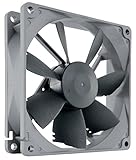
- High performance cooling fan, 92x92x25mm, 12V, 4-pin PWM, max. 1600 RPM, max. 17.6 dB(A), >150,000 h MTTF
- Renowned NF-B9 high-end 92x25mm 12V fan, more than 100 awards and recommendations from international computer hardware websites and magazines, hundreds of thousands of satisfied users
- Highly optimised low-noise design with outstanding quietness of operation, static pressure and airflow (CFM), ideal for chassis ventilation, cooling fan replacement for NAS and other devices, etc.
- 1600rpm 4-pin PWM version with excellent balance of performance and quietness, supports automatic motherboard speed control (powerful airflow when required, virtually silent at idle)
- Streamlined redux edition: proven Noctua quality at an attractive price point, wide range of optional accessories (anti-vibration mounts, S-ATA adaptors, y-splitters, extension cables, etc.)
Airflow and noise checks after any change
Verify direction
With the side panel off, use a thin strip of tissue near each grille to confirm whether air is entering or leaving. Restore the panel before judging final temperatures, because the open-case result is not representative of normal operation.
Check for obstruction and vibration
- Ensure fan blades cannot contact cables, guards or a loose grille.
- Listen for rattling that changes when you gently steady the chassis; that points to vibration rather than insufficient airflow.
- Make sure front intake air has a clear path to the motherboard and expansion cards.
Compare like with like
Use the same room, workload, panel position and temperature-monitoring method before and after the change. A single owner’s report that a related SX830 reached ambient case temperature is anecdotal and is not a benchmark for the SX840.
Quick Recap
Best Value

- 【High Performance Cooling Fan】 Automatic speed control of the motherboard through the 4PIN PWM fan cable interface, which can determine the speed according to the temperature of the motherboard, with a maximum speed of 2700RPM.
- 【Vibration Damping and Low Noise】 Four vibration damping pads around the fan reduce the vibration friction caused by PC fan rotation, perfectly reducing noise and allowing low noise operation.
- 【Dimensions of Silent Fan】 Size: 92*92*15mm, Speed: 2700RPM±10%, Noise ≤22.4dBA Connector: 4pin pwm, Air Pressure: 1.33mm H2O (MAX), Air Flow: 42.58CFM (MAX), Higher air flow for improved cooling performance.
- [Perfect Match] The ultra-thin fan can not only be used as a case fan, but also suitable with downward coolers to cooling down CPU jointly aim at maximized heat dissipation performance; Ideal for cases, radiators and CPU coolers.
- [High-quality Bearing] The well-designed superior liquid bearing can keep the noise of the fan at the lowest level, and provide the maximum cooling performance when needed, as well as extend the service life of fan.
Rank #4

- WIDE RPM RANGE: Thanks to the 4-pin connector, the speed can be controlled via PWM. Below 5 % PWM the fan stands still, above 5 % it is infinitely variable between 200-3000 rpm
- STATIC PRESSURE: Due to the high static pressure, the fan guarantees efficient cooling even with increased air resistance. Suitable for use on heat sinks & radiators
- DESIGNED FOR CONTINUOUS OPERATION: The premium quality of the Japanese double ball bearing allows continuous operation 24/7 without compromising on performance
- MAXIMUM QUIET RUNNING: Even at the lowest speed, the operating noise of the newly developed ARCTIC motor is barely perceptible. This allows you to work on your computer without disturbance
- TECHNICAL DATA: Fan speed: 200-3000 rpm, Airflow: 38.83 cfm | 65.97 m³/h, Static pressure: 3.12 mmH₂O, Connection: 4-pin fan connector + 4-pin socket
Decision guide
- No symptoms: leave the stock arrangement alone.
- One bad fan: replace it with a correctly fitting 80 mm fan.
- Persistent high temperatures: clean the system, verify heatsink contact and airflow direction, then consider the available front 80 mm mounts.
- Want a quieter larger fan: measure the case and holder first; a 92 mm unit is not documented as a drop-in fit.
- Want to experiment: treat cutting or bracket fabrication as a one-way custom project, not a guaranteed cooling upgrade.
Product prices and availability are accurate as of the date/time indicated and are subject to change. Any price and availability information displayed on Amazon at the time of purchase will apply.

