
Outdated Drivers Are Slowing You Down
One free scan finds every outdated or missing driver and matches the right update for your exact hardware.Free scan · exact hardware matchWindows Errors? Fix Them Before They Spread
Repair common Windows errors and clear accumulated junk for a smoother, more stable PC - no reinstall needed.Free scan · no reinstalliTechGuides is reader-supported. When you buy through links on our site, we may earn an affiliate commission. As an Amazon Associate I earn from qualifying purchases. Learn more
AMD’s “highest market share gains from Intel in 15 years” claim refers to Q1 2021, not today. Mercury Research data reported at the time put AMD at 8.9% of server CPU shipments, up 1.8 percentage points from the prior quarter. Mercury Research president Dean McCarron described the increase as the fastest since Q2 2006. It marked a notable step in EPYC’s comeback, but it does not establish AMD’s current share or prove that EPYC is the best choice for every server.
What the 15-year market-share claim actually measures
The headline describes a quarter-over-quarter change in AMD’s server CPU share in Q1 2021. Mercury Research’s reported estimate showed AMD rising by 1.8 percentage points to 8.9%. A percentage-point change is the difference between two share percentages, not a 1.8% increase in processor performance or revenue.
The comparison reaching back 15 years is about the pace of the share gain: McCarron said it was the fastest since Q2 2006. It does not mean AMD had its highest share ever in 2021. The contemporaneous report contrasted the gain with AMD’s older 2006 volume peak, when the company sold a different mix of server CPUs; later EPYC products were positioned as higher-priced, higher-value parts. The figure is a reported Mercury Research estimate, and the underlying full table was not publicly available in the material cited at the time. HotHardware’s Q1 2021 report
The Tool Desk
Outbyte Driver Updater FREEFix the driver behind crashes, sound loss and screen glitchesFind Drivers →Outbyte PC Repair FREEClear out junk files and repair common Windows errorsFree Scan →How EPYC took share from Intel Xeon
There was no single cause. AMD’s gains built over time as it paired a competitive product roadmap with a wider route into enterprise and cloud deployments. The Q1 2021 story coincided with EPYC 7003, codenamed Milan, which AMD positioned with up to 64 cores and 128 threads. That generation followed earlier Zen-based EPYC chips that had helped establish the platform in the data center.
#1 Best Overall

- For AMD EPYC 9754 128 Core Bergamo 2.25GHz (100-000001234) EPYC 9004 Series Socket SP5 ZEN4 256MB L3 Bulk / Tray Pack (Unlocked) Server Processor
- More compute per socket: Higher core counts can let a customer run more parallel workloads on fewer servers, depending on software licensing, memory bandwidth, and the workload’s ability to scale.
- Performance and efficiency positioning: AMD promoted EPYC on performance per watt and total cost of ownership. Those are vendor claims whose practical value depends on the specific systems, power prices, utilization, and comparison CPUs.
- More ways to buy and deploy: Availability through OEMs, ODMs, and cloud providers reduces the friction of adopting a processor architecture. AMD’s 2024 annual report said more than 450 EPYC server platforms were available from major OEMs and ODMs.
AMD’s 2024 annual report characterized EPYC as “the CPU of choice for the modern data center” and said share gains had accelerated. These are AMD’s descriptions of its business, not independent market measurements. AMD annual reports
How to compare EPYC and Xeon without mixing unlike numbers
Market-share headlines can describe different things. Before comparing AMD with Intel, identify the measure and scope:
Rank #2

- Dual Processor Support: Supports and includes 2 AMD EPYC processors installed for enhanced computing performance
- Processor Configuration: Features 2 installed AMD EPYC processors for powerful server operations
- AMD Processor Technology: Equipped with AMD processor manufacturer components for reliable performance
- EPYC Processor Type: Utilizes AMD EPYC processor type designed for enterprise-level server applications
- 5th Generation Processing: Powered by 5th Gen AMD EPYC 9115 processors running at 2.60 GHz with hexadeca-core architecture
- Unit share versus revenue share: Unit share counts processors sold; revenue share measures sales value. A higher-priced processor can increase revenue share without an equal increase in units.
- Time period and geography: A quarterly worldwide estimate is not directly comparable to an annual result or a regional figure.
- Market definition: “Server CPUs” may cover a wider category than x86 processors, while EPYC-versus-Xeon comparisons focus on AMD and Intel products. Check what is included before treating percentages as equivalent.
- Workload and system configuration: Core count alone does not determine performance. Memory capacity and bandwidth, storage, accelerators, software, and the server’s power limits can change the result.
- Total cost: Include the server purchase, software licensing, electricity, cooling, support, and expected utilization—not just the processor’s list price.
- Platform fit: Verify socket, motherboard, firmware, memory type, expansion needs, and software or virtualization support for the exact server configuration.
AMD has presented EPYC as having approximately 40% revenue market share in 2025. That is a company-reported figure, not an independent estimate, and it is not directly comparable to the 8.9% Mercury Research server-share figure for Q1 2021 without confirming the market definitions and measurement bases. No current 2026 share figure is established here.
Which EPYC generation matters today?
The Q1 2021 milestone belongs to EPYC 7003 (Milan), but it is not the newest generation in the supplied product timeline. AMD announced EPYC 9005 (Turin) in October 2024, based on Zen 5 and compatible with the SP5 platform. AMD announced configurations ranging from 8 to 192 cores. It also claimed up to 2.7× performance for the top 192-core EPYC 9005 SKU versus the competition it cited; that is AMD’s comparison, not a neutral, workload-independent result. AMD’s EPYC 9005 announcement
Rank #3

- High Performance Server: Features an AMD EPYC 7313 processor with a speed of 1.44 GHz and 32 GB of DDR4 memory for fast performance.
- Expandable Storage: Includes an P408i-a storage controller and 8 SFF drive bays for flexible storage options.
- Modern Design: Has a sleek, modern style with a black finish and ergonomic keyboard for comfortable use.
- Easy Setup: Comes with an 800W power supply and pre-installed operating system for quick installation.
- Reliable Connectivity: Offers multiple USB and Ethernet ports for seamless connectivity to other devices.
For an upgrade or new build, choose by workload and complete-system requirements rather than by the generation with the largest core-count headline. Confirm that the server vendor supports the selected CPU, memory configuration, firmware, and required accelerators. EPYC compatibility is not interchangeable across generations or platforms simply because the brand name is the same.
Independent reader supportYour contribution helps us test, update, and keep practical guides available for everyone.Is EPYC better than Xeon for a server?
Neither brand is universally better. EPYC may be attractive where a validated configuration delivers the needed throughput, core density, or performance per watt at an acceptable system cost. Xeon may be the more practical choice where an organization’s existing server fleet, validated software stack, supplier arrangements, or support requirements favor Intel. Those considerations vary by model and deployment; compare complete systems against the workloads you actually run.
Rank #4

- HPE ProLiant DL145 Gen11 – P87460-005 – SMART CHOICE MODEL – COMPACT EDGE SOLUTION: Preconfigured and factory-tested for fast deployment and cost efficiency. Includes AMD EPYC 8024P (8 cores, 2.40 GHz), 16GB DDR5 ECC SmartMemory, 2 SFF chassis, 480GB SATA 6G Read Intensive SSD, Broadcom 1GbE OCP NIC, and single 700W Platinum PSU—ideal for IoT gateways, retail POS, and light virtualization.
- PERFORMANCE AND MEMORY – EFFICIENT FOR LIGHT WORKLOADS: The AMD EPYC 8024P delivers 8 cores at 2.40 GHz for edge compute tasks. Includes 16GB DDR5 RDIMM ECC (1x16GB) and supports up to 768GB across six DIMM slots—ideal for small-scale virtualization and real-time analytics.
- STORAGE – READY FOR OS AND DATA Includes one HPE 480GB SATA 6G Read Intensive SSD for quick deployment. Supports additional SFF drives for storage flexibility—perfect for edge workloads and local data storage.
- ENTERPRISE DESIGN – POWER AND CONNECTIVITY: Single 700W Platinum hot-plug power supply ensures reliable power delivery. Broadcom BCM5719 OCP NIC offers four 1GbE ports for edge networking and connectivity.
- SECURITY AND MANAGEMENT – BUILT-IN PROTECTION: HPE iLO6 with Intelligent Provisioning, TPM 2.0, Silicon Root of Trust, and secure boot protect against threats. Compatible with HPE OneView and Compute Ops Management for simplified lifecycle management.
Ask vendors or system integrators for configuration-specific benchmark results and power data, and check that the tests use comparable memory, accelerators, software versions, and power limits. For production deployments, also confirm support terms, availability, and the upgrade path for the exact platform.
Quick Recap
Best Value
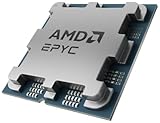
- The processor features Socket AM5 socket for installation on the PCB
- EPYC product line processor for better usability and increased efficiency
- Dodeca-core (12 Core) processor core allows multitasking with great reliability and fast processing speed
- 64 MB of L3 cache memory provides excellent hit rate in short access time enabling improved system performance
- Processor with 3.40 GHz clock speed for reliable and fast execution of instructions to ensure maximum convenience and feasibility
Product prices and availability are accurate as of the date/time indicated and are subject to change. Any price and availability information displayed on Amazon at the time of purchase will apply.

