
Quick wins for a faster PC:
Repair Windows errors before they cause bigger problemsFix Now →Scan for outdated or missing drivers - takes under a minuteDriver Scan →Clear out junk files and repair common Windows errorsFree Scan →iTechGuides is reader-supported. When you buy through links on our site, we may earn an affiliate commission. As an Amazon Associate I earn from qualifying purchases. Learn more
Using an aluminum electrolytic capacitor’s temperature multiplier can allow more ripple current at a higher operating temperature—but it does not also earn the lifetime benefit of running cooler. The multiplier spends thermal margin to support the increased current. To estimate longer life, calculate the part’s actual core temperature and use its manufacturer’s lifetime model without counting that same margin twice.
What a ripple-current temperature multiplier means
An aluminum electrolytic capacitor’s ripple-current rating is conditional: it applies under stated test or operating conditions, not at every frequency or temperature. In his 2004 chapter “Aluminum Cap Multipliers — Why We Can’t Have Them and Eat Them Too,” Sanjaya Maniktala describes ratings typically expressed as RMS amperes at 120 Hz and 105°C. The chapter gives 2,000–10,000 hours as a typical declared-life range under those cited conditions. These are historical figures from the chapter, not universal specifications or guidance for a capacitor sold today.
A temperature multiplier adjusts the allowable ripple current when the capacitor operates at a temperature below the rating’s reference temperature. Maniktala’s examples use a 105°C reference and give multipliers of 1.73 at 85°C and 2.236 at 65°C. Those multipliers represent increased allowable current under the chapter’s core-temperature assumption; they are not an additional lifetime credit.
Why higher ripple current and longer life cannot both be claimed
Ripple current heats the capacitor internally. The heating depends on RMS current and equivalent series resistance (ESR), and ESR can vary with frequency. A current multiplier uses available temperature margin to permit more current while maintaining the assumed core temperature. A life estimate based on a cooler core temperature, by contrast, relies on preserving that lower temperature. Counting the multiplier and then applying a life increase as though the capacitor were cooler spends the same thermal margin twice.
#1 Best Overall

- ALLECIN Electrolytic Capacitors Kit contain 24 Different Values In-line Aluminum Capacitors - Perfectly suitable for variety electronic experiments.
- Features & Advantages : Large capacity and small size. Ripple current resistance - small loss tangent, small leakage current, low internal resistance and low ripple.
- Dielectric material: aluminum electrolytic. Lead description: long lead = positive "+"; short lead = negative "-".
- Wide Application : In-line electrolytic capacitors are widely used in household appliances and various electronic products, and are also very suitable for DIY circuit boards.
- Humanized packaging for easy storage and use. # Please confirm the capacitance, voltage and volume before purchasing.
Maniktala summarizes the tradeoff: “We can increase the ripple current (but not the life) by applying the temperature multipliers OR we can increase the life (but not the ripple current) by not applying these multipliers.” This is the chapter’s framing of the calculation. For an actual component, its current datasheet and manufacturer lifetime guidance take precedence.
How the chapter illustrates the tradeoff
The 2004 chapter compares 1 A at 105°C with 1.73 A at 85°C using its example multiplier. It derives an illustrative core temperature of 115°C for that comparison. The 115°C figure belongs to the chapter’s example; it is not a universal operating temperature or a limit that applies to every aluminum electrolytic capacitor.
Rank #2

- Hello, In this set, we offer 36 Value electrolytic capacitors include 16V 25V 35V 50V 63V, range from 1uF to 1000uF total 925Pcs well packed in a plastic box,total weight about 1kgs=2.2lb, with clearly labeled compartments, parts inside will not slide or move around.
- Find in the package models: 10V470UF/ 10V680UF/ 10V1000UF/ 16V100UF/ 16V220UF/ 16V470UF/ 16V680UF/ 16V1000UF/ 16V1500UF/ 25V47UF/ 25V100UF/ 25V220UF/ 25V330UF/ 25V470UF/ 25V1000UF/ 35V47UF/ 35V100UF/ 35V220UF/ 35V330UF/ 35V470UF/ 35V680UF/ 35V1000UF/ 50V1UF/ 50V4.7UF/ 50V10UF/ 50V22UF/ 50V47UF/ 50V100UF/ 50V220UF/ 50V330UF/ 50V470UF/ 50V680UF/ 50V1000UF/ 63V100UF/ 63V330UF/ 63V470UF
- High Frequency Lowesr, High precision aluminum electrolytic capacitors. temperature range from -40℃ to +105℃, tolerance ±20%, stable and durable for long life use.
- Long operation life. more than 2000 hours.Our electrolytic capacitors are widely used in power supplies and in interconnecting stages of amplifiers at audio frequencies.
- You will receive our complete electrolytic capacitor assortment kit in a sturdy plastic box with compartments for different parts, which facilitates transportation and can be reused many times.
The chapter also states a rule of thumb that life doubles for each 10°C reduction in temperature. That helps explain why a cooler operating core may improve a life estimate, but it should not be treated as a universal guarantee. Use the selected manufacturer’s current lifetime model, which may have component-specific conditions and calculation methods.
How to evaluate a real capacitor design
- Start with the exact part’s current datasheet. Check its ripple-current rating, reference temperature and frequency, allowable operating conditions, and any frequency correction factors. Do not substitute the chapter’s 2004 examples for current part data.
- Determine ripple current under your operating conditions. Use RMS current and account for the frequencies present; the part’s ESR and ripple behavior can vary with frequency. Apply only the corrections specified by the manufacturer.
- Estimate internal heating and core temperature. Consider ripple-current heating, ESR, ambient temperature, and the capacitor’s thermal conditions. Ambient temperature alone does not establish the core temperature.
- Choose what the available temperature margin is for. If you use a manufacturer-specified temperature multiplier to support higher ripple current, do not also claim a life extension as though that margin had been preserved for cooler operation.
- Estimate service life with the manufacturer’s model. Use the calculated operating conditions and the model for that specific capacitor. Keep the assumptions visible, especially frequency, ripple current, ambient and core temperatures.
Where aluminum electrolytics fit
Aluminum electrolytic capacitors can be useful when their capacitance, voltage capability, and cost fit the design, but ESR, self-heating, and wearout matter. Maniktala’s 2004 discussion notes that all-ceramic input solutions can have oscillation concerns and discusses an electrolytic capacitor in parallel for damping in some cases. That is historical design context, not a universal prescription; evaluate the topology and components in the actual design.
Rank #3
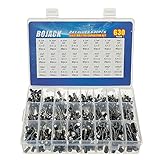
- In this set, we offer 24 Value electrolytic capacitors include 10V 16V 25V 50V, range from 0.1uF to 1000uF total 630pcs well packed in a plastic box, with clearly labeled compartments, parts inside will not slide or move around.
- These electrolytic capacitors have a wide range of 0.1uF to 1000uF, with clearly marked values and voltage ratings on each capacitor for you to easy select and use.
- Our electrolytic capacitors are widely used in power supplies and in interconnecting stages of amplifiers at audio frequencies.
- High precision aluminum electrolytic capacitors. temperature range from -40℃ to +105℃, tolerance ±20%, stable and durable for long life use.
- They are also great choice for DIY work, repairs and little projects, can be applied for repair TV, LCD monitor, radio, stereo, game console, microwave, etc.
The chapter appears in Appendix 1 of Maniktala’s Switching Power Supplies A to Z. Its examples explain a useful thermal-accounting principle, but component ratings and life estimates should be grounded in the current datasheet and model-specific manufacturer guidance.
Quick Recap
Best Value

- Comprehensive Assortment: 24 different models of SMD electrolytic capacitors with 400 pieces total, featuring capacities ranging from 1 microfarad to 1000 microfarads, capable of meeting your various working requirements
- Broad Application: Widely used in fields such as automotive electronics, network electronics, household electronics, lighting and display screens
- High-Quality Construction: These electrolytic capacitors are manufactured with high-quality materials to ensure their long-term use, featuring an extremely thin dielectric oxide layer and enlarged anode surface that enables them to withstand higher voltages than other capacitors
- Convenient Organization: This aluminum electrolytic capacitor is packaged in a plastic box for convenient transportation and storage, with each capacitor featuring a marking code for easy identification and quick model reference
- Industrial Use Only: Please note that these components are not sterile products and are intended for industrial purposes only, not for medical applications, and children aged 6 require adult supervision and assistance when using this product for making handicrafts
Rank #4

- ALLECIN 1000uf 10V 8x12mm Electrolytic Capacitor ### Stable and durable performance.
- Operating temperature: -40℃ ~ +105℃ ; Tolerance: ±20% ; Rated voltage: 10V.
- Features & Advantages: Large capacity and small size. Ripple current resistance - small loss tangent, small leakage current, low internal resistance and low ripple.
- Wide Application: In-line electrolytic capacitors are widely used in household appliances and various electronic products, and are also very suitable for DIY circuit boards.
- Humanized packaging for easy storage and use. # Please confirm the capacitance, voltage and volume before purchasing.
Product prices and availability are accurate as of the date/time indicated and are subject to change. Any price and availability information displayed on Amazon at the time of purchase will apply.

