
iTechGuides is reader-supported. When you buy through links on our site, we may earn an affiliate commission. As an Amazon Associate I earn from qualifying purchases. Learn more
Customer-service AI should finish an interaction only when it understands the customer’s goal, has reliable evidence, is authorized to act, and can verify the result. If any of those conditions fail—or the customer asks for a person—it should clarify or hand the interaction to a human. The right measure is not how quickly AI replies or how often it avoids an agent; it is whether the customer’s problem is correctly resolved with acceptable effort and risk.
Why a fast answer is not enough
AI can respond quickly and still leave a customer with the wrong answer, an incomplete task, or no clear route to help. Customer expectations reflect that distinction. Gartner’s survey of 3,566 B2B and B2C customers, conducted in February and March 2026, found that surveyed customers were approximately three times more likely to use third-party GenAI than company-provided chatbots for customer-service issues. Gartner also reported that customers expect access to a human when a company uses AI for service. Gartner’s July 2026 survey release describes the finding; it does not mean every customer rejects company chatbots.
Among surveyed GenAI users, 58% said they had used GenAI to complete a task on their behalf; the figure was 74% among B2B respondents. These are survey responses about use, not proof that AI completed every task correctly. Gartner analyst Eric Keller said, “Customers are embracing GenAI in both life and work, but so far, that has not translated into growth in the use of company-provided customer service chatbots.”
PC Slower Than It Used to Be?
A free scan shows the junk files, broken settings and background clutter dragging Windows down - then fixes them in one click.Free scan · Windows 10 & 11Crashes, No Sound, or Screen Glitches?
Random freezes, missing sound and display glitches usually trace back to one bad driver. Find and replace yours safely.Free scan · under a minuteHandoff is another part of the experience that needs deliberate design. In a 2025 survey of 4,800 consumers and 457 business leaders across 15 countries, Twilio reported that 78% of consumers considered the ability to switch from AI to human support important, while 15% said they had experienced a seamless handoff. These are findings from Twilio’s company-published survey, not a universal or independently audited measure. Read Twilio’s 2025 survey release.
#1 Best Overall

- 【AI Noise Cancellation】Stop letting background sounds distract you—This wireless headset with microphone uses intelligent noise filtering to cancel up to 99% of ambient noise, helping you stay productive no matter where you are. The 40mm acoustic drivers of bluetooth headphones with microphone make your voice sound clear on calls and bring your music to life. Ideal for remote workers, office, call center agents, or anyone in a shared office.
- 【Stay Comfortable All Day】This wireless headset with mic for work is designed for all-day comfort, featuring a soft padded headband and thick memory foam ear cushions that fit snugly without feeling heavy or sweaty. The 270° rotating boom mic of wireless headphones for work captures your voice perfectly from any angle, and the mute button puts privacy control right at your fingertips for quick on/off during calls.
- 【Bluetooth 5.0 & USB Dongle】Powered by the latest Bluetooth 5.0 chip, this headsets with microphone for work gives you a stable, lag-free connection that works seamlessly with most computers, phones, and tablets. Wireless headphones with mic also comes with a USB dongle for plug-and-play use on devices without built-in Bluetooth, and works perfectly with Skype, Zoom, Teams, and most other calling apps.
- 【Stay Charged All Week】 Get through your busiest days with 26 hours of talk time and 200 hours of standby on a single charge. This bluetooth headset for work features a charging dock with two options—wireless charging for easy drop-and-go, or Type-C wired charging for quick top-ups. Designed for extended travel, back-to-back meetings, or full-day teaching.
- 【Connect to Two Devices at Once】This wireless headphones for work stays connected to two devices at the same time, like your computer and cell phone, so you can take calls without missing a beat. It switches instantly from a laptop meeting to a mobile call with zero delay. With a 49-foot wireless range, you can move between rooms while enjoying clear, steady audio on every call.
A practical rule for deciding when AI should stop
The following is an operational design proposal, not a standard mandated by Gartner, NIST, or Twilio: let AI complete an interaction only when every condition below is satisfied.
- The goal is clear. The system understands what the customer wants and has the relevant account or transaction context. If intent is ambiguous, it should ask a focused clarifying question rather than guess.
- The facts are grounded. The answer comes from current, approved business information that applies to this customer and situation. If the system cannot establish the relevant facts, it should not present speculation as certainty.
- The action is authorized and verifiable. Any change the customer requests is within explicit permissions, and the system can confirm whether it actually succeeded. A claim that an action was completed is not a substitute for checking its outcome.
- The potential downside is acceptable. The organization’s risk policy allows AI to handle this kind of request, taking into account the harm an error could cause and whether it can be reversed.
- Human help remains available. The customer has a practical way to ask for a person, whether or not the AI believes it can finish the task.
If one of these tests fails, the system should stop autonomous completion: clarify when a question could resolve the uncertainty, or transfer the interaction when it cannot. NIST’s AI Risk Management Framework is voluntary guidance for incorporating trustworthiness into AI design, development, use, and evaluation; its Generative AI Profile was released July 26, 2024. NIST does not prescribe this particular service threshold. NIST’s AI Risk Management Framework page records the framework’s status, including that revision work is underway.
When to clarify, transfer, or keep going
Clarify when the missing fact is easy to supply
If a customer says “change my plan” without specifying which plan or what change they mean, ask a concise question. Keep going only after the answer resolves the ambiguity and the requested action passes the authorization and risk checks. Repeatedly asking variations of the same question is not clarification; it is a signal that the interaction may need a person.
Rank #2
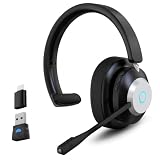
- 【Bluetooth & USB Dongle Connection】Our wireless headphones feature a advanced chip that delivers faster and more stable connectivity. Easily pair with your phone or tablet via Bluetooth. For desktop computers or older PCs, the included USB adapter enables plug-and-play setup in seconds—no built-in Bluetooth required on your device
- 【ENC Noise Cancellation and One-touch Mute】Equipped with an advanced ENC microphone that blocks up to 98% of background noise, it delivers a clearer calling experience. The wireless headset features a one-touch mute button to prevent awkward audio leaks during meetings and protect your privacy
- 【Seamless Dual-Device Connectivity】These Bluetooth headset support multipoint connectivity, allowing you to connect to two devices simultaneously—such as a smartphone and a computer. You can easily switch between phone calls and online meetings, ensuring you never miss any important information. Combined with a stable wireless range of 10 m/32 ft, offering you ultimate freedom while working
- 【Extended Battery Life and All-day Comfort】Earbay wireless headset with mic for work is designed specifically for people who need to wear headset for long time.The headset offers extended battery life. With 45H working time and 480H standby time, you’ll never have to worry about running out of power. The soft ear cushion and adjustable headband ensure all-day comfort
- 【Wide Range of Applications】This Bluetooth headphone is ideal for truck drivers, remote workers, call centers, online classes, and entertainment. Wherever your day takes you—on the road, at your desk, or in the classroom—enjoy reliable audio performance that keeps you connected
Transfer when facts, safety, or authority are uncertain
A handoff is especially appropriate when the system cannot establish the facts, the customer repeats or disputes an answer, the request involves a sensitive or high-consequence decision, or the action falls outside policy or authorization. It should also transfer when the customer asks for a person. These are proposed operational triggers based on broader risk and service guidance; the cited sources do not require this exact list.
Finish routine tasks only when the result can be checked
For a low-risk request with a clear goal and an approved source, AI may be able to complete the task end to end. But it should report what happened accurately: distinguish a confirmed change from a submitted request, a pending action, or a failure. When it cannot verify completion, it should explain that limitation and provide the appropriate next step or handoff.
Make a handoff useful, not just available
A transfer button alone does not make a handoff seamless. When an interaction moves to an agent, pass the information the agent needs to continue without making the customer start over:
Rank #3

- 【AI Noise Cancelling Mic】 2-mic AI noise cancellation system and Acoustic Shield Tech helps reduce background in open offices and home. Oval-shaped noise-isolating foam ear cushions provide effective passive noise isolation, while 300° rotatable boom microphone supports accurate voice pickup for business calls and online classes
- 【All-Day Comfort】 Weighing only 3.4 oz, this single ear usb headset is designed for remote worker or customer service. Adjustable headband and ear cushions are made with hydrolysis-resistant leather and soft, breathable memory foam for lasting comfort .
- 【USB-A Universal Connectivity】Wired Headphones with USB-A ( 5.6ft length) for plug & play connectivity to computer and phones. Integrated call controls, quick mute (button/flip boom), volume adjustment, and busylights improve virtual meeting management
- 【 35mm Speakers & Dynamic EQ】Large 35 mm speaker drivers and professional acoustic components deliver wideband HD audio(20Hz -20kHz) and balanced sound. Computer headset feature Dynamic EQ automatically switches between call and music modes to optimize WFH users
- 【Certified for Teams & Zoom】Yealink teams/zoom certified headset is compatible with major global software platforms and operating systems (Windows/Mac). Backed by 2 years of professional technical support and customer service to ensure the long-term stable operation of this PC headset with microphone
- The customer’s stated goal.
- Relevant facts that have been verified.
- Actions already attempted and their confirmed outcomes.
- The unresolved question or decision that requires the agent.
Pass only the context needed for the agent to help, and handle it under the organization’s applicable privacy and data rules. Twilio’s survey reported consumer unease about AI’s use of context and personal or financial information; Gartner recommends policies covering privacy, security, and escalation in its July 2026 release. A carefully limited summary can reduce repeated explanations without treating every detail in the chat as necessary to share.
What’s actually slowing this PC down?
Pick the symptom - the matching free tool is one click away.
Evaluate the journey by outcomes, not deflection alone
Compare automated and human-supported service using the same outcome-focused criteria. NIST’s 2024 AI Use Taxonomy lays out 16 AI-use activities and emphasizes human goals, outcomes, evaluation, trustworthiness, and usability. That framing supports asking what the customer needed and whether the system’s contribution helped achieve it—not just whether AI participated. See NIST’s 2024 AI Use Taxonomy.
| What to assess | Questions for the service team |
|---|---|
| Task success and correctness | Was the customer’s goal actually completed? Can the outcome be verified, and how often does it need correction? |
| Customer effort and speed | Did the journey reduce waiting, work, and repeated explanations—not merely produce a quick first response? |
| Risk and reversibility | What harm could an error cause, and can the action be undone? |
| Escalation quality | Can the customer reach a person, and does that agent receive enough useful context to continue? |
| Privacy and security | Is the data used or transferred necessary, protected, and governed by policy? |
| Measurement | Are teams checking completion, repeat contacts, correction rates, escalation outcomes, and customer satisfaction—not just deflection? |
There is no universal accuracy or confidence cutoff established by these sources for autonomous resolution. Set thresholds through the organization’s own risk analysis and validated service data. Counting a conversation as “resolved” because it ended in the AI channel can conceal failed tasks, repeat contacts, and customers who gave up.
Read automation projections as forecasts, not results
Gartner’s March 2025 release projected that agentic AI would resolve 80% of common customer-service issues without human intervention by 2029, with a 30% reduction in operational costs. Those figures are a forecast, not a measured current performance level or guaranteed outcome. Gartner analyst Daniel O’Sullivan described agentic AI as a shift toward proactively resolving service requests on customers’ behalf; whether a particular system can do so safely and effectively depends on the task, its permissions, and the evidence available. Read Gartner’s March 2025 forecast.
Quick Recap
Product prices and availability are accurate as of the date/time indicated and are subject to change. Any price and availability information displayed on Amazon at the time of purchase will apply.

