
iTechGuides is reader-supported. When you buy through links on our site, we may earn an affiliate commission. As an Amazon Associate I earn from qualifying purchases. Learn more
Climate models suggest that suitable habitat for New Mexico’s introduced Gemsbok could extend well beyond its current range by 2100, with some modeled areas reaching Texas, Arizona, Utah, California, and farther north. That is a forecast of environmental suitability—not a map of where antelopes will certainly travel or become established.
What the climate study projects
A 2026 study in the Journal of Mammalogy modeled potential Gemsbok habitat through 2100. The researchers used occurrence records and species distribution models to estimate where environmental conditions resemble places associated with recorded Gemsbok occurrences. They tested three climate pathways—SSP1-2.6, SSP3-7.0, and SSP5-8.5—at two geographic extents, buffered 25 km and 100 km around the modeled area, and examined three periods: 2011–2040, 2041–2070, and 2071–2100. Read the study.
| # | Preview | Product | Price | |
|---|---|---|---|---|
| 1 |
|
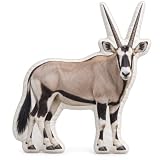
Realistic Gemsbok 3D Simulation Wildlife Animal Plush Pillow Doll ELVEAI190 | $14.99 | Buy on Amazon |
Across the scenarios and extents, the study reports broad agreement that suitable habitat expands and becomes more aggregated and connected. The University of Illinois summary describes modeled suitability extending beyond New Mexico into Texas, Arizona, Utah, and California, with some suitability reaching southern Washington and Montana. Those locations are not equally supported in every scenario, and the northern projections are especially constrained by differences between those environments and the Gemsbok’s current range. See the university summary.
Free tools Windows power users keep installed
One-click scans. No signup required.
Where could suitable habitat connect?
The study does not describe one fixed route north or east. It reports increased suitability linking the current range eastward through lower-elevation areas even under SSP1-2.6. Under SSP3-7.0 and SSP5-8.5, suitable conditions also increase in some mountainous areas, which could reduce environmental barriers to eastward dispersal.
#1 Best Overall
- REALISTIC ANIMAL DESIGN – Detailed 3D simulation artwork creates a distinctive animal-shaped decorative pillow with lifelike visual details.
- DOUBLE-SIDED 3D PRINT – High-detail digital artwork is printed on both sides for an attractive appearance from multiple viewing angles.
- SOFT MICRO PEACH FABRIC – Made with Premium Micro Peach fabric for a smooth, soft-touch surface suitable for cuddling or decoration.
- PP COTTON FILLING – Soft PP cotton filling gives the 16-inch pillow a comfortable, plush feel while helping maintain its dimensional shape.
- ANIMAL LOVER GIFT – A fun choice for bedrooms, sofas, offices, reading areas, collections, or as a gift for wildlife and animal enthusiasts.
The university summary highlights western Texas, western New Mexico, Arizona, and parts of California, including Death Valley, as places where separate patches may coalesce. As study contributor Kieran Andreoni explained, “When there are these isolated patches, there might be dispersal barriers that they can’t cross to get to the next patch. But when these patches coalesce and connect, there might be increased opportunities for gemsbok to invade and expand into these novel habitats.” University of Illinois summary.
Connectivity can create opportunities, but it does not establish that animals will cross the landscape. The model estimates suitability; it does not demonstrate movement, successful arrival, survival, or reproduction in any projected area. The authors call for further study of dispersal barriers and management.
Why do the projections vary?
Temperature seasonality, temperature during the coldest quarter, and human footprint were among the model’s important predictors. The researchers also considered factors including precipitation, vegetation cover, terrain ruggedness, and human population density. The two model extents produced high overall agreement, but the paper identifies geographic uncertainty in parts of the north and east. Study summary and interpretation.
What’s actually slowing this PC down?
Pick the symptom - the matching free tool is one click away.
In particular, projecting into areas unlike the environments associated with current Gemsbok records is less certain. A suitability result in a distant state should therefore be read as a signal for potential habitat, not as a prediction that a population will reach that state.
How Gemsbok became established in New Mexico
New Mexico’s Gemsbok population began with 95 captive-bred animals released on the Tularosa Range of White Sands Missile Range (WSMR) between 1969 and 1977, according to the New Mexico Department of Wildlife and the National Park Service. The NPS says thousands now reside on the missile range. These animals were deliberately introduced; they are not a native New Mexico species. NMDOW and NPS background.
Management has included hunting and efforts to keep animals out of sensitive areas. The NPS says annual hunts have continued to help control and stabilize the population. A 67-mile (108 km) boundary fence was erected in 1996 to keep Gemsbok out of White Sands National Park, which has measures to reduce their local impact. This is a description of management at White Sands, not a statement about a nationwide legal classification. National Park Service background.
The New Mexico Department of Wildlife’s 2023–2024 forecast says annual harvest had exceeded 1,500 in recent years at the time of publication, and that off-range public draw licenses were increased during 2022 rule development. Those are historical management figures, not a current population census or a 2026 harvest count. NMDOW forecast.
PC Slower Than It Used to Be?
A free scan shows the junk files, broken settings and background clutter dragging Windows down - then fixes them in one click.Free scan · Windows 10 & 11Crashes, No Sound, or Screen Glitches?
Random freezes, missing sound and display glitches usually trace back to one bad driver. Find and replace yours safely.Free scan · under a minuteWhat expansion could mean for wildlife and land managers
If Gemsbok expand into new areas, potential concerns include competition for forage with cattle and native ungulates, pressure on vulnerable grasslands, and disease transmission. These are risks to consider, not confirmed outcomes in every place the model marks as suitable. The study notes that Gemsbok in the Southwest have shown serological evidence of several diseases; expansion could expose new communities, but that does not prove future outbreaks.
Forage overlap may matter because Gemsbok can use lower-quality plant material. Lead author Nathan Alexander said, “Along with that diet overlap, gemsbok are able to forage on lower quality plant materials than some of our native species.” The NPS describes local foods including desert grasses, yucca, buffalo gourds, and mesquite bean pods. Study co-author Bob Schooley also noted that Gemsbok can obtain water from plants and tolerate heat and drought; these adaptations help explain why climate suitability is worth monitoring, but they do not guarantee establishment in a new location. University of Illinois summary and NPS information.
What the map cannot tell you
- Whether Gemsbok will arrive: suitability does not account for every barrier, movement decision, or human intervention.
- Whether they will persist: a suitable climate does not prove that a local population will survive and reproduce.
- How many animals might occur: the reported material does not provide a numerical population forecast for each projected region.
- Which locations will be affected: model agreement is broad, but regional uncertainty remains, especially where habitats differ from the current range.
The paper also identifies human-caused mortality as an expected population limit in the introduced range. Future spread will therefore depend not just on climate, but on movement barriers, local conditions, mortality, and management choices.
Quick Recap
Product prices and availability are accurate as of the date/time indicated and are subject to change. Any price and availability information displayed on Amazon at the time of purchase will apply.

