
Do these 3 things before closing this tab:
1Clear out junk files and repair common Windows errors2Fix the driver behind crashes, sound loss and screen glitches3Repair Windows errors before they cause bigger problemsiTechGuides is reader-supported. When you buy through links on our site, we may earn an affiliate commission. As an Amazon Associate I earn from qualifying purchases. Learn more
Adaptive neuro-symbolic planning is a proposed way to combine sensor-based predictions, multilingual maintenance reports and rule-checked action planning for bio-inspired soft robots. Rikin Patel’s DEV Community post describes one such architecture, but its performance figures are author-reported simulation results, not independently verified field evidence. Separate robotics and industrial-maintenance publications support parts of the general approach; they do not establish that this system works on soft actuators or across multilingual maintenance teams.
What does the proposed system do?
Patel’s post describes a four-part system intended to turn machine data and maintenance reports into feasible service plans. Its central idea is to let learned models estimate conditions or guide decisions while an explicit symbolic representation gives the planner named components, failure modes, procedures and constraints to work with.
- Represent the robot and its maintenance knowledge. A symbolic ontology is meant to organize morphologies, failure modes and procedures. In principle, this gives a planner explicit concepts to reason over rather than treating every report or sensor reading as an isolated text or number.
- Estimate degradation from telemetry. A neural predictor uses sensor data to estimate a degradation state. The post describes this state as latent, meaning it is an estimate rather than a directly observed measure of remaining life.
- Map reports across languages. A cross-lingual semantic aligner links stakeholder descriptions to ontology concepts. The post’s example is Japanese, German and Portuguese records interpreted as describing a similar dielectric-elastomer fatigue issue.
- Plan maintenance actions. A planner combines symbolic search with neural value estimates to select a maintenance schedule. The post also describes simulated annealing for scheduling and confidence-triggered human labeling when the system is uncertain about an input.
This is an architecture proposal, not a product specification. The post mentions silicone casting, pneumatic channels, fiber reinforcement, dielectric elastomer actuators and soft grippers, but does not identify a commercial robot, compatible replacement part or validated repair protocol.
Outdated Drivers Are Slowing You Down
One free scan finds every outdated or missing driver and matches the right update for your exact hardware.Free scan · exact hardware matchWindows Errors? Fix Them Before They Spread
Repair common Windows errors and clear accumulated junk for a smoother, more stable PC - no reinstall needed.Free scan · no reinstallHow can learned predictions and symbolic checks work together?
A learned model can estimate a condition or rank possible actions, but those predictions do not by themselves establish that a proposed maintenance sequence is permitted, achievable or safe. A symbolic planner can represent actions and their preconditions, while a validator checks a candidate plan against encoded rules. This division of roles can make constraints explicit, but the result is only as sound as the model inputs, rule set and validation process.
#1 Best Overall

- Intro to Robotics & Circuits: The kit includes motors, PCB microcontroller boards, and wires, by assembling and operating this robotic arm, It offers a fantastic first-time opportunity for children to know how electronic circuits work and control mechanical movement. Combining 3D puzzle with electrical enginnering, it's Fun and entertaining robotic science experiment for kids ages 8-14 and up! Note: 6 AA batteries needed but not included.
- Spark Interest in Engineering: This mechanical arm perfectly combines education with fun. Kids gain hands-on experience in physics & engineering principles while enjoying the thrill of building and play, making learning exciting. It sparks interest in future engineering and science pursuits.
- Challenging & Cool Wood Building Set! With wooden pieces and precise assembly tutorial, this wood building kit offers a satisfyingly complex building experience that enhances problem-solving skills, patience.
- Perfect Gift Idea: Designed for people who love to build and create, this DIY electronics kit for kids makes a gift or basker stuffer for boys and girls, tweens, teens, adults on birthday, christmas, easter, valentine day, also works for students in educational institutions, school science classes like science summer camping toy, or as STEAM game for families. It provides hours of challenging fun and a great sense of accomplishment once completed.
- STEM Project & Fun Toy for All Ages: No solidering required, the robot arm toy comes with all accessories you need to assemble this. Developing a lifelong love for science, the mechanical engineering kit is good for kids, teens, adults, boys and girls 8,9,10,11,12,13,14 years old and up
In the 2026 paper “EvoPlan: Evolutionary Neuro-Symbolic Robot Planning with Spatio-Temporal Guarantees,” authors describe learned plan generation and repair alongside programmatic validators and mined Signal Temporal Logic constraints. Their loop checks waypoint sequences, rejects violations, commits a verified prefix and replans. The evaluations involve Bench2Drive, HA-VLN-CE, ALFWorld Text and Gazebo demonstrations—not soft-robot maintenance. The paper therefore supports a general design pattern, not the maintenance performance of Patel’s proposal.
A 2024 paper in Frontiers in Neurorobotics, “A framework for neurosymbolic robot action planning using large language models,” discusses PDDL, a formal language used by symbolic task-planning frameworks such as ROSPlan. This is relevant context for representing actions and goals, but it does not validate multilingual maintenance-report alignment or soft-actuator repair plans.
Rank #2

- BUILD, CODE & DRIVE YOUR OWN ROBOT CAR: Turn coding, electronics and engineering into a working programmable robot car you can assemble, program and drive; ideal for weekend family projects, STEM classrooms, coding clubs, robotics lessons and maker challenges
- EXPLORE FPV, LINE TRACKING & OBSTACLE AVOIDANCE: Control the robot with the ELEGOO app or IR remote, view live FPV video through the onboard camera, follow black lines, avoid obstacles with the ultrasonic sensor and explore multiple interactive driving modes
- BEGINNER-FRIENDLY BUILD WITH GUIDED WIRING: Keyed XH2.54 connectors help reduce wiring mistakes, while the illustrated tutorial and example programs guide beginners step by step from chassis assembly and module connection to programming and the first successful run
- GO BEYOND ASSEMBLY WITH CREATIVE CODING: Program with Arduino IDE to explore movement, sensors and control logic, then modify example code to create custom routes, reactions and robotics experiments that develop coding, problem-solving and engineering skills
- COMPLETE RECHARGEABLE STEM ROBOTICS KIT: Includes an ELEGOO UNO R3 controller board, ESP32-WROVER-based camera and Wi-Fi module, line-tracking and ultrasonic sensors, motors, IR remote and a 2000 mAh rechargeable lithium-ion battery; recommended for ages 8+ with adult guidance for first-time builders
Automated planning searches for action sequences that achieve specified goals. The Linköping University National Supercomputer Centre notes that real-world planning also faces computational challenges. A maintenance planner must therefore balance plan quality and computation with operational constraints such as deadlines, available procedures and downtime budgets; symbolic checks alone do not make that balance automatic.
What results does the exact-title post report?
Patel’s post reports a simulated fleet of 24 soft grippers across Japan, Germany and Brazil. The figures below are claims made by the post’s author; the reviewed publications do not independently corroborate them, and they should not be read as field results.
Rank #3
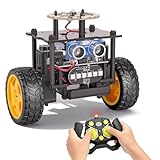
- 【EggTailz Smart Robot Car】This is an educational STEM toys for kids to get experience about electronics assembling and robotics knowledge. DIY assembly and construction will help to cultivate children's concentration and hands-on ability. It is a great combination of challenge and excitement, learning and fun
- 【Multi-functional STEM Toys for Ages 8-13】Equipped with ultrasonic radar allows the car to detect and avoid obstacles in real-time. Headlights for illumination, Taillights for warning, recreating the authentic driving experience. Plus an additional top ring-light, a dazzling light show is about to begin!
- 【Excellent Robot Toys for Children】Featuring advanced self-balancing technology, this 2WD toy car for kids can stays upright and self-corrects its angle. Built-in a rechargeable battery, eco-friendly and convenient—fully charges in 2 hours for 1-4 hours of playtime. Note : Remote control requires 2 AA batteries (Included)
- 【Double Modes, Double the Fun】Auto-Go Mode: the toy car autonomously explores and cruises around the room; Remote Control Mode: you can steer the toy car to forward, backward, turn left, turn right, and 360-degree rotation. Both modes feature radar obstacle avoidance capabilities, offering dual playstyles for twice the enjoyment
- 【Awesome Gift for Kids 8-12】Surprise your child with this awesome robotics kit. Great entertainment away from screens—get kids moving and thinking while reducing their reliance on electronic devices. Perfect educational toy gift for birthdays, Children's Day, Christmas, party, summer camps, back-to-school season, or family fun time
| Author-reported measure | What the post claims | How to interpret it |
|---|---|---|
| Cross-lingual grounding | 89% concept-level accuracy | A reported score for mapping multilingual descriptions to concepts in the proposed setup; the post does not establish accuracy across real maintenance teams or a representative field dataset. |
| Degradation prediction | 0.07 mean absolute error on a latent degradation scale | A simulated-model error claim. The post does not make this figure a physical measurement of actuator life or remaining useful service time. |
| Training data | Around 6,000 simulated telemetry hours | Simulated data, not an equivalent number of hours collected from deployed soft robots. |
| Downtime-budget violations | 23% for a neural-only planner | A comparison reported by the author; the post’s summary does not establish that the same rate would occur in real operations. |
| Planning time | Roughly 40% lower after applying a symbolic penalty during evaluation | An author-reported change in planning time under the described evaluation, not a general speedup guarantee. |
The post’s result listing says “Posted on Sep 29” but gives no clear year. Its account is first-person and describes the author’s experimentation; it is not an independently reviewed evaluation.
What does independent maintenance work establish?
“Counterfactual Enabled Neuro-Symbolic Digital Twins for Intelligent Industrial Maintenance,” published in Computers, Materials & Continua 88(3) in 2026, describes a digital-twin framework combining temporal-transformer time-series modeling, physics-informed constraints, counterfactual failure events and maintenance-policy optimization. Its experiments use 24,042 sensor measurements from CNC machines, pumps, compressors and robotic arms.
Rank #4

- Hands-On STEM Robot Learning---This STEM robot kit combines coding, electronics, and robotics into a fun, hands-on learning experience. Powered by an ESP32 controller and guided by 16 story-based tutorials, this robotics kit for kids helps children ages 8–12 and 12–16 build real-world STEM skills. Ideal for robotics for kids, classroom teaching, or at-home learning.
- 3 Programming Languages for All Skill Levels---This coding robot kit supports Scratch, Arduino, and Python, making it suitable for beginners and advanced learners alike. Scratch block coding is perfect for younger kids and first-time coders, while Arduino and Python support deeper learning for teens and tech enthusiasts. A flexible programmable robot designed to grow with students.
- Mobile-Friendly Coding – Learn Anytime, Anywhere---Unlike many traditional robot kits, this robotics kit supports programming on computers, laptops, tablets, and mobile devices like smartphones and iPads. Kids can code directly on mobile devices, making it especially suitable for schools, training centers, and self-learning at home. A practical STEM kit for kids in modern learning environments.
- Build Your Own Robot – Beginner-Friendly DIY---This robot building kit includes HD videos and illustrated step-by-step instructions, allowing kids to assemble the robot independently or with parents. No soldering required. The building process strengthens hands-on skills, patience, and confidence—making it a strong choice among STEM toys for kids and engineering kits for kids. Tutorial path: ACEBOTT Official Website → Resources → WIKI & Assembly Video Note: Batteries not included.
- App & Remote Control for Interactive Learning---Control the robot using the smartphone App (iOS & Android) or the included IR remote. Kids can instantly see how their code affects movement and behavior, reinforcing core coding logic. This robot kit keeps learning engaging while remaining easy to use for beginners.
That paper reports a 21.52-hour RMSE and an R² of 0.918 for remaining-useful-life results, 94.2% failure-prediction accuracy, and a 51.7% reduction in equipment failures versus its rule-based scheduling baseline. Those are results from the paper’s industrial-machine experiments. They are not measurements of soft robots, multilingual reports or the system described in Patel’s post, and they do not establish that the reported gains transfer to those settings.
The Tool Desk
Outbyte Driver Updater FREEScan for outdated or missing drivers - takes under a minuteDriver Scan →Outbyte PC Repair FREEClear out junk files and repair common Windows errorsFree Scan →Taken together, the robotics and industrial-maintenance publications make the broader design direction plausible: combine learned estimates with explicit constraints, validation or physical information. They do not show that a particular ontology, language aligner or planner is ready to maintain bio-inspired soft robots.
Best Value

- 4 INDIVIDUAL KITS INCLUDED: Perfect for group activities, family bonding, or classroom projects, this set includes 4 complete kits for endless fun and learning opportunities.
- HANDS-ON LEARNING FUN: Build your own robot! This STEM kit offers kids aged 8+ an exciting opportunity to learn about electrical circuits, robotics, mechanics, and engineering principles while assembling their robots.
- GREAT FOR STEM COMPETITIONS AND SCIENCE FAIRS: This kit is a fantastic tool for school projects, STEM challenges, and science exhibitions, helping kids stand out and succeed.
- INTERACTIVE & CREATIVE PLAY: Each robot is equipped with fun googly eyes and an electric motor, encouraging kids to engage in creative and interactive play while exploring STEM concepts.
- PERFECT GIFT IDEA: Whether it’s for a birthday, holiday, or a special occasion, this STEM kit makes a thoughtful and educational gift for boys and girls, sparking creativity and curiosity.
Why is multilingual grounding a consequential part of the design?
A maintenance report is not just a translation problem. Stakeholders may use different words for a component, symptom or failure mechanism, and a planner must connect those words to the right robot-specific concept before it can reason about a repair. A mistaken match could make a schedule internally consistent but based on the wrong diagnosis.
In Patel’s proposal, the semantic aligner bridges stakeholder language and the symbolic ontology, while confidence-triggered human labeling is described as a way to handle uncertain mappings. The post’s 89% concept-level figure is its own reported result; the reviewed independent sources do not establish a multilingual soft-robot maintenance benchmark, a validated ontology or demonstrated language coverage across sites. A score without details about test examples, language pairs, terminology review and error severity is not enough to infer operational reliability.
For a real deployment, teams would need to agree on terminology for each robot’s morphology, materials, components, symptoms and approved procedures. They would also need a defined escalation path for ambiguous reports, mismatched sensor evidence or low-confidence mappings. These are practical requirements for the proposed workflow, not capabilities independently demonstrated by the cited publications.
What would be needed before relying on it in a maintenance operation?
The evidence described here is insufficient to treat the proposed system as a validated maintenance authority. An organization considering this design would need to establish whether its representations, predictions and plans hold for the particular robot, procedures and operating environment.
- Robot-specific maintenance knowledge: verify that the ontology covers the actual actuator morphology, materials, failure modes and approved procedures. Generic references to silicone, pneumatic channels, fiber reinforcement or dielectric elastomers do not define a repair instruction.
- Representative evaluation data: test degradation estimates on telemetry tied to known physical conditions, and evaluate the language aligner on reviewed maintenance reports from the intended languages and sites. Simulation results alone do not show field performance.
- Explicit operational constraints: encode and validate relevant prerequisites, resource limits, downtime budgets and safety rules. A validator can only check the conditions represented in its rules; it cannot guarantee safety beyond them.
- Human review for uncertainty: decide which uncertain diagnoses or language mappings require a technician, and prevent an ambiguous input from silently becoming a repair action.
- Failure analysis and recovery: examine incorrect predictions and plan violations, define how a plan is stopped or revised, and assess whether a verified plan remains valid when the robot’s condition changes.
No directly supported commercial product, compatible part or validated soft-robot repair protocol is identified in the available material. The practical conclusion is therefore about a promising research direction and a proposed architecture—not a ready-to-install maintenance system.
Quick Recap
Product prices and availability are accurate as of the date/time indicated and are subject to change. Any price and availability information displayed on Amazon at the time of purchase will apply.

