
What’s actually slowing this PC down?
Pick the symptom - the matching free tool is one click away.
iTechGuides is reader-supported. When you buy through links on our site, we may earn an affiliate commission. As an Amazon Associate I earn from qualifying purchases. Learn more
The Arsia Mons Elongated Cloud is a vast water-ice cloud that repeatedly forms downwind of a Martian volcano. A 2026 study proposes that its unusual behavior can be explained by homogeneous nucleation: water vapor forming ice particles directly, without first condensing on dust or other particles. The team’s model reproduces important features of the cloud, but it is an explanation supported by modeling—not a direct observation of ice particles forming in the Martian atmosphere.
What is the strange cloud on Mars?
The Arsia Mons Elongated Cloud (AMEC) is a white water-ice cloud that appears downwind of Arsia Mons during spring and summer in Mars’s southern hemisphere. It is an orographic cloud, meaning airflow interacting with a mountain or volcano helps shape it. Arsia Mons is about 20 km tall, according to the European Space Agency (ESA).
ESA says the cloud develops and fades in a daily cycle over several months and can stretch up to 1,800 km. Its striking length and recurring appearance make it a distinctive feature of images of Mars. ESA’s overview of the cloud and the proposed explanation describes these observations and the new modeling.
What does “exotic physics” mean in this case?
It does not mean that the cloud requires quantum mechanics, relativity, or a new fundamental force. Here, “exotic physics” is shorthand for a surprising cloud-microphysics process: homogeneous nucleation. The term is unusual because this process is generally treated as theoretical and is not usually expected to occur naturally in an atmosphere.
#1 Best Overall

- 【Excellent Optics】Astronomical telescope features 80mm aperture 600mm(f/6.7) focal length-The big aperture can capture more light; high transmission multi-fully coated optical lens can improve light transmittance, reduce the reflection of light. It will bring you more bright and clear images.
- 【Portable & Stable】Our refractor telescope has a backbag, an adjustable aluminum tripod and an upgraded phone adapter. All accessories can be packed into the bag, which is convenient for you to carry and storage for traveling. The tripod is stable and the height can adjust from 17.7" to 52", which is suitable for adults and kids. With the phone adapter, you can take amazing photos through your phone.
- 【Easy to Operate】 This telescope is easy to assemble even for astronomy beginners and kids. You can set up easily with the detail installation manual and video. No tools are required. It’s a great astronomy gift telescope for adults, astronomy enthusiasts, beginners and kids 8-12.
- 【Optimum Magnification】Our telescope for kids and adults is equipped with two replaceable excellent-quality eyepiecesa (20mm and 9mm) for 30X and 66X magnification. A moon filter transmits only 13 percent of the incoming light and improving contrast. Also with 5x24 finderscope, you can locate objects easily. A great option for astronomy lovers to explore the moon, Saturn and Jupiter.
- 【Satisfaction Service】We provide 3 years satisfaction service. If you have any questions about the product and service, please feel free to contact us to get 24-hour technical support from our expert team. Whether observing moon or viewing planets, our telescope can meet your all needs. It’s a great telescope for adults & 8-12 kids & astronomy beginners.
The usual route: heterogeneous nucleation
In conventional heterogeneous nucleation, water vapor condenses onto a particle already suspended in the air, such as dust, salt, soot, or pollen. The particle provides a surface on which an ice particle can form.
The proposed route: homogeneous nucleation
With homogeneous nucleation, water vapor forms ice directly, without a pre-existing particle acting as a nucleus. ESA says this process requires extremely high relative humidity—over 100,000 times levels typically experienced in daily life on Earth. That figure describes the exceptional conditions required in the modeled scenario; it is not a direct measurement of humidity inside the cloud.
Rank #2
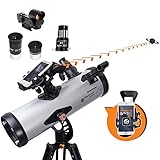
- SMARTPHONE-POWERED SKY TOUR: No experience needed! Just dock your phone, launch the StarSense Explorer app, and follow the on-screen arrows to locate stars, planets, nebulae, and more.
- PATENTED STARSENSE TECHNOLOGY: Unlike other astronomy apps, StarSense Explorer uses sky recognition technology to turn your phone into a celestial navigation system, analyzing star patterns overhead to pinpoint your telescope’s position.
- TONIGHT’S BEST TARGETS, INSTANTLY: The app generates a curated list of the top objects to see based on your time and location. See planets, bright nebulae, galaxies, and star clusters from the city—and even more from dark skies.
- SIMPLE SETUP, SMOOTH TRACKING: Features a manual altazimuth mount with altitude slow motion adjustment with a sliding rod. Follow the on-screen arrows to your target; when the bullseye turns green, you can view it clearly through the eyepiece.
- 114MM REFLECTOR WITH IMPRESSIVE VIEWS: The 4.5" Newtonian reflector with high-reflectivity coatings delivers sharp, vivid views of the Moon, planets like Jupiter and Saturn, and deep-sky favorites like the Orion Nebula and Andromeda Galaxy.
How might Arsia Mons make those conditions possible?
In the study’s modeled explanation, winds interacting with the volcano rapidly lift moist air. As the air rises, it cools, pushing its relative humidity high enough for water vapor to form ice directly. ESA reports that the model produces a temperature drop of 30 degrees in 10 minutes during this uplift.
The proposed chain is therefore: airflow encounters Arsia Mons, moist air rises and cools rapidly, and the resulting conditions allow homogeneous nucleation. The model’s central claim is that including this process helps explain the cloud’s distinctive form. The temperature change and humidity comparison are reported by ESA as features of the modeled conditions, rather than measurements taken directly within the cloud.
Rank #3
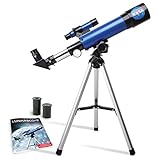
- INSPIRE CURIOSITY – The NASA Lunar Telescope allows your child to see the moon in incredible detail; the perfect gift for girls and boys interested in space, the moon, and astronomy!
- HIGH-QUALITY OPTICAL GLASS AND FINDER SCOPE – This easy-to-use telescope comes with a finder scope, low power, and high-power eyepieces; when used correctly, this combination will allow your child to easily locate the moon then zoom in for a close-up view.
- TABLETOP TRIPOD & SMOOTH MOUNT SYSTEM – Use the included tripod to steady your Lunar Telescope for optimal viewing, with a smooth mounting system that allows easy scanning of the entire lunar surface.
- PERFECT FOR BEGINNERS – This telescope is easy to assemble and use, making it ideal for young scientists and parents to enjoy together.
- AMAZON EXCLUSIVE - Blue Marble has developed this product exclusively for Amazon.
How strong is the evidence?
The case rests on a comparison between spacecraft observations and atmospheric modeling. The researchers added homogeneous nucleation to a Mars meteorological model and report that it reproduced important characteristics of the AMEC. ESA also notes that the model does not match every observed aspect exactly, so the explanation should not be treated as a complete, in-situ confirmation of how every part of the cloud forms or evolves.
The study, “Homogeneous ice Nucleation from Water Vapour Suggested by Elongated Clouds on Mars,” was published in Nature Geoscience, according to ESA’s 7 October 2026 announcement. The related arXiv preprint, submitted on 29 September 2026 under the title “Homogeneous Nucleation of Water Vapor Evidenced by Elongated Clouds on Mars,” states that adding homogeneous nucleation to a Mars meteorological model allowed the team to reproduce the cloud’s unique characteristics. That arXiv page says the preprint had not undergone peer review at the time represented there; this is distinct from ESA’s report that the paper was published in Nature Geoscience.
Rank #4

- 【Ultra-Light Design for All Adventures】Only 3lb/1.35kg - World's Most Portable Smart Telescope! Fits perfectly in standard backpack for travel. Ideal for spontaneous stargazing trips and outdoor adventures. Take it anywhere, anytime!
- 【Dual Imaging System for Day & Night】Advanced Dual Lens Design: Telephoto lens masters wildlife & landscape & deep space objects, while wide-angle lens captures Milky Way & star trails. In daytime, telephoto for subjects, wide-angle for target location. Perfect dual-camera imaging solution!
- 【Smart Auto-Tracking & 4K Clarity】Professional 4K Auto-Tracking ensures crystal-clear shots of stars, planets, and wildlife. Advanced system automatically follows celestial objects and moving subjects for stunning results every time.
- 【Cloud-Powered Image Processing】One-touch processing through dedicated DWARFLAB App with cloud computing power. Instantly enhance your photos - no PC or complex software needed. From capture to stunning final image in minutes!
- 【Easy-to-Master for All Ages】Perfect for beginners to experts (6-98 years)! Start amazing astrophotography in just 2 minutes. Intuitive app interface and automatic features make professional imaging accessible to everyone.
Why the proposed explanation matters
If homogeneous nucleation is occurring in the AMEC, it would show that an atmospheric process usually considered unlikely can happen under conditions on another planet. It also offers a concrete way to investigate an unusual Martian cloud: test whether models that include direct ice formation better reproduce the observed cloud than models that rely only on condensation around existing particles. The result is intriguing, but the model’s remaining differences from observations matter when judging how settled the explanation is.
Recommended Free Tools
Quick Recap
Product prices and availability are accurate as of the date/time indicated and are subject to change. Any price and availability information displayed on Amazon at the time of purchase will apply.

