
Free tools Windows power users keep installed
One-click scans. No signup required.
iTechGuides is reader-supported. When you buy through links on our site, we may earn an affiliate commission. As an Amazon Associate I earn from qualifying purchases. Learn more
Gold nanoparticles can be recovered from nanowaste and used to make new nanoparticles, according to a laboratory proof of concept published in 2016. The method uses α-cyclodextrin to help separate gold after it has been converted into a soluble bromide complex. It is promising chemistry, not a ready-to-use recycling service: the process also uses strong acids, and its environmental benefits depend on recovery rates and energy-intensive steps.
How the gold-recycling method works
Pati, McGinnis, and Vikesland studied how to recover gold from nanowaste—including gold nanoparticles—and reuse it to produce new nanoparticles. Their method adapts an α-cyclodextrin-based approach to gold recovery. The 2016 paper describes the work as laboratory-scale.
- Convert the gold into a soluble complex. The gold-bearing material is treated with potassium chloride, hydrobromic acid, and nitric acid, converting the gold into tetrabromoaurate, [AuBr₄]⁻.
- Add α-cyclodextrin. It facilitates formation of a host–guest complex involving [AuBr₄]⁻ and [K(OH₂)₆]⁺.
- Separate the gold-containing material. The complex precipitates and can be filtered out.
- Recover gold for reuse. The gold is extracted from the precipitate and reduced to metallic gold, which can then be used to synthesize new gold nanoparticles.
The Chemistry World report also describes possible application to alloy scraps and electronic waste. That is reported laboratory applicability or potential—not evidence of a commercially deployed recycling service. Chemistry World’s 2016 report and the 2016 paper in Environmental Science: Nano provide the method’s context.
What’s actually slowing this PC down?
Pick the symptom - the matching free tool is one click away.
What the environmental assessment found
The authors used a life-cycle assessment to model gold-nanoparticle production without recycling and under scenarios recovering 10%, 50%, or 90% of the gold. These percentages are modeled recovery fractions, not a claim that every real-world batch achieves those yields. In the studied process, recycling could reduce impacts in some assessed categories, with the results depending on recovery assumptions and process inputs.
#1 Best Overall
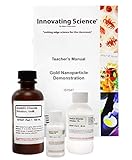
- Kit demonstrating a reduction reaction
- Solution undergoes multiple color changes before forming colloidal gold nanoparticles
- Great demonstration for chemistry classrooms and labs
- Kit contains enough material to perform the demonstration 5 times
- Includes SDSs for all materials, teacher's manual, and student study guide copymasters
Energy use and nitric-acid removal
One consequential process step was removing nitric acid by boiling it off before producing new nanoparticles. In the laboratory process inventory, this step used about 17 times the energy required for gold recovery. That is a process-specific comparison, not a general ratio for gold recycling. It identifies a potential process-design improvement: reducing or avoiding the energy burden of acid removal could change the assessment.
Environmental trade-offs
The model did not show a benefit in every category. In its modeled scenarios, the nitric-acid removal step increased fossil-fuel depletion relative to the no-recycling case, even as recycling improved other assessed impact categories. The authors also identified acid use and energy consumption as influential factors. The findings apply to the life-cycle model for this gold-nanoparticle process; they do not establish that recycled gold is always more environmentally favorable than newly sourced gold.
Rank #2
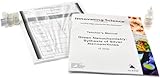
- Synthesize silver nitrate nanoparticles using renewable materials
- Benign reagents ensure safe application of chemistry
- Materials for 15 groups of students for hands-on learning
- Suitable experiment for students at the middle school level and up
- Kit includes teacher's guide, student copymasters, and material safety data sheets (MSDS)
The paper included 1,000 Monte Carlo runs in its uncertainty analysis. That helps evaluate uncertainty within the model, but it does not turn the modeled scenarios into measurements of commercial-scale performance.
Crashes, No Sound, or Screen Glitches?
Random freezes, missing sound and display glitches usually trace back to one bad driver. Find and replace yours safely.Free scan · under a minutePC Slower Than It Used to Be?
A free scan shows the junk files, broken settings and background clutter dragging Windows down - then fixes them in one click.Free scan · Windows 10 & 11What the study does—and does not—establish
- It demonstrates a laboratory recovery-and-reuse concept: gold from nanowaste can be recovered through α-cyclodextrin-assisted precipitation and reused to make nanoparticles.
- It does not establish commercial readiness: the authors explicitly describe the work as lab-scale proof of concept. The study does not show that a commercial plant or consumer service uses this process.
- It is not a home recycling procedure: the workflow uses nitric acid and hydrobromic acid as well as other chemicals. The authors call α-cyclodextrin “benign” in context, but that description does not apply to the full process. The paper is not guidance for safely carrying out the chemistry.
- Its environmental conclusion is conditional: recovery fraction, acid handling, and energy demand affect the modeled outcome. A favorable result in one impact category does not settle the overall comparison.
How to assess later gold-recycling claims
Gold-recycling studies can address very different feedstocks and outcomes. A process for electronic scrap is not directly comparable to one for nanoparticle waste, and a modeled reuse pathway is not the same as demonstrating recovery and reuse in practice. When comparing a later study with this one, check:
Rank #3

- LEARN TO PAN FOR GOLD – Everything kids need to become a junior prospector is included! Start by sifting through paydirt to find real pyrite (fool’s gold), then take your new skills outdoors to hunt for actual gold in nature.
- PAN FOR REAL PYRITE SPECIMENS – Unearth the excitement of real gold prospecting! The paydirt in this kit is loaded with genuine fool’s gold, offering kids the thrilling experience of discovering their first treasure.
- EVERYTHING INCLUDED – This complete gold panning kit features a pan, pipette, tweezers, storage container, magnifying glass, and specimen dish—everything is reusable, so kids can continue their treasure hunt outdoors!
- KID-FRIENDLY INSTRUCTIONS & LEARNING GUIDE – Easy-to-follow panning instructions paired with a Learning Guide full of fascinating facts about the California Gold Rush and fool’s gold make learning fun and engaging.
- AWARD-WINNING PRODUCTS - Blue Marble, winner of the Toy Association's prestigious Toy of the Year Award, proudly develops products that foster education, imagination, and creativity, with a U.S. support team to ensure a stellar experience!
- What the incoming material is: nanowaste, electronic scrap, alloy scrap, or another stream.
- Whether the researchers recovered and reused gold experimentally, or only modeled that possibility.
- The recovery fraction and whether it was measured or assumed.
- The chemicals and energy required, including any treatment or removal steps.
- The scale of the work and the boundaries of its life-cycle assessment.
- Which environmental impact categories improved and which worsened.
A 2024 paper by Kang and colleagues continues research into reusable gold nanoparticles and α-cyclodextrin-based reuse strategies. Its publication indicates ongoing research, but does not by itself establish that the 2016 recovery method is commercially ready. The 2024 paper’s landing page describes that later work.
Quick Recap
Best Value
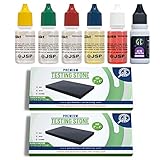
- ALL-IN-ONE GOLD AND SILVER TESTING & APPRAISAL KIT
- FUN, FAST, AND ACCURATE! DETERMINES THE KARAT OF GOLD AND SILVER JEWELRY IN SECONDS!
- 2 AUTHENTIC *LARGE* GTE 2''x 4'' JEWELRY TOUCHSTONES FOR SAFE TESTING THAT WON'T DAMAGE YOUR JEWELRY
- BONUS* GTE NEUTRALIZER QUICKLY CLEANS STONE
- A MUST-HAVE FOR ANYONE WHO WANTS TO INVEST IN GOLD AND SILVER
Rank #4

- Stansport - Yukon Gold Prospecting Kit
- Kit includes 10.5" and 14" gold pans
- 2 gold vials (1 oz. and 1/2 oz.)
- Hand trowel, plastic 3/8" mesh classifier and snuffer bottle
- Precision tweezers with magnifier and resource book
Product prices and availability are accurate as of the date/time indicated and are subject to change. Any price and availability information displayed on Amazon at the time of purchase will apply.

