
Do these 3 things before closing this tab:
1Clear out junk files and repair common Windows errors2Fix the driver behind crashes, sound loss and screen glitches3Repair Windows errors before they cause bigger problemsiTechGuides is reader-supported. When you buy through links on our site, we may earn an affiliate commission. As an Amazon Associate I earn from qualifying purchases. Learn more
Engineered ridges can make a water drop leave a superhydrophobic surface sooner by redirecting how the liquid spreads and recoils. In a 2013 laboratory study, a macrotextured surface produced a 7.8-millisecond contact time in a representative experiment, compared with 12.4 milliseconds on a control surface. The finding shows how surface shape can change a drop’s motion; it does not establish a commercial coating or a proven aircraft anti-icing system.
Why contact time matters when a drop bounces
After striking a superhydrophobic surface, a drop spreads into a thin shape, retracts, and may rebound. The interval it spends touching the solid is called contact time. Shorter contact can limit the time available for exchanges of mass, momentum, and energy between the drop and surface.
Earlier efforts to shorten contact time focused on reducing interactions and pinning where the drop’s edge meets the surface. The conventional expectation was that symmetric spreading and recoil imposed a hydrodynamic lower limit. Bird, Dhiman, Kwon, and Varanasi showed that changing the surface’s larger-scale shape could alter the flow and bring contact time below that assumed limit.
How a ridge changes the drop’s recoil
A ridge beneath an impacting drop redistributes liquid rather than allowing it to spread and retract uniformly in every direction. The liquid layer over the ridge becomes thinner than nearby portions, and that thinner section retracts faster. The resulting motion is non-axisymmetric: instead of recoiling as one broad, radially symmetric mass, the liquid divides into smaller regions that travel shorter distances before detaching.
#1 Best Overall

- HANDS-ON WATER FILTRATION: Kids can build their own water filtration and distillation plant, providing a practical understanding of how clean water is produced and the science behind water purification.
- SOLAR POWER DISINFECTION: The kit teaches children how to disinfect water using solar power, promoting renewable energy concepts and demonstrating sustainable practices in water resource management.
- COMPREHENSIVE EXPERIMENTATION: Includes a detailed booklet with suggested experiments and activities, allowing for a variety of hands-on learning experiences that reinforce the principles of clean water science.
- ENVIRONMENTAL AWARENESS: Features alarming water facts that educate children about environmental issues and the importance of protecting clean water resources, fostering a sense of responsibility toward the planet.
- PERFECT FOR ALL SETTINGS: The kit includes clear instructions and all necessary materials, making it simple for children to conduct experiments safely and effectively. STEM powered learning.
The authors described the principle in the abstract of their paper, “Reducing the contact time of a bouncing drop”: “Here we demonstrate that it is possible to reduce the contact time below this theoretical limit by using superhydrophobic surfaces with a morphology that redistributes the liquid mass and thereby alters the drop hydrodynamics.” The paper’s authors are James C. Bird, Rajeev Dhiman, Hyuk-Min Kwon, and Kripa K. Varanasi.
Contact times reported in the 2013 experiments
Nature’s supplementary material gives representative experimental timings for three surfaces. These are examples from the study’s conditions, not universal performance specifications.
Rank #2

- STATIC ELECTRICITY & LIGHTNING FORMATION: Discover the power of static electricity by making hair stand on end and bending water with a charged balloon. Simulate lightning just like in real storm clouds.
- CLOUD FORMATION & EVAPORATION SCIENCE: Use an air pump to create instant clouds in your palm and watch them disappear as they "evaporate." This activity demonstrates the processes of condensation and evaporation.
- GREENHOUSE EFFECT: Trap heat using CO2 produced from baking soda and vinegar in this hands-on demo of the greenhouse effect. See firsthand how global warming works and understand its impact on Earth's climate.
- WATER CYCLE & ECOSYSTEM IN ACTION: Build a desktop water cycle model featuring a cloud-covered mountain. Watch as rain forms and grows a bean plant in a self-contained ecosystem—a practical demonstration of the water cycle.
- WIND CONVECTION: Conduct eco-experiments like testing the harmful effects of acid rain on plants using vinegar. Explore wind convection by observing warm air rise and spin a paper spiral, simulating real wind patterns.
| Surface | Representative contact time |
|---|---|
| Micropillar array | 18.0 ms (Nature supplementary material, 2013) |
| Control surface | 12.4 ms (Nature supplementary material, 2013) |
| Designed macrotextured surface | 7.8 ms (Nature supplementary material, 2013) |
In the simplest geometry, Varanasi told Chemistry World that contact time fell by approximately 40%. He also described larger reductions as a research goal, not as an achieved result in that statement. The percentage and the timings above refer to different descriptions of the experiments and should not be treated as a general rating for textured surfaces.
What the molten-tin demonstration showed
The supplementary material also describes a specific molten-tin test. A droplet at 250 °C bounced from a macrotextured ridge in 6.8 ms under the reported conditions, while a droplet on the unridged substrate stuck after local solidification. This demonstrates behavior in that experiment; it does not establish performance across other materials, temperatures, or operating environments.
Rank #3

- Science Kits for Kids 3-5: Science kit provides plenty of fun and learning for kids. Through the use of test tubes and droppers to conduct various kinds of fun science experiments, children can not only experience the charm of chemical reactions, but also cultivate meticulous observation, accurate operation ability and independent thinking of scientific research spirit
- Test Tubes: Science experiment kit is made with high-quality plastic material without the risk of breaking glass and cutting your little hand. BPA-free, easy to clean, smooth and rounded edges design makes kids safer while playing, and parents no longer worry about scratches during role playing
- Science Experiments for Kids 4-6: Science experiment kit is made of safe and environmentally friendly materials. Water dropper is crystal clear, like a window to the microscopic world, and the subtle changes of each reaction can be clearly observed. Educational science kits are designed ergonomically for kids and is small and lightweight for small hands to grasp
- Kids Chemistry Set: Kids absolutely love experimenting with authentic tools and trying new creative toys, games and activities. Children can use common household items for additional experimentation and discovery while cultivating academic achievement. Little chemists can safely explore simple scientific principles with this tool-and-journal set
- Kids Science Kit: Toddler science kits are a great gift choice for Birthdays, Christmas, and other holidays for kids & toddlers over 3 years old. Open the door of science with kids' test tubes and droppers, lead kids to perceive the mystery of science between drops, experience the fun of experiments, and ignite the scientific dream in the heart
Could faster rebound help prevent icing?
Reducing the time a drop remains on a surface could be useful where liquid water is a problem. The Nature abstract identifies resistance to icing as a motivation for water-repellent surfaces, and Chemistry World named freezing rain on aircraft engines as a potential application. Those are possible uses, not a validated deployment: the cited reporting does not establish a commercial engine coating or an aircraft anti-icing system based on this work.
What natural surfaces do—and do not—show
The study’s supplementary video description notes non-axisymmetric recoil on a Nasturtium leaf and a Morpho butterfly wing, whose ridges or veins can trigger similar motion. That observation does not show that either natural structure evolved for this particular function; Chemistry World characterized that interpretation as speculative.
Rank #4
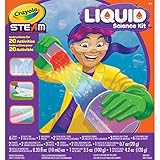
- LIQUID SCIENCE KIT: Includes supplies for 15 science labs, used in combination with common household items.
- STEM ACTIVITIES: 15 out-of-the-box experiments inspired by STEAM and STEM learning.
- STEP-BY-STEP INSTRUCTIONS: Easy, full-color instructions for kids to follow along. Adult supervision is recommended.
- EDUCATIONAL TOY: Crayola STEAM kits are perfect for educational play and at home learning!
- GIFT FOR KIDS: A great kids toy for ages 8 & up.
The paper behind the result
James C. Bird, Rajeev Dhiman, Hyuk-Min Kwon, and Kripa K. Varanasi, “Reducing the contact time of a bouncing drop,” Nature 503, 385–388 (2013). Nature lists the paper as published on 20 November 2013, with an issue date of 21 November 2013. View the paper record at Nature.
The Tool Desk
Outbyte Driver Updater FREEFix the driver behind crashes, sound loss and screen glitchesFind Drivers →Outbyte PC Repair FREERepair Windows errors before they cause bigger problemsFix Now →Quick Recap
Best Value
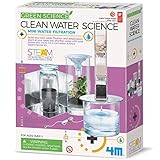
- This personal desalination kit demonstrates the scientific way to extract salt from sea water.
- The kit contains a plastic filter system, active carbon, sand, rock and filter paper.
- Perfect for young science enthusiasts, especially those with an interest in chemistry and the environment.
- Detailed instructions for use and care are included.
- Recommended for ages 8 years and up.
Product prices and availability are accurate as of the date/time indicated and are subject to change. Any price and availability information displayed on Amazon at the time of purchase will apply.

