
Quick wins for a faster PC:
Scan for outdated or missing drivers - takes under a minuteDriver Scan →Repair Windows errors before they cause bigger problemsFix Now →Fix the driver behind crashes, sound loss and screen glitchesFind Drivers →iTechGuides is reader-supported. When you buy through links on our site, we may earn an affiliate commission. As an Amazon Associate I earn from qualifying purchases. Learn more
A colour change can help chemists quickly screen many visible-light photocatalytic reactions, but it is a proxy—not a universal substitute for chromatography or mass spectrometry. In a 2016 study, Michal Poznik and Burkhard König used indicators to detect common reaction by-products across 96 reactions in a microtiter plate. The signal correlated with conversion or product yield in many cases, making it useful for finding promising candidates that warrant closer analysis.
How can a colour change show whether a photocatalytic reaction worked?
The key is to look for something reactions may share, rather than trying to make one indicator identify every possible product. Different photocatalytic reactions can form very different products, but may produce common stoichiometric by-products, including reactive oxygen species or protons. An indicator responds to those by-products, producing a measurable colour signal.
Poznik and König’s method irradiated reactions in a microtiter plate, then added an indicator to detect the by-products spectroscopically. Because the amount of a by-product correlated with starting-material conversion or product yield in many cases, the signal could help flag promising reactions. The relationship is not universal: a colour response does not directly identify a product or establish its yield in every reaction.
What did the 2016 study demonstrate?
The paper reports parallel irradiation and evaluation of 96 visible-light photocatalytic reactions in a microtiter plate. That is the demonstrated capacity of this particular workflow, not a general limit for high-throughput chemistry.
#1 Best Overall

- 1.Horizontal compression measurement, physical positioning observation window. During the measurement process, you can follow the observation windowCheck the measurement position at all times to avoid measurement position errors.
- 2.Provide printing-specific measurement indicators:Color density measurement, dot area measurement, overprint rate measurement, printing contrast measurement, hue error and grayscale measurement.
- 3.The CMYK 2 Color Densitometer adopts high-precision nanometer spectroscopic devices, which enables the repeatability accuracy of the instrument to reach a level of dE*ab≤0.02 that is difficult to match with similar products.
- 4.The CMYK 2 Color Densitometer supports 3 apertures, Φ11mm,Φ5mm, Φ3mm, and can be flexibly applied to a variety of samples of different sizes and testing conditions.
- 5.CMYK 2 Color Densitometer provide spectral reflectance, CIE-Lab, CIE-LCh,ΔE*ab, covering power, whiteness, yellowness and other 30+ measurement indicators; A, B, C,There are nearly 40 evaluation light sources to choose from such as D50, D55, and D65.
- Photooxidation: The authors used riboflavin tetraacetate (RFTA) in known photooxidation reactions and report reproducing published results and gas-chromatographic analyses with the colorimetric assay.
- Boronic-acid hydroxylation: The screen identified two photocatalysts for hydroxylating boronic acids.
- Aryl-radical generation: It helped identify new substrates for photocatalytic aryl-radical generation from aryl halides.
- Dehalogenation: The authors found photochemical dehalogenation reactions among screened aryl-halide-containing drug molecules. Selected indicator results were checked by gas chromatography.
The study appeared in Reaction Chemistry & Engineering in 2016 (volume 1, pages 494–500; DOI 10.1039/C6RE00117C). The institutional repository record identifies it as peer reviewed. Chemistry World’s 5 August 2016 feature introduced the screening idea to a broader audience.
What does the colour assay tell you—and what does it not?
It tells you whether the measured by-product signal is consistent with reaction progress under the conditions of the assay. The paper describes the resulting readouts as semi-quantitative, with correlation to conversion or yield in many—not all—cases.
Rank #2

- Scan any object or surface to instantly match to 300,000+ brand name paints.
- Not just for paint - Instant RGB, HEX, CMYK and more digital color values.
- 95%+ hit rate on top paint brands including Benjamin Moore, Behr, PPG, Valspar, Sherwin-Williams and more. Paint libraries vary by country region.
- Get instant matches to Pantone, RAL and NCS premium databases.
- Scan instantly and for years to come with no calibration required + dust and water resistance (IPX4 rating).
It does not, by itself, provide the compositional detail of chromatography or mass spectrometry. A colour response is not proof of isolated-product identity, and the method should not be treated as a guaranteed yield measurement for every reaction. Its role is to help prioritize candidates and support early optimization, with more detailed analysis used when the decision requires it.
What’s actually slowing this PC down?
Pick the symptom - the matching free tool is one click away.
How does colorimetric screening compare with chromatography or mass spectrometry?
| Consideration | Colorimetric screening in the study | Chromatography or mass spectrometry |
|---|---|---|
| Parallel workflow | Demonstrated evaluation of 96 visible-light photocatalytic reactions in a microtiter plate | The paper describes these methods as analytical options, without giving a comparable throughput figure |
| What is measured | An indicator response to common stoichiometric by-products | More direct and detailed analysis of reaction composition |
| Analytical detail | Semi-quantitative screening signal; correlation with conversion or yield in many cases | More accurate and detailed evaluation, according to the paper |
| Best suited to | Rapidly prioritizing reactions for follow-up | Decisions that require more detailed compositional evidence |
The trade-off is analytical detail for accessible parallel screening. Chromatographic methods such as gas chromatography and high-performance liquid chromatography, and mass spectrometry, require instruments and analysis that may not be available in every laboratory. The colorimetric approach can make an initial screen more practical, but it does not eliminate the value of those methods for confirmation.
Rank #3

- PRECISION PAINT COLOR MATCHING: The Spectro 1 Pro spectrophotometer (espectrofotometro) is a professional-grade color reader for paint matching, delivering lab-level accuracy in a portable design. This high-performance colorimeter, spectrometer, and color sensor captures exact shades to ensure consistent color matches every time.
- WHAT’S INCLUDED & PORTABLE DESIGN: This paint color matching tool comes complete with the Spectro 1 Pro device, USB charging cable, and protective carrying pouch. Lightweight and compact, this handheld color meter is designed for portability and convenient, making it the ideal paint scanner and color reader for designers, painters, and contractors.
- FEATURES & TECHNOLOGY: Built with precision sensors and professional-grade colorimeter components, this color reader for paint delivers consistent readings across multiple surfaces and lighting conditions. The integrated spectrometer technology ensures accurate paint color matching while supporting fan deck libraries from major paint brands.
- EASY-TO-USE WITH WIRELESS CONNECTIVITY: Simply scan with the portable colorimeter to capture color data instantly, then connect wirelessly to the Spectro App on iOS or Android. This paint color matching tool simplifies the workflow for painters, designers, and DIY users, allowing fast, on-the-go paint scanner results without guesswork.
- COLOR MATCHING SOLUTION: Engineered for versatility, the Spectro 1 Pro paint color reader and spectrophotometer delivers consistent accuracy for painters, designers, and contractors. Whether used as a spectrometer, colorimeter, or portable color sensor, this paint scanner provides precise paint color matching across multiple applications.
When should a lab use this kind of screen?
It is most useful when many reaction conditions need an initial comparison and a relevant common by-product can be monitored. A promising signal can guide which reactions deserve further work; a final characterization or yield decision may still call for chromatography or another detailed analytical method.
The central idea is modest but useful: one indicator need not recognize every product if a shared by-product can serve as a workable proxy. That can make early photocatalyst and substrate screening more accessible without confusing a screening signal with a full analysis.
Quick Recap
Best Value
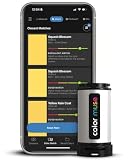
- SIMPLE AND PORTABLE - Scan any flat surface to find the closest matching paint colours and products in the Color Muse app. Color Muse pairs to the app via wireless so that you can scan colours anywhere.
- MATCH WITH CONFIDENCE - Trust that you’re getting accurate colour matches with an accuracy rate of over 90%. Spot touch-ups are not recommended. Colour matches may be used for wall-to-wall painting. For best results, scan a smooth, flat surface. Scanned colours may vary from what’s displayed on your phone screen.
- LARGE PRODUCT LIBRARY - The Color Muse app includes paints and products from Sikkens, Farrow & Ball, PPG, Dulux, Sherwin-Williams, Benjamin Moore, Color Is, Dulux, Munsell, and other leading brands.
- COORDINATE, SAVE, SHARE - Find coordinating colours, inspiration photos, and even your scan’s HEX, CMYK, RGB, LAB, LCH, LRV, HSB, and HSV colour values in the Color Muse app. Save and share your favourite colours.
- COMPARE - Compare two colours side-by-side or see how close your colour matches to the available products. You can compare RGB, CMYK, Lab values, and more.
Rank #4
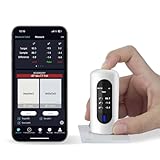
- 【APPLICATIONS】This mini color reader is designed for color recognizing. One simple click is enough to measure the color values, as a color scanner, it makes work easier especially for painters, designers and DIY.
- 【MULTI-FUNCTIONAL】Work with or without APP. Equipped with a IPS full color screen of 1.14 inch, this colorimeter can work alone if not connected to the APP, pass or fail judgment can be seen directly. It can capture, match, compare, save and share colors.
- 【SIZE & WEIGHT】You may need to measure different colors in different places, this spectrophotometer is 85mm in height and 34mm in diameter, weight only 75g, We suppose you don’t want to carry a heavy color card with you, so just put this portable wireless color sensor in your pocket.
- 【FEATURES】Easy connected to Android, IOS, Windows via Bluetooth, The built-in rechargeable battery gives 7,000 times of measurement after a fully charge. Auto calibration design for easier and correct color test.
- 【ABOUT APP DOWNLOAD AND REGISTRATION】The name in the APP Store is "ColorMeter". Google Play Store is still under review. You can scan the QR code in the manual to download the APK file. It is safe and secure. When you register, you need to enter an email (we recommend using Gmail or Outlook) and click "Get verification code". At this time, you need to find a 4-digit verification code in the email, fill it in the APP registration page, and then enter a password.
Product prices and availability are accurate as of the date/time indicated and are subject to change. Any price and availability information displayed on Amazon at the time of purchase will apply.

