
iTechGuides is reader-supported. When you buy through links on our site, we may earn an affiliate commission. As an Amazon Associate I earn from qualifying purchases. Learn more
The biggest hurdles to Internet of Things (IoT) adoption are integrating devices with existing systems, making products interoperate, managing cybersecurity and privacy risks, justifying total costs, and finding the skills to deploy and operate systems safely. These are recurring concerns in a 2024 U.S. IoT Advisory Board report, not a statistically ranked list that applies to every country or type of user.
What the 2024 evidence says—and what “top” means
The NIST-managed Internet of Things Advisory Board’s October 2024 report identifies overlapping barriers to realizing IoT’s benefits in the United States. NIST’s summary describes 26 findings grouped into six themes and reports that the board made 104 recommendations. Those counts describe the report’s findings and recommendations; they do not rank hurdles by prevalence.

Cross-country evidence points to a different kind of limitation: surveys do not always define IoT or measure non-use in the same way. The OECD notes that national surveys vary in definitions, examples, and scope, so their results cannot be treated as one universal league table. Its business surveys include reasons such as no identified need, limited skills, cost, security and privacy concerns, legal concerns, inadequate connectivity, incompatibility, and unclear business models. NIST’s October 2024 summary and the OECD’s cross-country discussion therefore support identifying major hurdles, not asserting a global order of importance.
Outdated Drivers Are Slowing You Down
One free scan finds every outdated or missing driver and matches the right update for your exact hardware.Free scan · exact hardware matchWindows Errors? Fix Them Before They Spread
Repair common Windows errors and clear accumulated junk for a smoother, more stable PC - no reinstall needed.Free scan · no reinstallWhy IoT projects are difficult to integrate
An organisational IoT project is usually more than buying connected devices. Hardware from different suppliers, platforms, connectivity services, and software must be assembled for a specific use, then connected to established enterprise systems and operational technology (OT). Existing processes and infrastructure may not have been designed for that arrangement.
#1 Best Overall

- Dual-Core Performance Up to 240 MHz: Run sensor processing, wireless communication, automation logic and connected-device tasks on a 32-bit dual-core ESP32 platform designed for responsive embedded and IoT projects
- Built-in Wi-Fi and Bluetooth 4.2: Connect to 2.4 GHz Wi-Fi networks or use Bluetooth Classic and BLE for wireless sensors, smart devices, remote controls, home automation and other connected projects
- Flexible Power-Saving Modes: ESP32 power-management features support dynamic clock scaling and low-power operating modes, helping developers reduce energy use in compatible sensing, monitoring and connected-device applications, suitable for battery-powered Internet of Things (IoT) devices.
- USB-C Programming with CP2102: Connect through USB-C for power, sketch uploads and serial monitoring, while GPIO, UART, SPI and I2C interfaces support sensors, displays, motor drivers and other modules (USB-C cable not included)
- Over-the-Air Update Support: Configure OTA functionality through a compatible ESP-32 software framework to update deployed firmware over Wi-Fi without reconnecting the board by USB for every revision
That work can make deployment complex, costly, and dependent on specialist skills. In industrial, healthcare, and other enterprise environments, a retrofit can require teams to fit new systems around existing equipment and workflows without disrupting operations. The IoT Advisory Board identifies complexity and integration with legacy infrastructure as recurring barriers.
Why interoperability can be a separate obstacle
Integration is the work of fitting a solution into an organisation’s environment; interoperability is whether its devices and systems can communicate and exchange data reliably in the first place. IoT products may not work smoothly across systems when standards are missing, when competing standards divide the market, or when a provider’s closed ecosystem limits connections to other products.
Rank #2

- Certified & Future-Ready: Espressif-certified ESP32-WROOM-32E ensures full hardware compatibility and lifetime firmware support. Upgraded 8MB Flash handles IoT data and OTA updates.
- Dual-Core Speed: 240MHz dual-core processor runs Wi-Fi/BLE and sensors 2x faster. 38 GPIO pins (10 RTC) support SPI/I2C/UART for LCDs, motors, and industrial sensors.
- Plug & Play Dev: USB-C driver pre-installed: upload code instantly on Windows/Mac/Linux. Works with Arduino IDE, MicroPython, and Espressif IDF.
- All-Environment Ready: Run Wi-Fi smart switches (Home Assistant) and BLE tracking on one board. Industrial-grade stability (-40°C~85°C) for outdoor/automated systems.
- Advantages: The ESP32 development board offers high performance, low power consumption, and rich wireless connectivity, making it suitable for developers of all levels, especially beginners.
That makes interoperability a procurement and lifecycle concern, not just a connectivity checkbox. A device that works on its own may still be a poor fit if it cannot exchange information with the organisation’s other devices, software, or OT systems. The board identifies these standards and “walled ecosystem” problems as part of IoT’s adoption challenge.
Free tools Windows power users keep installed
One-click scans. No signup required.
How security, privacy, and trust affect adoption
Every connected device can add another potential access point to a larger system. An attack may disrupt device operations or provide a path toward connected back-office or enterprise systems. Organisations handling sensitive information or operating critical infrastructure may therefore be especially cautious. The board also notes that manufacturers have not all adopted secure-by-design or secure-by-default practices; this does not mean that every IoT device is insecure.
Rank #3
Privacy and confidentiality concerns are related to, but distinct from, cybersecurity. Organisations must consider what data a system collects, how it is handled, and which rules apply in the relevant sector and use case. The board’s findings, as summarized by NIST, say that “IoT cybersecurity concerns are a major barrier to widescale adoption” and that “Privacy concerns undermine trust in IoT and are a significant barrier to widescale adoption.” These are the board’s findings reproduced in NIST’s October 22, 2024 summary.
Trust also depends on whether a system operates reliably, produces outcomes users can rely on, and can be supported by resilient supply chains. The board includes vulnerable global chip supply chains among its concerns; that is a risk to account for, not evidence that all supply chains are compromised.
Rank #4

- 2.4GHz Dual Mode WiFi + Bluetooth Development Board
- Support LWIP protocol, Freertos
- SupportThree Modes: AP, STA, and AP+STA
- Ultra-Low power consumption, Compatible with Arduino IDE
- ESP32 is a safe, reliable, and scalable to a variety of applications
Why the total cost can exceed the device price
Upfront device and infrastructure spending is only part of the financial decision. Organisations may also need integration, deployment, implementation, and ongoing operational capability. The IoT Advisory Board’s October 2024 report estimates that the IoT solution represents 30% of total cost, while implementation and deployment account for the other 70%. This is the report’s estimate, not a universal ratio for every project.
The business case can be harder to establish when benefits are uncertain, the organisation lacks complementary digital capabilities, or a workable business model is unclear. OECD business surveys also identify service, equipment, and implementation costs as reasons firms may not use IoT.
Best Value
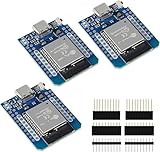
- D1 Mini NodeMCU Type-C ESP32 WLAN WiFi Bluetooth IoT Development Board 5V Compatible for Arduino
- Designed with ultra-low power technology, it offers the full range of performance and features of the ESP32 chip. The pin arrangement provides compatibility with the modules developed for the D1 Mini ESP8266 while also offering fast WLAN, enhanced GPIO, Bluetooth functionality, and with its higher performance, a wider range of applications.
- 100% compatible with Arudino IDE, Lua and Micropython, it shows robustness, versatility, and reliability in a wide variety of applications and power scenarios.
- All I/O pins have interrupt, PWM, I2C and one-wire capability, except the pin DO.
- Designed with ultra-low power technology, it offers the full range of performance and features of the ESP32 chip. The pin arrangement provides compatibility with the modules developed for the D1 Mini ESP8266 while also offering fast WLAN, enhanced GPIO, Bluetooth functionality, and with its higher performance, a wider range of applications.
Where workforce skills become a bottleneck
The capability gap extends across an IoT system’s lifecycle. The skills identified in NIST’s summary include developing, integrating, deploying, operating, and maintaining devices, systems, and applications. Cybersecurity and privacy expertise are part of that need, as are the practical skills to fit products into complex environments and keep them running.
As a result, a project may be difficult to start and harder to sustain if an organisation lacks the people to manage integration, security, maintenance, and day-to-day operation. The constraint is not simply a shortage of developers.
Why barriers vary between businesses and consumers
The decision not to adopt IoT can reflect different concerns depending on who is making it and what the system is for. OECD survey categories include a lack of perceived need, skills, cost, security or privacy concerns, legal uncertainty, insufficient communications infrastructure, incompatibility with existing equipment or software, and unclear post-adoption business models.
The Tool Desk
Outbyte Driver Updater FREEFix the driver behind crashes, sound loss and screen glitchesFind Drivers →Outbyte PC Repair FREEClear out junk files and repair common Windows errorsFree Scan →- Businesses and public-sector organisations: Integration, compatibility with legacy or OT environments, deployment costs, governance, and ongoing operational capacity can all matter alongside security and privacy.
- Consumers: Whether a product seems useful or necessary can be a central reason for non-use; consumer motivations should not be conflated with enterprise procurement challenges.
- Different sectors and deployments: A retrofit may involve more legacy integration than a new deployment, while the sensitivity of data and the consequences of failure affect security, privacy, and reliability concerns.
For context, the OECD reports an average IoT use rate of 29% among firms in European countries in 2021, with variation between countries and survey-comparability caveats. That earlier adoption measure is not a 2024 barrier ranking and does not show which hurdle is most important.
How to interpret the hurdles for a specific project
There is no supported universal ranking of the top IoT adoption barriers for every audience. The 2024 U.S. advisory report and OECD’s cross-country survey discussion cover different populations and questions. For a particular project, the useful assessment is to identify where its own constraints lie:
Quick Recap
- Map how devices, platforms, and connectivity will integrate with existing enterprise and OT systems.
- Check whether the selected products can exchange data with the systems they must work with, including over the expected lifecycle.
- Assess security, privacy, confidentiality, and reliability requirements in light of the data and operating context.
- Estimate implementation and deployment effort as well as solution costs, rather than evaluating devices alone.
- Identify who will develop, integrate, operate, secure, and maintain the system.
- Confirm that the intended users have a clear need and that the expected benefits and operating model justify adoption.
Product prices and availability are accurate as of the date/time indicated and are subject to change. Any price and availability information displayed on Amazon at the time of purchase will apply.

