
iTechGuides is reader-supported. When you buy through links on our site, we may earn an affiliate commission. As an Amazon Associate I earn from qualifying purchases. Learn more
A newly planted tree can lose leaves from transplant stress, but leaf drop alone does not identify the cause. Start by checking moisture inside the original root ball: it can be dry even when the surrounding soil feels wet. Water slowly when the root ball is dry, but do not keep soil saturated. If leaf loss continues or worsens, check planting depth, roots, weather, pests, and disease.
Why a newly planted tree may be losing leaves
Moving a tree disrupts roots and changes its growing conditions. Transplant stress can show up as wilting, yellowing, browning, or leaf drop, but those symptoms overlap with other problems. Underwatering and overwatering can both damage roots and lead to declining foliage; poor planting depth, root injury, weather extremes, pests, and disease are other possibilities. Do not diagnose from fallen leaves alone. Iowa State University Extension’s guidance on newly planted tree decline and University of Wisconsin–Madison Extension’s overview of leaf drop both emphasize considering the tree’s care and conditions.
Useful context includes the species, planting date and season, nursery stock size, weather since planting, soil drainage, watering history, planting depth, and what the leaves look like. Note whether they are yellow, scorched, wilted, spotted, curled, or falling while still green. These details can help distinguish stress patterns, but soil checks are still important.
Do these 3 things before closing this tab:
1Scan for outdated or missing drivers - takes under a minute2Repair Windows errors before they cause bigger problems3Fix the driver behind crashes, sound loss and screen glitchesCheck moisture in the root ball before watering
New roots are initially concentrated in the original root ball, so its moisture can differ from that of the surrounding backfill. A dry root ball beside damp soil can leave a tree short of water; a persistently wet root ball can deprive roots of oxygen. Check both areas rather than judging by the surface or by nearby soil alone.
#1 Best Overall

- LASTING COLOR: Miracle-Gro Tree & Shrub Plant Food Spikes are fertilizer spikes for trees and shrubs; they promote vibrant color and foliage for trees and shrubs in your yard
- PROVIDES NUTRITION: These easy-to-use outdoor tree food spikes provide slow release nutrients directly to your trees and shrubs' roots, where they need it most
- WHERE TO USE: Use tree spikes with deciduous, flowering and evergreen trees as well as acid-loving plants like hydrangeas, azaleas and magnolias
- APPLICATION: Apply the outdoor plant food spikes once in spring and once in fall by placing plant spikes around the tree's drip line with at least 3 ft. between each spike (see packaging for more details)
- COVERAGE: This 3 lb. package Miracle-Gro Tree & Shrub Plant Food Spikes includes 12 spikes, enough plant food sticks to feed 3 trees with a 4-ft drip line diameter or 1 tree with a 12-ft. drip line diameter
Iowa State University Extension and Outreach recommends checking the root ball itself; its general trigger is when the ball feels dry 1 or 2 inches below the surface. Penn State Extension’s July 20, 2026 guidance describes probing the rooting zone at 6 to 9 inches to assess moisture. These are different, source-specific checks, not a universal threshold for every soil, tree, or climate. A simple metal rod can help probe soil; a commercial moisture meter is not required by Penn State’s advice.
Choose a watering routine that fits conditions
A calendar can remind you to check and water, but a fixed schedule cannot account for every soil, rainfall pattern, or planting site. Use a schedule as a starting point, then check the root zone so you do not water saturated soil. Penn State offers the following simple schedule for its readership; adapt it to local conditions and moisture checks:
Rank #2
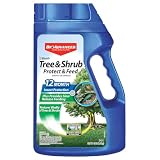
- INSECT KILLER: 12 Month Tree & Shrub Protect & Feed kills Japanese Beetles, Emerald Ash Borers, Adelgids, Leafminers, Aphids, and other listed insects that damage trees and shrubs
- PROTECTS UP TO 12 MONTHS: One application kills listed insects and prevents new infestations for up to a year
- FEEDS & PROTECTS: Slow-release plant food improves the health of your outdoor trees, shrubs, and container plants
- EASY APPLICATION: No spraying or mixing required; Measure with the built-in cup, sprinkle around the base, and water in
- GET MORE FROM THE BLUE BOTTLE: The threats of invasive insect species that attack trees and shrubs continue to spread across the country; Take action to protect your trees with our collection of tree and shrub products
- For 1–2 weeks after planting: water daily.
- From weeks 3–12: water every 2–3 days.
- After week 12: water weekly until the first frost.
- For a tree planted in fall: resume weekly watering in spring and continue through the growing season.
- After the first year: continue weekly watering until the tree is established.
Penn State says substantial, prolonged rainfall may justify skipping a scheduled watering, while a brief heavy downpour may mostly run off. University of Maryland Extension takes a more check-based approach: water thoroughly at planting, check daily for the first two weeks and deep-water if the top 6 inches are dry; then check at least weekly during the first two years and water when soil is dry at 6 inches. Its guidance is available in Watering Trees and Shrubs. Together, these recommendations show why local weather and actual root-zone moisture matter more than a schedule alone.
Quick wins for a faster PC:
Repair Windows errors before they cause bigger problemsFix Now →Scan for outdated or missing drivers - takes under a minuteDriver Scan →Clear out junk files and repair common Windows errorsFree Scan →Water slowly and cover the root zone
When the root ball is dry, apply water slowly enough to wet the entire ball and some adjacent soil. Shallow sprinkling may wet the surface without supplying the root zone. As roots extend, gradually enlarge the watered area.
Rank #3

- Contains natural ingredients to feed microbes in the soil
- For use on all flowering trees, shrubs and other acid-loving plants
- Helps maintain deep, lush green foliage and colorful blooms throughout the season
- Gets plants off to a good start and provides continuous release feeding for up to 3 months for beautiful trees and shrubs all season long
- Conveniently can be used on plants, both in ground and in containers
Iowa State lists several ways to apply water slowly, including a hose with a water breaker, soaker hose, spot sprinkler, trickle hose, watering bag, or leaky bucket. These are convenience options for even delivery, not treatments for a tree whose underlying problem is something else. A watering bag can help deliver water to the root ball, but it does not replace moisture checks and may not reach roots once they extend beyond the original ball. A hose works too when used slowly and aimed across the root zone.
Use leaf and soil symptoms together
Foliage can provide clues, but it should be interpreted alongside soil moisture. Penn State describes dry soil at 6 to 9 inches, wilted or curled leaves, and older leaves turning yellow or brown and dropping as signs associated with underwatering. Persistent dampness, yellowing young leaves, wilted but pliable shoots, and brittle green leaves can point toward overwatering. These are clues rather than a stand-alone diagnosis; poor drainage and excessive irrigation can resemble drought stress in some ways.
Rank #4

- PATENTED BIOSTIMULANT FORMULA: MitoGrow works at the cellular level to help plants use existing nutrients more efficiently, speeding up establishment and strengthening natural defenses without adding excess fertilizer.
- COMPREHENSIVE ACTIVE INGREDIENTS: Contains 2.50% Indole-3-Butyric Acid for root development, essential B vitamins (B1, B3, B6), beneficial Bacillus bacteria, and a diverse blend of endo and ectomycorrhizal fungi for enhanced nutrient uptake.
- YEAR-ROUND PLANT SUPPORT: Ideal for new plantings to establish faster, transplants to reduce stress, and existing trees and shrubs needing healthier growth or recovery after challenging weather conditions.
- REDUCES TRANSPLANT SHOCK: Helps plants take hold quickly when bringing home new plantings, supports stressed plants during relocation, and accelerates recovery for established trees and shrubs.
- ENHANCED NUTRIENT EFFICIENCY: Functions as a plant supplement that optimizes nutrient utilization rather than replacing fertilizer, promoting healthier growth and stronger root systems for long-term plant vitality.
Overwatering is not harmless: water filling soil pores displaces oxygen roots need and can suffocate them. If the root zone stays wet, do not add more water just because the foliage looks wilted. Consider drainage and allow soil to dry between waterings according to site conditions. Penn State discusses both watering symptoms and root-zone oxygen in its newly planted tree watering guidance.
What’s actually slowing this PC down?
Pick the symptom - the matching free tool is one click away.
Check planting depth, mulch, and other sources of stress
Look at the trunk flare
The trunk flare—the point where the trunk widens into the major roots—should be at the soil line, not buried. Planting too deeply can contribute to decline and may cause mortality. Iowa State’s decline guidance also identifies root injury, poor drainage, and girdling support wires as possible contributors.
Best Value

- Supports Roots, Foliage & Structure – Helps encourage strong roots and steady plant development.
- Liquid Formula for Easy Feeding – Designed for simple mixing and consistent nutrient delivery.
- Ideal for Landscape Trees & Shrubs – Suitable for ornamentals, hedges, and garden plantings.
- Made in USA
Keep mulch off the trunk
Mulch helps moderate soil temperature and reduce evaporation, but it should not cover the trunk flare or pile against the bark. Penn State recommends a mulch layer no deeper than 3 inches and kept 3 inches away from the trunk; University of Maryland explains mulch’s moisture and temperature benefits in its tree and shrub watering guidance.
Consider weather, roots, pests, and disease
Late frost or winter injury, unsuitable soil conditions, damaged roots, pests, and disease can all contribute to decline. Pests or disease may be secondary to a more basic stress such as overwatering or poor planting, so treating a visible symptom without addressing the growing conditions may miss the cause. Do not apply pesticide or undertake drastic pruning based on leaf drop alone.
How long establishment takes
A tree is established when its roots have spread into the surrounding soil and its growth remains consistent from year to year, according to Penn State Extension’s watering guidance. The time varies with species, tree size, soil, climate, and care. Iowa State gives an approximate rule of 12 months per inch of trunk diameter for USDA hardiness zones 4 and 5 in its newly planted tree care advice; that regional estimate should not be treated as a universal timetable.
Hold off on fertilizer and unnecessary pruning
Leaf loss alone is not a reason to fertilize. Colorado State University Extension cautions that fertilizer-driven new growth may be more than a stressed tree can support; diagnose the problem and correct care conditions first. Its advice is in Care of Recently Planted Trees. Make pruning or pest-treatment decisions using tree-specific local guidance rather than reacting to fallen leaves alone.
When to get local help
Contact a local Cooperative Extension office or a qualified arborist if decline progresses, branches die back, the trunk is damaged, or you cannot determine whether the root zone is too wet or too dry. Share the species, planting date, recent weather, watering routine, soil conditions, and photos of the whole tree, trunk base, and affected leaves. Local advice matters because recommendations vary with climate, soil texture and drainage, species, tree size, and season.
Quick Recap
Product prices and availability are accurate as of the date/time indicated and are subject to change. Any price and availability information displayed on Amazon at the time of purchase will apply.

