
NBench lets you measure .NET code and turn performance expectations into test assertions. To get started, install the NBench package in a console application, define a benchmark class with setup and cleanup methods, and mark each benchmark with [PerfBenchmark]. Use throughput mode for operations per second and iteration mode for timing, allocation, or garbage-collection observations.
Set up an NBench console application
NBench 2.x runs from your application rather than relying on a separate external runner. Create a console project, then add the researched package version:
dotnet add package NBench --version 2.0.1NBench 2.0.1 targets .NET Standard 2.0. Its NuGet listing states support for .NET Framework 4.6.1 and later and .NET Core 2.0 and later. See the NBench 2.0.1 NuGet listing and the official NBench documentation.
Create a benchmark class
A benchmark class is a plain C# object with a default constructor. NBench creates the object and calls its setup, benchmark, and cleanup methods during each iteration. Use [PerfSetup] to prepare fixtures or obtain counters from the BenchmarkContext; use [PerfCleanup] to release resources created for the iteration.
#1 Best Overall

- [INTEL POWERED CONTENT] - Built with a 8th Generation Hexa-Core Intel i5 and 32GB of DDR4 RAM; Modern, Windows 11 ready, with 4K support, Executive multitasking, media streaming and smooth, multi-tab web browsing; Perfect as an all-purpose multimedia computer; built for content creators; Plenty of RAM and Mass storage for photo and video editing powered by Intel HD 630
- [LATEST WIRELESS TECH] - This Dell Desktop Computer easily connects to the internet through the Built In WiFi / Bluetooth
- [SOLID STATE STORAGE] - This Dell Computer setup comes with an ultra-fast 1TB Solid State Drive (SSD); Setup as the primary boot device; Boot and load programs with lightning speed ; Additional expansion available
- [BUY & OWN WITH CONFIDENCE] - From the world's largest Microsoft Authorized Refurbisher; Quality Guarantee and Free Tech Support; Award-winning Customer Service; | Support Sustainable Business
- [MODERN HI-SPEED PORTS] - USB 3.0 (x4) | USB 2.0 (x4) | DisplayPort (x1) | HDMI Port (x1) | Audio Combo Jack (x1) | Audio Out (x1) | RJ-45 Ethernet (x1) | Internal SATA (x3)
using NBench;
using NBench.Util;

public class QueuePerfSpecs
{
    private Counter _counter;

    [PerfSetup]
    public void Setup(BenchmarkContext context)
    {
        _counter = context.GetCounter("Enqueue");
    }

    [PerfBenchmark(
        Description = "Measures queue enqueue throughput",
        NumberOfIterations = 3,
        RunMode = RunMode.Throughput,
        RunTimeMilliseconds = 1000,
        TestMode = TestMode.Test)]
    [CounterThroughputAssertion("Enqueue", MustBe.GreaterThan, 1000000.0d)]
    public void Enqueue()
    {
        _counter.Increment();
    }

    [PerfCleanup]
    public void Cleanup() { }
}
This example shows the attribute arrangement; its threshold is illustrative, not a recommended target. Select a bound that reflects your own workload and environment. Multiple benchmark methods in one class are run as separate benchmarks.
Choose throughput or iteration mode
The run mode determines what question a benchmark answers. Throughput runs a workload for a configured duration; iteration repeats the benchmark a configured number of times. These approaches are not interchangeable.
Rank #2

- Model: Dell OptiPlex 7050 Small Form Factor (SFF)
- Processor: Intel Core i7-7700 3.60 GHz
- Memory: 32GB DDR4 Ram
- Storage: 1TB Solid State Drive (SSD) Fast Boot + Storage
- Operating System: Windows 11 Pro (64-bit)
| Mode | Best suited to | Configuration and measurement |
|---|---|---|
RunMode.Throughput |
How many operations the code performs over time | Set RunTimeMilliseconds; increment a named counter and use CounterThroughputAssertion or CounterTotalAssertion. |
RunMode.Iteration |
Elapsed time, allocations, or GC effects for repeated work | Set NumberOfIterations; use timing, memory, or GC measurement and assertion attributes as appropriate. |
With either mode, leave warmups enabled for ordinary measurements. NBench pre-JITs code and estimates runtime during pre-warmup and warmup before performing the measured work. SkipWarmups is available, but should be reserved for a specific reason, such as a long-running iteration benchmark whose setup makes warmups unsuitable.
Measure and assert performance
Measurement attributes collect values; assertion attributes define bounds that can make a test fail when run in test mode. Choose the pair that matches the requirement you need to monitor.
Rank #3

- IMMERSIVE 24 INCH DISPLAY: Experience stunning clarity on a Full HD IPS screen with ultra-thin bezels, offering a 90% screen-to-body ratio that makes everything from spreadsheets to streaming come alive with vibrant colors and crisp details.
- POWERFUL INTEL PROCESSING: Tackle demanding tasks with ease thanks to the Intel processor and 16GB of high-speed memory, delivering smooth performance whether you're multitasking between applications or running productivity software.
- GENEROUS STORAGE: Store all your important files, photos, and programs with blazing-fast solid state drive technology that ensures quick boot times, rapid file access, and plenty of space for your digital life.
- ENHANCED PRIVACY AND COLLABORATION: Work confidently with the pop-up privacy camera that tucks away when not in use, plus dual microphones with noise reduction for crystal-clear video calls that keep you connected professionally.
- ECO-CONSCIOUS DESIGN: Feel good about your purchase with an EPEAT Gold registered and ENERGY STAR certified computer that combines premium performance with responsible environmental manufacturing practices.
- Throughput and operation totals: obtain a named
CounterfromBenchmarkContext, then useCounterMeasurement,CounterThroughputAssertion, orCounterTotalAssertion. - Memory allocation: use
MemoryMeasurementto report memory orMemoryAssertionto impose a limit, such as onMemoryMetric.TotalBytesAllocated. - Garbage collection: use
GcMeasurement,GcTotalAssertion, orGcThroughputAssertionto observe or bound Gen0, Gen1, Gen2, or all-generation collections. - Elapsed time: use
TimingMeasurementto report timing orElapsedTimeAssertionto set a limit.
NBench documentation describes a full-GC cleanup before and after a run, but not an imposed collection immediately before measuring collection attempts. A GC benchmark therefore needs a workload that creates realistic opportunities for collection; otherwise a low count may say little about production behavior.
Make the benchmark enforce a regression gate
Set TestMode.Test on the benchmark when assertion bounds should determine pass or fail. If a measured value violates an assertion, NBench reports failure. Use TestMode.Measure when you want measurements reported without assertion attributes acting as pass/fail gates; the attributes can still declare metrics to collect.
Rank #4
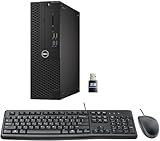
- This Certified Refurbished product is tested and certified to look and work like new. The refurbishing process includes functionality testing, basic cleaning, inspection, and repackaging. The product ships with all relevant accessories, a minimum 90-day warranty, and may arrive in a generic box. Only select sellers who maintain a high-performance bar may offer Certified Refurbished products on Amazon.com.
- Dell Optiplex 3050 SFF Desktop computer PC, Intel Quad Core i5-6500 up to 3.6GHz, 16GB DDR4, 256GB SSD
- Includes: USB Keyboard & Mouse, USB WiFi adapter, Microsoft office 30 days free trail.
- Port: Front: USB 3.0(2), USB 2.0(2); Rear: DP, HDMI, USB 3.0(2), USB 2.0(2), RJ-45.
- Support 4K (3840x2160) Dual display, makes it easy to connect two monitors at the same time, and you can expand working Windows, mirror content, or expand a single window across multiple monitors.
Before treating a threshold as a CI regression gate, run the benchmark repeatedly under representative conditions and record the environment. A bound that is not stable across normal runs can produce noisy failures rather than useful regression signals. Calibrate the threshold from the requirement and observed variability, not from the illustrative value in a sample.
Independent reader supportYour contribution helps us test, update, and keep practical guides available for everyone.Interpret results in light of setup and lifecycle
Each iteration includes object creation and the configured setup, benchmark, and cleanup lifecycle. Keep fixture preparation and resource release intentional: work placed in the benchmark method is part of what the benchmark measures, while work in setup or cleanup is part of the iteration lifecycle. For concurrent or asynchronous code, structure the benchmark so the operation being measured—not unrelated fixture construction or teardown—is the meaningful workload.
Best Value

- Connectivity: Includes WiFi, Bluetooth, and LAN for wireless and wired connections
- Memory: Features 16GB DDR4 RAM for smooth multitasking and performance
- Storage: Combines 500GB SSD and 1TB HDD for ample storage space
- Graphics: Integrated Intel UHD Graphics 630 for crisp visuals and video playback
- Design: Sleek desktop tower with black color and slim profile for modern look
NBench is intended for macro-level performance tests of features, including throughput, memory, and GC behavior. It can help answer whether a feature meets a performance bound; it does not make a poorly isolated or unrepresentative workload meaningful merely by attaching an assertion.
Quick Recap
Product prices and availability are accurate as of the date/time indicated and are subject to change. Any price and availability information displayed on Amazon at the time of purchase will apply.

