
Recommended Free Tools
For a very high step-up ratio, start by checking whether the boost controller’s maximum duty cycle and minimum off-time allow the conversion at your chosen frequency. If a basic boost cannot meet those limits, compare a tapped- or coupled-inductor boost with a flyback. The coupled-inductor boost may have a small efficiency advantage; choose a flyback when isolation, source decoupling, multiple outputs, or its fault behavior is more important.
What should you choose for a very high voltage ratio?
There is no single best topology for every high-ratio supply. A basic boost is attractive when its duty-cycle limit is sufficient and its component stresses are manageable. When it is not, a tapped-inductor or other multiplied boost can extend the ratio without necessarily adding isolation. A flyback is a stronger candidate when the design also needs galvanic isolation or a way to prevent an output short from providing a direct path back to the input source.
Robert Kollman’s 2013 EE Times comparison illustrates the scale of the problem with a 5 V-to-200 V example. His conclusion is not that one topology always wins: a coupled-inductor boost can be slightly more efficient, while a flyback can provide isolation and more over-current protection.
What limits a basic boost converter’s ratio?
A boost converter raises its output by controlling how long its switch conducts relative to each switching cycle. In practice, the controller cannot operate at every theoretical duty cycle: its maximum duty cycle and minimum off-time limit the usable range. As Kollman put it, “boost controllers have a limited conversion ratio set by the minimum off-time of the controller and the operating frequency.” Check the actual controller’s specifications at the intended switching frequency rather than assuming an idealized ratio.
Outdated Drivers Are Slowing You Down
One free scan finds every outdated or missing driver and matches the right update for your exact hardware.Free scan · exact hardware matchPC Slower Than It Used to Be?
A free scan shows the junk files, broken settings and background clutter dragging Windows down - then fixes them in one click.Free scan · Windows 10 & 11#1 Best Overall

- Mini DC-DC step up voltage regulator with DC 2-24V input and 5V-28V output,just connected with USB power adapter then you can get 9V 12V 18V 24V voltge.
- Equipped with MT3608 voltage booster chip with high conversion efficiency up to 93%.
- Widely used for storage battery, power transformers, DIY adjustable regulated power supply, industrial equipment, 5V, 9V, 12V, 28V output, etc.
- MT3608 includes under-voltage lockout, current limiting, and thermal overload protection to prevent damage in the event of an output overload.
- Note: Before the first use, the module is not powered and not connected to the load, the blue potentiometer copper head a word mouth adjustment cap, aligned with the direction of the chest, counterclockwise rotation of the potentiometer to the end of the "ta" sound, and then clockwise rotation of the potentiometer more than 30 turns, and finally connected to the power supply, using a multimeter to monitor the module's output voltage to achieve the desired voltage
Texas Instruments’ 2019 article, “Get more boost from your boost converter,” gives a useful illustration: a basic boost with a 90% maximum duty cycle reaches only about a 10:1 conversion ratio. That is a rule of thumb tied to the stated maximum duty cycle, not a universal ceiling for all boost controllers or operating conditions.
Even when the controller can reach the requested ratio, a simple boost can become unattractive at high ratios. Analog Devices application note AN-1126 identifies high MOSFET voltage and current stress, high rectifier stress, high duty cycle, and possible discontinuous conduction as concerns. These affect device selection, losses, and thermal performance, so feasibility is not just a question of whether the output voltage can be reached.
Rank #2

- XL6009 is a high-performance 400KHz 4A switch currency step-up (BOOST) module. This module is coming with the 3rd generation high-frequency switch technology as the core chip, The performance is much higher than LM2577
- Wide input voltage: 3V~32V;Optimum operating voltage range: 5~32V;Wide output voltage: 5V~35V
- With 4A high efficiency MOSFET switches, the efficiency of XL6009 can be up to 94%(LM2577current is 3A
- With ultra high switch frequency 400KHz , even if small capacity filtering capacitors can achieve very good results, ripple is smaller (Compared to LM2577,its frequency is 50KHz)
- With 0.1uF high-frequency bypass capacitor, effectively filter out high-frequency noise
How do the main high-ratio options compare?
| Topology | When it is worth considering | Key trade-off or qualification |
|---|---|---|
| Basic boost | The requested ratio fits the controller’s duty-cycle and minimum-off-time limits, and switch and rectifier stresses remain acceptable. | Few parts and good efficiency at low-to-moderate ratios, according to Analog Devices AN-1126; high ratios increase stress and can lead to discontinuous conduction. |
| Charge-pump-multiplied boost | High voltage is needed at low output current. | Analog Devices AN-1126 says charge-pump multipliers are best confined to applications where output current does not exceed roughly 50 mA to 100 mA. That is the application note’s guidance, not a universal hard limit. |
| Tapped- or coupled-inductor boost | A basic boost falls short on ratio, but galvanic isolation is not a requirement. | The turns ratio can extend the boost range. Kollman’s comparison reports slightly lower turns ratios, diode voltage stress, and peak switch current than the flyback example, with a possible slight efficiency advantage. |
| Flyback | High ratio is needed together with isolation, source decoupling, multiple outputs, or useful over-current behavior. | It is an isolated, low-power topology with magnetic, switching-spike, ripple, and control-loop considerations; see the limits below. |
| SEPIC multiplied boost | A design needs another high-ratio boost alternative. | Analog Devices AN-1126 describes a tested topology for approximately 10:1 to 50:1 ratios and a design range from about 1.8 V input to perhaps 500 V output. The note’s accessed page does not state a publication date. |
When does a flyback make more sense than a tapped-inductor boost?
The decisive difference is often what the system needs besides voltage conversion. A tapped-inductor boost can be a good way to extend the ratio when isolation is unnecessary. A flyback uses a coupled inductor to transfer energy while keeping the input and output electrically isolated, making it a more natural fit when galvanic isolation or multiple outputs are required.
Fault behavior can also decide the choice. Kollman notes that a shorted boost output has no current limit beyond the input source: there is a direct connection back to that source. A flyback has no such direct connection, allowing the controller to protect against the fault condition. This does not mean every flyback automatically has adequate short-circuit protection; the controller and protection design still need to be selected for the intended fault conditions.
Quick wins for a faster PC:
Scan for outdated or missing drivers - takes under a minuteDriver Scan →Clear out junk files and repair common Windows errorsFree Scan →Fix the driver behind crashes, sound loss and screen glitchesFind Drivers →Rank #3
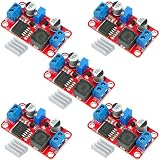
- XL6019 Boost Converter Module:The conversion efficiency can reach over 90%, which is convenient for thermal design
- Size:50*28*13mm
- Current: Maximum: 0-5A; Recommended value 0-3A
- Input: Maximum: 3-40V; Recommended value 3V-35V
- Output: Maximum: 5-45V; Recommended value 5V-40V (by rotating the potentiometer)
For the specific coupled-inductor boost and flyback comparison in Kollman’s article, the boost has slightly lower turns ratios, diode voltage stress, and peak switch current, and may therefore be slightly more efficient. Treat that as a comparative result for the discussed designs, not a guarantee that every boost implementation will outperform every flyback.
How do output current and power change the decision?
Current capability helps separate charge-pump options from magnetic converters. For high voltage at very low current, a charge-pump multiplier may be economical; AN-1126 advises keeping its output current to roughly 50 mA to 100 mA or less. For more current, compare magnetic topologies against the required stresses, efficiency, and thermal limits instead of assuming a multiplier remains suitable.
Rank #4

- Input Voltage: 12V nominal, Input Current: 10A (max) ; Output Voltage: DC 24V 10A 240W
- Maximum Efficiency:≥95%; Ripple Wave: 50Mv; Starting delay time:≤2S. If the product does not function, check whether the positive and negative terminals are reversed. The label on the back of the product provides connection instructions for the positive and negative terminals. Please follow the instructions.
- Over-current /Over-load /Low-load /Short-circuit /Over-heat intelligent protection.
- Compact aluminium shell with epoxy potting, 100% waterproof, anti-dust, anti-shock protection and better heat dissipation. Two quick-connect terminals make it easy to quickly connect your devices.
- Widely used to golf cart, motor, speaker, GPS, LED car display screen, air-conditioner, electric fan, solar energy, photo-voltaic power, DVD, industrial equipment ect.
TI’s March 2023 application brief SLVAFK6 describes flyback as a low-power isolated topology, with typical maximum output power around 100 W. That is a typical figure, not a fixed ceiling: the achievable limit depends on design conditions. At higher power, compare flyback with forward or other transformer-based topologies rather than treating flyback as the automatic next step.
Independent reader supportYour contribution helps us test, update, and keep practical guides available for everyone.What flyback design constraints should you account for?
A flyback stores energy in the air gap of its coupled inductor—the flyback transformer—while the switch conducts, then transfers that energy to the output when the switch turns off. TI’s 2023 brief highlights several consequences that matter in a real design:
Best Value

- Boost Converter :Adjustable high power digital booster module
- Size:72*48mm
- Voltage:Input voltage:4-35V;Output voltage:5-45V
- Electric current:5A max
- Compatible with power supplies for laptops or solar panels and other electronic devices digital products etc
- Leakage-inductance spikes: leakage inductance can create voltage spikes, so the switch and its voltage-management approach must account for them.
- Pulsed currents and ripple: input and output currents are pulsed, and ripple and filtering need attention.
- Control-loop bandwidth: the flyback has a right-half-plane zero (RHPZ) that constrains achievable loop bandwidth. TI says a common design practice is to target about one-tenth of the RHPZ frequency for phase and gain margin.
- Optocoupler feedback: when an optocoupler is used, the regulation bandwidth is further constrained.
These are design trade-offs, not reasons to rule out flyback. Include them when comparing the complete supply—especially its switch stress, thermal performance, ripple, filtering, and regulation needs—not just its nominal conversion ratio.
Quick Recap
What to check before committing to a topology
- Confirm the conversion limit. Check the candidate controller’s maximum duty cycle and minimum off-time at the intended switching frequency. If a basic boost does not meet the ratio, move to a multiplied or transformer-based option.
- Set the load requirement. Establish output power and current. A charge-pump multiplier is most plausible at low current; flyback is generally a low-power isolated candidate, while higher-power designs merit comparison with forward or other transformer-based topologies.
- Decide whether isolation or multiple outputs are required. If yes, weigh flyback directly against non-isolated tapped-inductor boost alternatives.
- Compare component and magnetic stresses. Assess switch, diode, and magnetic-component voltage and current stresses, as well as expected efficiency and thermal performance.
- Evaluate faults and regulation behavior. Consider short-circuit and over-current behavior, ripple and EMI filtering, leakage-inductance spikes, and feedback bandwidth.
- Compare implementation cost and complexity. Account for parts count, size, and cost only after the electrical requirements and protection strategy are clear.
Product prices and availability are accurate as of the date/time indicated and are subject to change. Any price and availability information displayed on Amazon at the time of purchase will apply.

