
Quick wins for a faster PC:
Fix the driver behind crashes, sound loss and screen glitchesFind Drivers →Clear out junk files and repair common Windows errorsFree Scan →The bathtub curve describes how failure rates can change across a population of equipment over time; it cannot tell you when a particular machine will fail. Use it to frame lifecycle risks, then use reliability-centered maintenance (RCM) and failure-mode analysis to choose actions for the asset, its operating conditions and the consequences of failure. If you are considering refurbishment or reuse, add testing, traceability and lifecycle-cost checks before deciding.
What does the bathtub curve mean?
The bathtub curve is a model of a population’s failure behavior. Its name comes from a curve that falls, stays relatively level, then rises:
- Early failures: The rate is higher at the beginning of service and declines. NASA’s Reliability-Centered Maintenance Guide calls this “Infant Mortality.”
- Intrinsic or useful life: The rate is comparatively stable. NASA labels this region “Random Failures.”
- Wearout: The rate rises as age-related degradation becomes more influential. NASA calls this “Wearout.”
NIST describes the curve as a population hazard-rate model. For repairable systems, the vertical axis may instead represent repair rate or rate of occurrence of failures (ROCOF). Those measures describe a group’s behavior over time; they do not provide a guaranteed expiration date for an individual asset.
NASA’s guide contrasts the first-generation bathtub characteristic with a second-generation “saucer” characteristic. It associates fewer early failures with better commissioning and less maintenance, and longer life with improved maintenance tasks and proactive maintenance. The useful lesson is not that every asset follows one shape, but that failure behavior and the effectiveness of maintenance can differ across a lifecycle.
Recommended Free Tools
#1 Best Overall

- PROTECT YOUR HOME AND WELLNESS: Understand the impact of hard water on your home and health. Hard water can damage appliances, clog pipes, and affect your skin and hair. By using Varify's Water Testing Kit to monitor your water's hardness, you're taking an important step in preventing potential damage and ensuring the well-being of your household.
- QUICK AND ACCURATE RESULTS: Discover the ease and precision of Varify Water Hardness Test Kit. In just seconds, get reliable readings on the hardness of your drinking water, pool, or any other water source. Our simple dip-and-read approach ensures you don't have to wait or travel for accurate water quality information.
- EASY-TO-READ COLOR CHART: Experience hassle-free testing with our oversized color chart, designed for effortless result reading. Varify's clear visual guide ranges from red to green, enabling you to quickly understand water hardness levels from 0-25 GPG and 0-425 PPM. Making water testing accessible and straightforward for everyone.
- EXTENDED SHELF LIFE WITH VARIFY FRESHSEAL: Enjoy the convenience of our Varify Water Testing Kit, which comes with 100 total hardness test strips in a ready-to-use bottle and two separately sealed pouches for extended freshness. Our innovative FreshSeal technology guarantees the reliability and accuracy of each test, long after your first use.
- SUPPORT CLEAN WATER INITIATIVES: With every Varify's Water Hardness Test Kit, you contribute to providing clean water for a year to someone in the Central African Republic. Make a difference in the world's water crisis and support our mission for #WaterForGood and #CleanWaterWorldwide with each water test you perform.
How do you turn the curve into maintenance decisions?
Do not schedule work just because an asset is thought to be “in the wearout phase.” Establish what the asset must do, identify how it can fail and what those failures would mean, then select an appropriate response. RCM is the broad decision framework for this; FMEA or FMECA supplies a structured way to analyze failure modes.
Reliability-centered maintenance (RCM)
NASA describes RCM as a way to improve overall equipment effectiveness while controlling lifecycle cost. It can combine different strategies, from run-to-failure to FMEA and predictive testing and inspection. NASA’s facilities policy describes RCM as identifying actions that reduce failure probability and selecting a cost-effective mix of proactive and reactive maintenance, with operating data used to improve future decisions.
Rank #2

- 1 Kit, 3 Essential Tools – Unzip it to reveal your complete diagnostic setup: a digital multimeter, non-contact voltage pen, and GFCI outlet tester. No more wasted trips to the truck or fumbling for separate meters. Built for electricians, HVAC pros, and dedicated DIYers who value efficiency and need to get the job done right—without the downtime.
- Versatile Digital Multimeter: Measures AC/DC Voltage (600V), DC Current (10A), Resistance (20MΩ), Continuity, Diode & Batteries (1.5V/9V). Backlit LCD, Data Hold, auto-off & CAT III 600V safety.
- Smart Non-Contact Voltage Detector: No guess work! LCD gives live % and color read-outs, plus beeps and flashing LEDs when voltage is detected. Dual-range 12–1000 V AC / 70–1000 V AC. Built-in flashlight, auto-off. Highest Safety: CAT IV 600V/CAT III 1000V.
- Advanced GFCI Outlet Tester: Detects wiring configurations, confirms correct wiring & indentifies common wiring faults with crystal-clear LCD codes. Results automatically freeze for 5 min so you can read at a glance. Works on GFCI & standard outlets. CAT II 125V rated.
- Complete Kit: Includes Digital Multimeter, NCV Tester, GFCI Tester, 2 Test Leads, 6 AAA Batteries, User Manual, and Carrying Case. No extra purchases—everything you need is in the box.
In practice, RCM asks what functions matter, how those functions can fail, what the consequences are and which action is justified. A task is not automatically worthwhile because it is preventive: if it does not address a meaningful failure risk, or costs more than the risk it controls, another response may make more sense. Depending on the case, that response can include inspection, testing, scheduled maintenance, running to failure or changing how the equipment is operated.
FMEA and FMECA
IEC 60812:2018 describes failure mode and effects analysis (FMEA) as a method for identifying how an item or process might fail, along with the effects, causes and treatments. Failure mode, effects and criticality analysis (FMECA) adds criticality prioritization. The standard covers hardware, software, processes and interfaces, and addresses planning, performing, documenting and maintaining the analysis.
What’s actually slowing this PC down?
Pick the symptom - the matching free tool is one click away.
Rank #3

- SMART BUY: A complete, high-performance kit that offers convenience and value
- COMPLETE OUTLET TESTER TOOL KIT: Includes GFCI Tester (Cat. No. RT210) and Non-Contact Voltage Tester Pen (Cat. No. NCVT1P)
- DETECT COMMON WIRING PROBLEMS: Quickly identifies wiring issues in standard and GFCI receptacles
- GFCI OUTLET COMPATIBLE: Confirms the proper operation of ground fault protective devices in GFCI outlets
- VOLTAGE TESTER PEN: Non-contact detection of voltage in cables, circuit breakers, lighting fixtures, switches, and more
FMEA/FMECA does not by itself select the full maintenance strategy. It organizes evidence about possible failures and their consequences so a team can prioritize treatments. RCM provides the wider decision context in which that analysis can inform maintenance choices.
Use operating evidence to revise the plan
Record failures, inspections, tests and maintenance outcomes in a form that can inform later decisions. NASA’s facilities policy specifically describes using operating data to improve maintenance. If an assumed failure pattern is not borne out by operating experience, revisit the task or its timing rather than treating the curve as proof that the original plan is right.
Rank #4

- All-in-One Circuit Diagnosis: The KT302P Circuit Breaker Finder is designed for fast, intuitive troubleshooting. It easily locates breakers, checks outlet wiring, and tests GFCI protection—all in one compact tool. Combines a Circuit Breaker Finder, Outlet Tester, and GFCI Tester for fast, reliable troubleshooting in residential or commercial settings
- Reliable Breaker Tracing: Operating on 90–120V AC circuits, this Circuit Breaker Finder uses a simple two-scan process—learn first, then locate—to accurately identify the correct breaker without manual sensitivity adjustments. Stable signal performance and straightforward operation make it ideal for homeowners, DIYers, maintenance staff, and electricians who need a lightweight solution for routine breaker identification.
- Clear Visual & Audible Alerts: The receiver features bright LED indicators and a distinct audible signal to quickly identify the target breaker. When the correct breaker is found, the light illuminates and the beeper sounds for accurate confirmation. A built-in flashlight helps illuminate dark panels or tight spaces for added convenience
- Dual-Sided LED GFCI Outlet Tester: The transmitter doubles as a GFCI Outlet Tester with an automatic trip test function. Unlike traditional outlet testers that require referencing bottom light patterns, this upgraded transmitter features 6 LED indicators on both front and back, directly representing 6 wiring conditions. The dual-sided design eliminates blind spots caused by ground-up or ground-down outlets, ensuring clear visibility in any orientation.
- Complete Accessory Kit & Carrying Case: This Circuit Breaker Finder kit includes a 3-prong to 2-prong adapter, light socket adapter, and alligator clip adapter for expanded compatibility with various outlets and fixtures. The durable carrying case keeps the tool and accessories organized, protected, and easy to transport, making it practical for professionals on the go and organized home users alike.
How do RCM, FMEA and the bathtub curve differ?
These tools answer different questions rather than compete as substitutes. The curve frames population behavior; FMEA/FMECA structures the analysis of failure modes; RCM turns asset functions, failure consequences and costs into a maintenance approach.
| Tool | Main question it helps answer | How it informs life extension | Key limitation |
|---|---|---|---|
| Bathtub curve | How might a population’s failure rate change across its lifecycle? | Frames early-failure, comparatively stable and wearout behavior. | Does not predict an individual asset’s failure date or establish that every asset follows this pattern. |
| RCM | Which maintenance approach best addresses asset functions, failure consequences and lifecycle cost? | Selects a mix of proactive and reactive actions and can use operating data to improve the plan. | Requires decisions grounded in the asset’s function, risks, costs and operating evidence. |
| FMEA/FMECA | How could an item or process fail, what would cause it, and what would the effects be? | Identifies failure modes and treatments; FMECA adds criticality prioritization to help direct attention. | Structures failure analysis but is not, by itself, a complete maintenance strategy. |
| Refurbishment and life-extension assurance | Can a reused or life-extended product meet the necessary reliability and functional expectations? | Supports decisions about refurbishment, updating, upgrading, maintenance and second-hand use. | Reused-part products need appropriate tests and analysis; age or appearance alone does not establish assurance. |
What maintenance can help prevent wearout?
There is no universal task that prevents wearout for every asset. The appropriate action depends on the failure mode, its consequences, the available evidence and the cost and disruption of maintenance. RCM helps decide whether a proactive task is justified; FMEA/FMECA can help identify and prioritize the failure modes that task should address.
Best Value
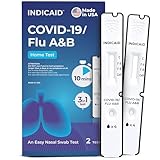
- Comprehensive 3-in-1 Test: The INDICAID COVID-flu test combo is a convenient way to detect COVID-19, Flu A, and Flu B. Everything you need is in this test home kit. It’s a must-have over-the-counter solution for anyone experiencing cold and flu symptoms.
- Fast, Reliable Results: This rapid influenza and COVID home test kit gives you 3 results in just 10 minutes, and it’s incredibly easy to use. All it requires is a shallow nasal swab, and the test can be completed in four simple steps. No more guessing!
- Trusted Technology: This flu and COVID test kit at home is FDA 510(k)-cleared, ensuring high-quality and accurate results. The combo test uses the same technology as COVID-19 rapid tests and can detect multiple COVID-19 and Flu A&B variants and strains.
- Versatile Use: The INDICAID COVID and flu test kit comes in a compact package, perfect for travel, school, work, and home. It’s also family-friendly. Individuals ages 14 and over can self-check, while children ages 2-14 require adult assistance.
- Extended Shelf Life: The shelf life of the INDICAID COVID-19/Flu A and Flu B Rapid Antigen Test has been extended to 16 months and is regularly extending. Simply scan the QR code on the box to find out the tests’ expiry date. Made in the USA.
Maintenance can support life extension when it addresses a relevant failure risk, but it cannot make a population model into a precise forecast for one machine. NASA’s guide links improved maintenance tasks and proactive maintenance with life extension, while its RCM material allows strategies ranging from run-to-failure to predictive testing and inspection. Select according to the equipment and risk, not a blanket assumption that more scheduled work is always better.
Independent reader supportYour contribution helps us test, update, and keep practical guides available for everyone.When should you refurbish, update, upgrade or reuse equipment?
Life extension is broader than repairing worn parts. IEC 62309:2024 explicitly covers extending useful life through refurbishment, life extension, updating, upgrading, maintenance and second-hand use. It requires tests and analysis before a product containing reused parts can be declared “qualified-as-good-as-new” (QAGAN).
That requirement makes assurance central to the decision. A reused-part product should not be treated as equivalent to a new-parts product solely because it operates or looks serviceable. Determine what testing and analysis are needed to support the intended reliability and functionality, and retain the evidence needed to justify the qualification.
Check the case for extension
- Failure risk: Identify the failure modes the work is meant to address and how their likelihood or consequences could change.
- Safety and regulatory consequences: Consider the effect of failure and the evidence needed to support use in the intended context.
- Labor and downtime: Include the maintenance or refurbishment effort and the disruption required to perform it.
- Testing and traceability: Establish what analysis, tests and records are needed, especially when reused parts are involved.
- Reversibility: Consider whether the change can be undone if results are poor, or whether it commits the organization to a harder-to-reverse path.
- Residual uncertainty: Identify what remains unknown after the proposed work and whether that uncertainty is acceptable for the asset’s role.
How do supportability and lifecycle cost change the decision?
Extending service life is not automatically the least-cost or lowest-risk choice. The relevant comparison includes performance, cost and risk across creation, operation, maintenance and refurbishment—not just the immediate cost of a repair or replacement. IEC 60300-3-14:2024 provides supportability guidance for any lifecycle stage and frames this balance. IEC 60300-3-3:2017 provides lifecycle-cost guidance that highlights dependability-related costs for managers, engineers, finance staff and contractors.
Crashes, No Sound, or Screen Glitches?
Random freezes, missing sound and display glitches usually trace back to one bad driver. Find and replace yours safely.Free scan · under a minutePC Slower Than It Used to Be?
A free scan shows the junk files, broken settings and background clutter dragging Windows down - then fixes them in one click.Free scan · Windows 10 & 11Use that perspective to compare feasible options on the same basis: how well each can meet the required function, the risk it leaves, the maintenance labor and downtime it entails, the evidence needed to justify it, and the costs associated with dependability over the relevant lifecycle. If the operating data are weak or the remaining uncertainty is unacceptable, a nominally cheaper extension may not be the better decision.
Quick Recap
A practical decision sequence
- Define the required function and context. State what the equipment must do and what the consequences of losing that function would be.
- Describe credible failure modes. Use FMEA or FMECA to organize causes, effects and treatments; add criticality prioritization when the analysis calls for it.
- Select a maintenance response through RCM. Compare proactive and reactive options against failure consequence, effectiveness, labor, downtime and lifecycle cost.
- Review operating feedback. Use recorded failures, inspections and test results to improve the maintenance approach rather than relying on the curve alone.
- Assess life extension or reuse. For refurbishment, updating, upgrading or second-hand use, define the testing, analysis and traceability needed to support the intended reliability and functionality.
- Balance supportability, cost and residual risk. Compare extension with other feasible options over the lifecycle and make explicit what uncertainty remains.
Product prices and availability are accurate as of the date/time indicated and are subject to change. Any price and availability information displayed on Amazon at the time of purchase will apply.

