
What’s actually slowing this PC down?
Pick the symptom - the matching free tool is one click away.
A Teensy 4.1 can serve as the controller for a capable CNC machine when paired with a compatible grblHAL breakout board such as the T41U5XBB. The project publishes support for up to five axes, auto-squaring, rotary axes, Ethernet, and spindle control. Its published 600 MHz processor and maximum step rate above 400 kHz make it a strong option for machines that need more than a basic three-axis hobby controller—but those figures describe controller specifications, not guaranteed cutting speed or accuracy.
What the Teensy CNC controller is
This is a controller system, not a Teensy board that can drive motors directly. Its core is a PJRC Teensy 4.1 running grblHAL firmware, installed on a compatible CNC breakout board. The breakout board connects the controller to external motor drivers, switches, spindle-control wiring, and other machine hardware.
The Grbl Project describes its grblHAL Teensy 4.1 breakout board as a full CNC motion controller for machines including routers, mills, lasers, and lathes. The project’s T41U5XBB resources cover firmware, setup, mounting, Web Builder configuration, and networking.
Published specifications and connections
The Grbl Project’s published comparison reports the following Teensy CNC specifications and features. These are project-published controller capabilities, not results from a standardized machine test.
#1 Best Overall

- Pre-Soldered Header Pins
- ARM Cortex-M7 at 600 MHz
- 4X Larger Flash Memory
- Provides Greater I/O Capability
- Includes Ethernet PHY, SD Card Socket, and USB Host Port
| Area | Published capability |
|---|---|
| Processor and step output | 600 MHz processor and a maximum step rate above 400 kHz, as listed in The Grbl Project comparison page retrieved in 2026. |
| Axes | Up to five axes; the comparison lists auto-squaring, moving-gantry support, and rotary-axis support. |
| Spindle control | PWM and 0–10 V spindle-speed control, with spindle enable and direction support described for the breakout board. |
| Inputs and outputs | The comparison lists four digital inputs, three digital outputs, and seven directly driven relays. The breakout-board description also identifies opto-isolated cycle-start, feed-hold, emergency-stop, safety-door, and probe inputs, plus axis-limit inputs and up to seven relay outputs. |
| Connectivity and G-code | USB, Ethernet, UART, and SD-card G-code execution are listed for the breakout board. |
Input and output counts depend on how the board’s features and pins are allocated in a particular configuration. Check the documentation for the exact board revision and firmware setup rather than assuming every listed connection is simultaneously available for every machine.
When it makes sense for a powerful CNC
The platform is worth considering when the machine needs capabilities beyond a straightforward three-axis setup, such as a dual-motor moving gantry with auto-squaring, a rotary axis, a high pulse rate, Ethernet connectivity, opto-isolated safety inputs, or integrated relay control for coolant and other auxiliaries.
Rank #2

- Designed to bring all general purpose I/O pins to breadboard friendly pads on the outside edges
- Ethernet Option
- Version 4.1
- NXP iMXRT1062 chip, the fastest microcontroller available today
- Pins not included
Controller features alone do not determine machine performance. Cutting capability also depends on the motors and drivers, power supply, mechanical stiffness, wiring, tuning, and configuration. The published clock and step-rate figures should not be read as a promise of a particular feed rate, surface finish, or accuracy.
What else is needed to build the system
- A Teensy 4.1 and a compatible grblHAL breakout board, such as the T41U5XBB variant described by The Grbl Project.
- An external stepper or servo driver for every controlled axis. The Teensy breakout board provides controller signals; it is not a substitute for motor power drivers.
- A spindle or VFD with a compatible control interface, plus suitable wiring and any required interface components.
- Limit switches and any required safety devices, connected to the appropriate inputs and configured in firmware.
- A power and wiring plan that matches the voltage requirements of the exact board, drivers, switches, and other field devices.
The breakout-board resources describe 5 V and 0–10 V control options; some commercial board variants add 12 V or 24 V field wiring. Those options are not interchangeable. Confirm the exact board manual and device specifications before making connections, especially where a VFD or higher-voltage field wiring is involved.
Rank #3
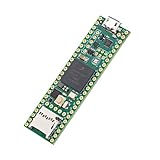
- Designed to bring all general purpose I/O pins to breadboard friendly pads on the outside edges
- This board DOES NOT feature the Ethernet option
- Can be programmed using the Arduino IDE with Teensyduino add-on
- NXP iMXRT1062 chip, the fastest microcontroller available today
- Pins not included
Firmware setup and machine commissioning
- Identify the exact board. Confirm the breakout board model and revision, the Teensy 4.1, the motor-driver interfaces, and the voltage levels required by connected devices.
- Configure grblHAL with Web Builder. Select the matching board and enable only the machine features you need, such as the number of axes, spindle options, Ethernet, or SD-card support. The Teensy configuration source lists Ethernet and SD-card plugins as options for Teensy 4.1, alongside board-specific features.
- Generate and load the firmware. Use the generated firmware for the selected board and follow the board-specific instructions for loading it onto the Teensy 4.1. Do not use a build for a different board configuration.
- Connect a grblHAL-aware sender. The official resources identify ioSender as a compatible G-code sender. Choose the intended connection method—USB or Ethernet, for example—and verify that the sender can communicate with the controller before enabling motion.
- Commission one function at a time. With the machine made safe for testing, verify axis direction and travel, limits, emergency-stop behavior, spindle commands, and relay-controlled accessories individually. Confirm that the configured machine behavior matches the actual wiring before running a job.
VFD spindle control and encoder-synchronized lathes
The standard T41U5XBB supports spindle-speed commands through PWM or a 0–10 V output. Whether that is sufficient for a specific VFD depends on the VFD’s control inputs and the wiring required by the machine. A speed command is not, by itself, proof that every VFD function—such as run/stop, direction, or fault handling—is configured.
Encoder-synchronized lathe work is a separate requirement. The Grbl Project states that the standard board cannot synchronize with the spindle without modification. Its documented modification connects high-speed encoder and index pulses to designated inputs. A buyer planning threading or other spindle-synchronized operations should verify that modification and the complete encoder setup before choosing this controller.
Rank #4

- Teensy 4.1
- It features an ARM Cortex-M7 processor at 600MHz, with a NXP iMXRT1062 chip, the fastest microcontroller available today.
- 1024K RAM (512K is tightly coupled) 8 Mbyte Flash (64K reserved for recovery & EEPROM emulation)
- 55 Total I/O Pins 3 CAN Bus (1 with CAN FD) 2 I2S Digital Audio 1 S/PDIF Digital Audio 1 SDIO (4 bit) native SD 3 SPI, all with 16 word FIFO 7 Bottom SMT Pad Signals 3 SPI, all with 16 word FIFO
- 7 Bottom SMT Pad Signals 8 Serial ports 32 general purpose DMA channels 35 PWM pins 42 Breadboard Friendly I/O 18 analog inputs Cryptographic Acceleration Random Number Generator RTC for date/time Programmable FlexIO Pixel Processing Pipeline Peripheral cross triggering 10 / 100 Mbit DP83825 PHY (6 pins) microSD Card Socket Power On/Off management
How to judge it against another controller
The Grbl Project comparison discusses Teensy CNC alongside RP23CNC and Arduino, but the published material summarized here does not establish independent machine benchmarks, reliability results, or a current price comparison. Compare the exact boards against the machine’s needs instead of treating processor speed as the only measure.
Quick Recap
Best Value

- Processor: ARM Cortex‑M7 core at 600 MHz (NXP iMXRT1062), dual-issue superscalar design for high-performance real-time applications
- Memory: 8 MB flash memory and 1 MB RAM (512 KB tightly coupled), with two locations for optional PSRAM expansion
- Connectivity: USB host port and native microSD card socket, no onboard Ethernet PHY (requires separate magjack if needed)
- I/O Capability: Up to 55 I/O pins (42 breadboard-compatible), including multiple SPI, I²S audio, S/PDIF, CAN (1 CAN FD + 2 CAN 2.0), PWM, serial ports, and SDIO
- Power & Features: Approx. 100 mA at 600 MHz; supports dynamic clock scaling, On/Off push button control, and RTC via VBAT coin‑cell backup Note: This Teensy 4.1 does not have Ethernet capabilities
- Axis needs: Check the axis count and whether the firmware and board support the required ganged-axis or auto-squaring arrangement.
- Pulse requirements: Compare the controller’s published step-rate capability with the motor drivers and motion profile the machine actually needs.
- Spindle interface: Confirm PWM, 0–10 V, or another required interface, and separately verify any VFD run/stop, direction, or encoder requirements.
- I/O and safety: Check the number and isolation of the needed limit, probe, cycle, hold, emergency-stop, and accessory connections.
- Connectivity and operation: Decide whether USB, Ethernet, UART, or SD-card execution is useful for the intended workflow.
- Electrical compatibility and effort: Verify signal and field voltages, external driver requirements, wiring complexity, and the commissioning work needed for the specific machine.
Product prices and availability are accurate as of the date/time indicated and are subject to change. Any price and availability information displayed on Amazon at the time of purchase will apply.
Recommended Free Tools

