
The Tool Desk
Outbyte PC Repair FREERepair Windows errors before they cause bigger problemsFix Now →Outbyte Driver Updater FREEScan for outdated or missing drivers - takes under a minuteDriver Scan →Video compression algorithms reduce the data needed to store or transmit moving images, but no codec is best for every use. H.264 prioritizes broad compatibility; newer options such as HEVC, VP9, AV1 and VVC offer different efficiency, compute, feature and deployment trade-offs. The right choice depends on the content, delivery conditions, playback devices and quality target—not on a universal compression ratio.
How video compression works
A video contains substantial redundancy: nearby pixels in a frame often resemble each other, and many parts of one frame resemble parts of the next. A codec exploits those patterns to represent a video using fewer bits than an uncompressed sequence would require.
Modern video codecs generally combine several techniques:
- Prediction: The encoder estimates image regions from nearby areas in the same frame (spatial prediction) or from other frames (temporal prediction), then encodes the differences.
- Transforms: Differences are represented in a form that helps concentrate information into coefficients the encoder can process efficiently.
- Quantization: The encoder simplifies transform coefficients, reducing the data needed to represent them. Google’s VP9 documentation identifies quantization as a key operation. More aggressive simplification generally saves bits at the cost of image detail.
- Entropy coding: The encoder represents the remaining symbols compactly, taking advantage of patterns in their occurrence.
- Filtering: In-loop filters can reduce visual artifacts and improve the pictures used for subsequent prediction.
In a lossy codec, quantization discards information that cannot be recovered exactly by decoding. The encoder therefore balances bitrate against visual distortion, while also accounting for processing cost, delay, device support and other constraints. A codec is a way to navigate that trade-off, not a guarantee that every file will be smaller or look better.
What’s actually slowing this PC down?
Pick the symptom - the matching free tool is one click away.
#1 Best Overall

- NVIDIA GT 730 graphics cards offer basic display capabilities for office work and light multimedia,which with 1000 MHz Memory Clock 4GB DDR3 on Kepler architecture, support multiple monitors and HD video playback,easily upgrading for convenient usage to save your budget for your old pc
- The low-profile design of the PC graphics card saves installation space, easy to install,plug &play,making it easy to build a compact computer system, even compatible with ITX chassis.
- The 4x outputs enables multi-monitor productivity on up to 4 monitors simultaneously,including 2x HDMI,VGA,DP.Designed for full-size chassis and small case installations.
- PCI Express based PC is required with one X8 lane graphics slot available on the motherboard. 300 Watt or greater power supply. This video card can automatically install new drivers and support Win11,DirectX 12.
- 30W low power,no external power supply and the all-solid-state capacitor keeps low power consumption and high performance.If you have any problems about this card,please contact us via amazon messages.
How to compare video codecs
Compare codecs on the same representative clips and under the conditions that matter for your delivery. A standards-level efficiency claim is not a result you can assume for every encoder, setting, content type or quality measure.
- Rate–distortion efficiency: How many bits are needed to reach your chosen visual-quality target? Test the kinds of scenes you actually deliver, including motion, texture, noise and dark areas.
- Encoding and decoding cost: Measure encoding time, playback workload, memory use and power on the target hardware. A more efficient stream may take longer or require more resources to create or play.
- Latency and resilience: Live streaming and videoconferencing may need fast encoding and prompt delivery. The best settings for offline video can introduce too much delay for interactive use.
- Compatibility: Check the exact browser, operating system, device, decoder, codec profile, container and playback path. A device’s general support for a codec does not guarantee support for every format or configuration.
- Features: Match requirements such as resolution, frame rate, bit depth, HDR, chroma format, scalability and immersive-video tools to the codec and implementation.
- Licensing and deployment: Consider applicable patent or royalty exposure, available implementations, hardware acceleration, operational maturity and the cost of maintaining multiple delivery versions.
For a meaningful in-house comparison, record the encoder and version, preset, test clips, output settings, quality metric, hardware and date. Do not present a bitrate saving or compression ratio as universal unless the stated test conditions support that claim.
Rank #2

- Powered by NVIDIA GeForce GT 610, 40nm chipset process with 523MHz core frequency, integrated with 2048MB DDR3 memory and 64-bit bus width
- Compatible with windows 11 system, no need to download driver manually
- HDMI / VGA 2 ports output available. HDMI Max Resolution-2560x1600, VGA Max Resolution-2048x1536
- Support DirectX 11, OpenCL, CUDA, DirectCompute 5.0
- Original half height bracket matches with the low profile brackets make the Glorto GeForce GT 610 graphics card fit well with all PC tower, small form factor and HTPC(except micro form factor)
H.264, HEVC, VP9, AV1 and VVC compared
The table summarizes the broad distinctions established by the cited standards and technical guidance. It does not assign a universal latency, bitrate or compute score: those depend on the encoder, settings, content and playback system, and are not specified as universal values by the sources cited here.
| Codec | Efficiency | Encode/decode cost | Latency | Compatibility | Feature support | Licensing/deployment |
|---|---|---|---|---|---|---|
| H.264/AVC | Common baseline; less compression-efficient than newer generations in the cited HEVC comparison. | Not stated as a universal value by the cited sources; test the implementation and target hardware. | Not stated as a universal value by the cited sources; depends on configuration and use. | Common compatibility choice, according to the supplied technical overview; verify target devices and playback paths. | AVC is the ITU H.264 and MPEG-4 Part 10 specification, as MDN describes. | Specific licensing terms are not stated by the cited sources; assess for the intended deployment. |
| H.265/HEVC | MPEG describes HEVC as providing “a compression capability twice that of AVC.” This is a standards-level capability statement, not a guaranteed result for a particular file or quality metric. | Not stated as a universal value by the cited sources; test the encoder and decoder on target hardware. | Not stated as a universal value by the cited sources; depends on configuration and use. | Check support across the actual devices, software and delivery stack. | ITU identifies uses including Internet streaming, communications, videoconferencing, storage media and television broadcasting. | Specific licensing terms are not stated by the cited sources; assess for the intended deployment. |
| VP9 | MDN summarizes AV1 as offering higher data-compression rates than VP9; results for a particular workload still require measurement. | Not stated as a universal value by the cited sources; test the implementation and target hardware. | Not stated as a universal value by the cited sources; depends on configuration and use. | Google says VP9 decoding is supported across major browsers, Android devices and many smart TVs. Confirm the device, profile, container and playback path. | Google describes VP9 for low-bitrate through ultra-HD use, with 10- and 12-bit encoding and HDR support; it is used for adaptive streaming. | Specific licensing terms are not stated by the cited sources; assess for the intended deployment. |
| AV1 | MDN summarizes AV1 as achieving higher data-compression rates than VP9 and HEVC; Meta reports improved quality at the same bitrate or equivalent quality at lower bitrate than earlier codecs. Actual results vary. | AV1 commonly trades encoding speed and compute cost for efficiency. Measure with the encoder version, preset, content and quality metric you plan to use. | Not stated as a universal value by the cited sources; assess with the intended live or on-demand configuration. | Verify support on the specific browsers, operating systems, devices, hardware decoders and delivery stack. | Web-oriented codec; the cited sources do not establish a single feature set for every AV1 implementation. | Specific licensing terms are not stated by the cited sources; assess for the intended deployment. |
| VVC/H.266 | A newer MPEG-I video-coding generation; the cited MPEG page describes ongoing work exploring enhanced compression beyond VVC, but supplies no universal comparative ratio. | Not stated as a universal value by the cited sources; evaluate implementation and target hardware. | Not stated as a universal value by the cited sources; depends on the system and use case. | Check actual deployment and hardware support for the target platform. | Relevant to forward-looking, high-resolution and immersive systems; MPEG lists work on single-layer, multi-layer and immersive video representations. | Specific licensing terms are not stated by the cited sources; assess for the intended deployment. |
What the main codec families are for
H.264/AVC: when reach matters
H.264, AVC and MPEG-4 Part 10 refer to the same specification, according to MDN. It is a lossy, transform-based codec and remains a practical compatibility baseline when predictable playback across a broad range of devices matters more than pursuing the greatest compression efficiency.
Rank #3
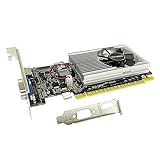
- The Geforce 210 is with a 589MHz core clock,up to 1066Mbps effective,perfect for working,video and photo editing,allows good fluency,which can effectively meet your needs.
- PCI Express 2.0 interface,offers compatibility with a range of systems. Also includes VGA and HDMI outputs for expanded connectivity,supports up to 2 monitors.Good for adding a simple low profile gpu to a small form factor pc.
- The computer graphics cards is small in size and saves more space,easy to install,plug and play,you can build a compact PC system easily for slim/ITX chassis.
- This low profile video card is good value option for entry level, if you just want basic upgrade graphics and daily simple work for your computer, or not be AAA gamer.(include low profile bracket)
- No external power supply and the all-solid-state capacitor keeps low power consumption and high performance,supports Windows 10/8/7/Vista/XP(not compatible with windows 11).
H.265/HEVC: an efficiency-oriented successor
HEVC is H.265, standardized as ISO/IEC 23008-2. MPEG characterizes its compression capability as twice that of AVC, while ITU lists applications spanning streaming, communications, videoconferencing, storage and broadcasting. Treat that comparison as a capability statement, not a promise that every HEVC encode will halve a particular AVC file at equivalent quality.
VP9: web and adaptive streaming
Google describes VP9 as a WebM Project format for uses from low-bitrate video to ultra-HD, and notes 10- and 12-bit encoding and HDR support. It is used by YouTube and other web-video providers and supports adaptive streaming. Google’s broad browser and device support description is useful, but playback still depends on the specific profile, container and device path.
Rank #4

- Chipset: NVIDIA GeForce GT 1030
- Video Memory: 4GB DDR4
- Boost Clock: 1430 MHz
- Memory Interface: 64-bit
- Output: DisplayPort x 1 (v1.4a) / HDMI 2.0b x 1
AV1: efficiency with implementation-dependent cost
AV1 is a newer web-oriented codec. MDN’s overview places its compression efficiency ahead of VP9 and HEVC, and Meta describes improved quality at a given bitrate or comparable quality at a lower bitrate than earlier codecs. Those summaries do not replace testing: AV1 commonly requires more encoding time and compute, and the balance varies with encoder version, preset, content and quality metric.
VVC/H.266: a newer generation to evaluate for the target system
VVC is MPEG-I’s newer video-coding generation. MPEG’s Joint Video Experts Team lists VVC work as well as exploration of enhanced compression beyond VVC. It is relevant to systems focused on high resolution, immersive representations or efficiency, but deployment should begin with a check of actual platform and hardware support.
Best Value

- AMD Radeon RX 550 Chipset, Silver plated PCB & all solid capacitors provide lower temperature, higher efficiency & stability
- 9CM unique fan provide low noise and huge airflow for your GPU
- GPU Boost Clock / Memory Speed : up to 1183 MHz / 4GB GDDR5 / 6000 MHz Memory, Stream Processors 512, Perfect for 3D CAD/CAM working, video and photo editing, Video Games @1080p
- Support: DirectX 12, Shader Model 5.0, OpenGL 4.6/4.5, 4K Video Decode
A codec is not a container or delivery protocol
A codec defines how video is encoded and decoded; it does not by itself define the file wrapper or the way a stream is delivered. A container organizes media tracks and related information in a file or stream. A delivery protocol or system handles how media is packaged, requested or transported to a player. MPEG lists technologies such as DASH, MMT, file formats and CMAF separately from its video codecs.
This distinction matters when diagnosing playback. A device may support a codec but not the particular profile, container or delivery combination. Check the full chain—from encoded stream through packaging and transport to player and hardware decoder—rather than treating a codec name as a compatibility guarantee.
Choose a codec for your use case
- Define the delivery mode. Decide whether the video is live, interactive, adaptive-streamed or stored for on-demand playback. For live and interactive work, measure latency and real-time encoding feasibility alongside compression.
- List the target playback paths. Include browsers, operating systems, device models, codec profiles, containers, streaming stack and available hardware decoding. If support is uncertain, test the actual playback path.
- Set a quality target and constraints. Specify resolution, frame rate, HDR or bit-depth needs, acceptable visual quality, bitrate or storage limits, and encoding time or power budget.
- Compare real clips. Encode representative content with the candidate codecs and intended settings. Record encoder version, preset, hardware and metric, then inspect quality and playback on the target devices.
- Choose the workable trade-off. If one codec cannot serve every target, decide whether compatibility or efficiency warrants multiple delivery versions, and account for the extra encoding, storage and operational work.
The MPEG standards process itself illustrates why codec comparisons need controlled conditions: MPEG Working Group 4 says its work uses representative test material, common test conditions, subjective and objective evaluation, reference software, and conformance and verification testing. A useful choice for your own service follows the same principle: compare candidates on the content and systems you actually intend to use.
Quick Recap
Product prices and availability are accurate as of the date/time indicated and are subject to change. Any price and availability information displayed on Amazon at the time of purchase will apply.
Do these 3 things before closing this tab:
1Clear out junk files and repair common Windows errors2Fix the driver behind crashes, sound loss and screen glitches3Repair Windows errors before they cause bigger problems
