
Smart transformers could help modernize the power grid in two distinct ways: conventional transformers with sensors can give utilities better information about equipment condition, while solid-state transformers (SSTs) use power electronics to control how electricity moves through a grid node. The first approach supports maintenance decisions; the second could add functions such as power-flow control and support for distributed energy resources. Neither should be mistaken for proof that smart transformers have already transformed the grid at scale.
What does “smart transformer” mean?
The term covers different technologies, and the distinction matters when judging their impact.
| Technology | What it does | Potential grid contribution |
|---|---|---|
| Conventional transformer with digital monitoring | Adds sensors, online condition monitoring or remaining-life analysis to a conventional transformer. | Helps utilities assess asset condition and prioritize maintenance, replacement and equipment selection. |
| Solid-state transformer (SST) | Uses power-electronic converters together with a high-frequency transformer to convert voltage and control electrical conditions. | Could provide more active control of power flow and support functions beyond conventional voltage step-up or step-down. |
Monitoring adds information about an asset; an SST changes how power can be converted and controlled. A monitored conventional transformer is not an SST simply because it sends data to a utility.
Why transformer modernization matters
Transformers connect parts of the electricity system and serve homes, businesses, manufacturing and data centers. In the United States, aging equipment, failures, end-of-life retirements and new customers all add pressure to plan replacements and expand capacity. The U.S. Department of Energy (DOE), in its November 2024 announcement summarizing an NREL-prepared distribution-transformer study, reported an estimate that about 55% of in-service U.S. distribution transformers were more than 33 years old.
#1 Best Overall
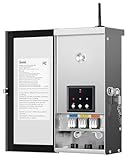
- [APP & Voice Control] Effortlessly manage your landscape light transformer with DEWENWILS APP; utilize Alexa and Google Assistant for automated lighting via smartphone or voice commands; No hub needed (supports 2.4GHz only)
- [3 Independent Zones] 120V 300W outdoor lighting transformer includes 3 zones, each offering independent control outputs, you can easily select between 12V and 14V AC output; upgraded clamp-connect terminals ensures easier wiring
- [5 Modes] Simply press the "+" button to automatically pair the Wi-Fi landscape transformer with the DEWENWILS APP; choose from 5 timer modes: Schedule/Circulate/Random/Countdown/Astronomical to suit your needs with each zone
- [Safe 300W] Our DEWENWILS smart low voltage transformer convert 120V AC to a safer 12V/14V AC, ideal for landscape lights, walkway lights, LED light, deck lighting; includes overcurrent and overload protection to prevent device damage, automatically shuts off if current thresholds are exceeded
- [Perfect for Outdoor Use] Made from high-performance stainless steel, this outdoor landscape transformer is durable, waterproof, and resistant to corrosion, protects transformers from rain, snow, dust, and wear over years of use, ideal for both indoor and outdoor installations
DOE also identified data centers, electric vehicles and charging stations, and renewable generation as important demand influences. That context makes better asset information and more flexible grid equipment relevant, but it does not mean SSTs are the only—or necessarily the best—answer to transformer demand and supply constraints.
What solid-state transformers could change in grid operation
DOE’s 2020 Solid State Power Substation Technology Roadmap describes a broader concept: a solid-state power substation, or SSPS, that strategically integrates high-voltage power-electronic converters at a substation or grid node. In the roadmap’s vision, modular converter blocks could act as power routers or hubs. They could control bidirectional AC or DC power flow between sources and loads, including across voltage or frequency differences.
Rank #2

- [Remote & Voice Control] Our landscape lighting transformer remote control via smartphone or voice commands; works with Alexa/Echo & Google Assistant via Smart Life APP; Control spotlights, garden and path lights effortlessly with a powerful WiFi signal, anytime and anywhere (2.4Ghz Only); No hub required(Please note the transforemr not for Halogen light)
- [Versatile Timer Function] This outdoor low voltage transformer can turn your lights ON/OFF automatically at scheduled times; 5 modes available: Programmable, Countdown, Circulate, Random, and Astronomical; saving energy and reducing costs; No worry about forgetting to turn off your lights again
- [Safe DC & Overload Protection] Our 120V to 12V transformer converts 120V AC 60Hz household voltage to 60W 12V DC safety voltage, providing a safe & stable lighting source; circuit breaker for overload & short circuit protection; auto-resetting after power cutoff/mode switch protects device from overload damage
- [Easy Installation & Weatherproof] Built-in hanging hole & 3.3ft power cable, mount our outdoor lighting transformer on outdoor walls easily; ready to use out of the box; high-quality PC housing & waterproof structure to resist humidity and heat; protects from rain, snow, dust, and wear for long-lasting performance
- [Wide Application] Compatible with DC 12V landscape lights, including pool lights, intelligent lights, yard lights, deck lights, string lights, and more; lightweight & easily hidden, our 12V transformer won't affect your yard's appearance
The roadmap describes these as potential capabilities, not outcomes established across an operating fleet. They include:
- Directing or sharing power flows and helping manage peak demand.
- Supporting power quality, system stability and distribution performance.
- Making more use of substation and transmission-line capacity and other grid assets.
- Rapidly isolating faulted sections, with possible resilience and black-start support.
DOE’s August 2023 Advanced Transformers Workshop Report records participants discussing possible SST applications involving electric-vehicle charging, distributed energy resources, storage, voltage support and virtual-power-plant hubs. These are workshop-discussed opportunities; the report does not establish that every use is commercially deployed or that every design delivers the same benefits.
Rank #3

- SMART FILM TRANSFORMER WITH REMOTE CONTROL: The Smart glass power adapter powers and controls PDLC smart film systems. It delivers stable performance and enables smooth switching between privacy modes.
- RELIABLE POWER CONTROL FOR PDLC SMART FILM: This device works as a Smart Film power adapter and delivers steady voltage. As a result, transitions between clear and opaque states stay smooth and consistent.
- SMART FILM POWER SUPPLY PERFORMANCE: Built as a dependable Smart Film power supply, the unit supports efficient energy flow. Therefore, the system maintains long-term reliability during daily operation.
- EASY REMOTE CONTROL OPERATION: The Smart Film transformer enables instant control via remote. Users can manage privacy quickly in residential, office, and commercial environments.
- POWER SPECIFICATION: The system operates at 50W and supports standard PDLC smart film applications.
What digital monitoring can—and cannot—do
For conventional transformers, online condition monitors and remaining-life algorithms can help utilities understand asset condition and inform equipment selection. EPRI describes research and evaluation in these areas as intended to help utilities prioritize replacement based on estimated remaining life.
Monitoring does not itself provide the power-electronic conversion and control functions of an SST. Its value is better information for asset management; it does not, on its own, establish that a transformer has more capacity, will last longer, or can support new electrical functions.
Rank #4

- Designed for Video Doorbells: 16V/30VA or 24V/40VA output (cannot use both voltages at the same time) provides reliable power for smart video doorbells
- Compatibility: Works with with Ring, Nest, Wyze, Eufy, Arlo, and other video doorbells
- 30VA or 40VA High Power Capacity: Delivers consistent power to prevent under-voltage issues, WiFi dropouts, or camera reset problems common with lower VA transformers.
- UL Listed Class 2 Safety Rated: Certified for safe indoor installation. Meets electrical standards for dependable residential doorbell applications.
- Easy Installation with Threaded Hub Mount: Built-in threaded hub allows direct outside mounting to a standard junction box for secure and professional installation (DO NOT install the transformer inside a wall because the transformer generates heat and needs space and proper ventilation for heat dissipation)
How mature is the technology, and what constraints remain?
The DOE roadmap and EPRI’s project information describe research, development and testing—not evidence that SSTs have already been deployed widely across the U.S. grid. EPRI identifies a prototype SST testing project as underway; project status may change. The sources do not establish a current deployment percentage, so claims of broad adoption would go beyond the available evidence.
DOE’s roadmap identifies development needs spanning hardware, simulation, controls, protection, thermal management, communications, cyber-physical security, standards, testing and markets. The DOE workshop report also records cost and reliability as adoption concerns, including concern that power-electronics converters could have shorter lifetimes. These are reported concerns, not a universal field failure rate or a quantified lifecycle comparison.
Free tools Windows power users keep installed
One-click scans. No signup required.
Best Value

- Smart App & Voice Control: Connect the landscape lighting transformer to the Smart Life App via Wi-Fi for convenient control of garden lights, pathway lights, landscape lights, and other outdoor lighting. It also works with Alexa and Google Assistant, allowing you to turn lights on or off and adjust settings with voice commands or your smartphone. No hub is required (2.4 GHz Wi-Fi only)
- Timer & Memory Functions: Set up the Wi-Fi landscape transformer by tapping the "+" icon in the Smart Life App for automatic pairing. Six modes - Manual ON/OFF, Schedule, Cycle, Random, Countdown, and Astronomical - provide flexible lighting control for different situations. The built-in memory function restores the previous settings automatically after a power outage, eliminating the need for repeated adjustments
- Reliable and Stable 120W Output: This 120W smart low-voltage transformer converts 120V AC power to 12V DC for landscape lights, pathway lights, and other outdoor lighting fixtures. Built-in overload and overcurrent protection disconnects the power when the current exceeds the limit and resets automatically once conditions return to normal, enabling reliable use for outdoor lighting systems
- Built for Outdoor Use: Designed to withstand outdoor conditions, the transformer offers dependable resistance to water, corrosion, dust, rain, snow, and everyday wear. It is suitable for both indoor locations, such as garages, and outdoor spaces, including patios, gardens, and walkways; compatible with a wide range of 12V DC landscape lighting, including pool lights, smart lights, garden lights, deck lights, string lights, and more
- Simple Installation & Setup: For remote control from anywhere, connect the transformer to a 2.4 GHz Wi-Fi network during setup. The built-in mounting holes and 6.3 ft (1.9 m) power cord allow the unit to be mounted directly to an outdoor wall for quick and convenient installation
Cybersecurity and interoperability matter beyond the transformer itself. DOE’s Smart Grid System Report describes cybersecurity risk management as important and plug-and-play interoperability as a challenging, long-term task for smart-grid modernization. A grid node cannot deliver its intended value in isolation: sensing, communications, controls and coordination with other grid resources also matter.
What utilities should compare before choosing an approach
The right choice depends on the grid problem being addressed. A utility considering monitoring equipment and one considering an SST are not comparing interchangeable products; they are evaluating different capabilities and system requirements.
- Use case: Is the priority better asset-condition information, or active power conversion and control?
- Electrical requirements: What system voltage and rating are needed, and does the application require power-flow control or AC/DC conversion?
- Integration: How must the equipment work with distributed resources, EV charging, protection systems and existing controls?
- Operational evidence: What field evidence exists for reliability, serviceability and lifetime in the intended application?
- System risks: How will cybersecurity and interoperability be managed?
- Economics and installation: How do footprint and lifecycle cost compare with conventional equipment and other ways of addressing the same grid need?
Those questions reflect the technical and institutional work identified in DOE’s roadmap and workshop report and EPRI’s evaluation activity. They are more useful than treating “smart transformer” as a single product category or assuming that one design is suitable for every grid location.
Quick Recap
Product prices and availability are accurate as of the date/time indicated and are subject to change. Any price and availability information displayed on Amazon at the time of purchase will apply.
What’s actually slowing this PC down?
Pick the symptom - the matching free tool is one click away.

