
What’s actually slowing this PC down?
Pick the symptom - the matching free tool is one click away.
Cloud computing changed data centers from mostly fixed, individually managed facilities into programmable pools of computing, storage, and networking. Virtualization made that shift possible; automation and hyperscale operations made it practical at large scale. The result is not the disappearance of traditional data centers, but a mix of public cloud, private facilities, colocation, hybrid systems, and edge sites—each suited to different needs.
How did cloud computing change the way data centers work?
The key change was to separate software workloads from individual physical servers. With virtualization, multiple isolated virtual machines can run on one physical host. IDC, as cited in an HPE 2024 spotlight paper, reports an average density of nearly 16 virtual machines per physical server. That consolidation can reduce the number of servers needed for a given workload, along with the space and power and cooling those servers require.
Once compute capacity was abstracted from a particular machine, operators could assign it through software rather than installing and configuring hardware for each new application. Virtual machines and containers let teams provision capacity programmatically, expand it as demand rises, and release it when demand falls. Automation, developer self-service, infrastructure as code, and consumption-based accounting grew from this model. Instead of waiting for a hardware procurement and setup cycle, a team can request resources through a portal or API.
Cloud computing is therefore more than putting servers in a remote building. It is an operating model built around pooled resources, software control, and metered use. A data center is the physical facility; cloud describes how computing resources are delivered and managed. Public-cloud services run in provider-operated infrastructure, while private and hybrid arrangements apply cloud-style management to infrastructure with different ownership or placement.
#1 Best Overall

- Save valuable floor space: 6U wall mount server cabinet Dimensions: 13.78" H x21.65" W x17.72" D.Maximum mounting depth is 14.2"
- Keep critical network equipment secure: glass door and side panels are lockable to prevent unauthorized access. Front door can be installed on either side of the front of the cabinet to satisfy your door swing orientation preference
- Easy equipment configuration: Fully adjustable mounting rails and numbered U positions, with square holes for easy equipment mounting with top and bottom punch-out panels for easy cable access
- Durability: Made of high quality cold rolled steel holds up to 110lb (50kg) (Easy Assembly Required)
- PCI & HIPPA and EIA/ECA-310-E compliant
How do traditional, cloud, and hybrid data centers differ?
These labels describe different combinations of ownership, control, and workload placement—not always mutually exclusive facility types. A company may, for example, use a colocation building to house its own equipment and connect it to public-cloud services.
| Model | Ownership and workload location | Provisioning and operating model | Typical trade-off |
|---|---|---|---|
| Traditional enterprise data center | The organization operates its own facility and equipment; workloads run on site. | Capacity is planned and managed around the organization’s hardware and operations. | Direct control over the environment, but capacity changes can depend on buying, installing, and maintaining equipment. |
| Colocation | A third-party facility houses customer equipment; the customer retains responsibility for its systems. | The facility operator supplies the data-center environment, while the customer manages its workloads and hardware. | Separates facility operation from IT equipment ownership; it does not by itself provide cloud-style elasticity. |
| Hyperscale public cloud | A cloud provider operates large data-center regions and supplies shared infrastructure to customers. | Resources are provisioned through software interfaces and scaled as needed; billing commonly follows consumption. | Fast, flexible access to provider capacity, with less direct control over the underlying facility and hardware. |
| Private cloud | Cloud-managed resources are dedicated to one organization, in its own facility or a hosted environment. | Automation and self-service can provide cloud-like management within a more controlled environment. | Offers organizational control, but the organization or its provider still has to supply and operate the underlying capacity. |
| Hybrid cloud | Workloads span private infrastructure and public-cloud regions. | Control planes and automation coordinate resources across locations. | Can match workloads to different environments, but requires integration and management across them. |
| Edge computing | Compute and storage are placed near users, factories, sensors, or network points of presence. | Workloads run closer to where data is generated or consumed, sometimes alongside centralized cloud services. | Can address latency, data-volume, security, or autonomy needs, but distributes infrastructure across more locations. |
There is no universal winner across latency, compliance, resilience, portability, or cost: these depend on workload requirements and implementation. In Uptime Institute’s 2024 survey of participating operators, 55% of enterprise workloads were reported to be off-premises, while many enterprises still retained their own facilities. That finding indicates a mixed operating landscape, not a census of every organization or data center.
Why did cloud produce hyperscale data centers?
Cloud providers had to operate the pooled, programmable model across many customers and large volumes of workloads. Hyperscale facilities extend the same principles: standardized and repeatable buildings, automated orchestration, software-defined storage and networking, and high-speed interconnection. Standardization makes it easier to deploy and manage capacity consistently across a region rather than treating every server or building as a separate project.
Rank #2

- Universal 19” Rack Mount Compatibility – Perfect for pro audio, video, IT, and network gear. Compatible with mixers, routers, patch panels, servers, power amps, and more.
- Heavy-Duty Load Capacity – Built to support up to 550 lbs. Ideal for studio gear, DJ setups, server equipment, and AV components that demand serious stability.
- Robust Steel Frame & Design – Made with 1.5mm thick steel and weighs 36 lbs for maximum durability, reduced vibration, and long-term reliability in any setting.
- Mobile & Secure – Preinstalled with 3” industrial-grade caster wheels (lockable), making it easy to move and position your rack exactly where you need it.
- All-In-One Setup Kit Included – Comes with 34 rack screws (5mm & 6mm), a 1U blank spacer, and an assembly tool—ready for fast installation out of the box.
That scale also changes facility priorities. Dense power distribution and cooling become central design concerns as more computing equipment is concentrated in each building. Uptime Institute reports rising rack densities and average power usage effectiveness (PUE) that remained mostly flat for five consecutive years; it also notes that newer, larger facilities tend to be more advanced. PUE is a facility-efficiency measure, not a complete accounting of the electricity or environmental impact of every workload.
The World Bank describes data centers as the backbone of cloud infrastructure and identifies reliable energy and broadband as prerequisites for successful operations. In practice, investment decisions are shaped not just by server availability, but by whether a site can secure power, remove heat, connect reliably, meet applicable rules, and attract the workforce needed to run it.
Why is cloud computing spreading data centers toward the edge?
Centralizing infrastructure is efficient for many workloads, but a distant region is not always the right place to process data. Edge sites put compute and storage closer to people, devices, or network connections. That can matter when a system needs a quick response, produces more data than is practical to send elsewhere, must continue operating during a network interruption, or faces security or data-sovereignty requirements.
Rank #3

- ADJUSTABLE DEPTH: 4- Post 22U 19" server rack enclosure with 4 vertical rails and adjustable mounting depth 5.7" to 33.0" (14,4cm to 83,8cm); IT rack is compatible with various servers / switches / data / video / AV and other IT networking equipment
- EASY SHIPPING AND ASSEMBLY: Enclosed 22U data rack cabinet ships compact flat-packed to avoid damage and facilitate installation; Include wheels & levelling feet to offer more stability; Home server rack cabinet is only 46.6in (118,3cm) in height
- DESIGN AND VENTILATION: Half height server rack cabinet has lockable and removable door and side panels with vented top allowing airflow; 4 Post 19" rack with 1764lb (800kg) weight capacity (stationary); Computer cabinet rack is EIA/ECA-310-E Compliant
- HARDWARE INCLUDED: Rolling home network rack includes rack mounting and equipment mounting hardware, such as 20 M6 cage nuts / screws, PVC cup washers; Front/rear doors and side panels Keys, 2x allen keys; Rack assembly hardware; Casters and leveling feet
- THE IT PRO'S CHOICE: Designed and built for IT Professionals, this 22U IT Server Cabinet is backed for life, including free lifetime 24/5 multi-lingual technical assistance
Google Cloud’s 2024 State of Edge Computing report, based on a survey of 640 business leaders, identifies low latency, security, data volume, AI, and open ecosystems among the drivers of edge computing. Edge is generally an extension of cloud capabilities, not a replacement for centralized data centers: workloads can be divided between local processing and larger regional infrastructure according to their needs.
Independent reader supportYour contribution helps us test, update, and keep practical guides available for everyone.Does cloud computing save energy?
It can reduce electricity use per unit of computing by raising utilization and improving facility and infrastructure efficiency. Virtualization can consolidate workloads onto fewer physical servers, and hyperscale operators can optimize infrastructure across large facilities. But better efficiency per workload does not guarantee lower total electricity consumption: more services, more compute, and newer workloads can outweigh efficiency gains.
Recommended Free Tools
The U.S. Department of Energy’s 2024 report estimates that U.S. data centers consumed 4.4% of the country’s electricity in 2023. It reports consumption rising from 58 TWh in 2014 to 176 TWh in 2023 and projects 325–580 TWh for 2028. The 2028 range is a projection, not a measured outcome, and these figures are U.S.-specific.
Rank #4
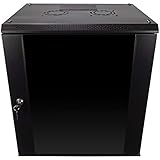
- DURABLE BUILD: Constructed from high-quality Cold Rolled Steel, the NavePoint Consumer Series 12U network cabinet boasts a sturdy, welded frame. Fitting EIA standard 19” networking equipment, this server cabinet confidently supports up to 110 lbs, providing a resilient base for your vital IT gear and equipment
- CONVENIENT DESIGN: This 12U cabinet features a reinforced, heat-treated, tempered glass front door with a security lock. Perfect for applications requiring both security and accessibility, its compact design of 17.72"L x 21.65"W x 24.42"H offers a practical solution for space-constrained settings.
- EASY & CUSTOMIZABLE EQUIPMENT SET UP - The 12U IT cabinet, with removable side panels and security locks, offers customization at its finest. Whether it's for an efficient device or cable management, this data cabinet ensures secure, adaptable configurations that suit your networking server requirements
- ENHANCED VENTILATION & SECURITY - Built-in fans and flow-through ventilation work to prevent overheating, ensuring optimal operation of your equipment. The reinforced, lockable tempered glass front door not only boosts security but also facilitates easy monitoring of installed equipment.
- SAFETY & COMPLIANCE - All NavePoint products are built to industry standards.
The global picture depends on the measurement boundary and methodology. The OECD estimates global data-center electricity use at 240–340 TWh in 2022. It also says workloads rose while energy use remained comparatively stable over 2010–2020, partly because of efficiency improvements and the shift to hyperscale facilities, while warning that future growth is uncertain. These global and U.S. figures use different scopes and years, so they should not be treated as directly interchangeable.
How widely have organizations adopted cloud services?
Cloud infrastructure is now part of ordinary business IT, though use varies by organization size and does not mean every workload has moved off-site. Eurostat figures reported by the European Commission in 2024 show that 45.2% of EU businesses used cloud services in 2023. Adoption was 77.6% among large enterprises, 59% among medium enterprises, and 41.7% among small enterprises. The figures describe EU businesses and the 2023 reference year, not global adoption.
What has changed for data-center technology overall?
Cloud shifted the center of gravity from purchasing and managing discrete servers toward coordinating pools of infrastructure through software. That shift enabled greater workload density, faster provisioning, elasticity, and new operating models. It also drove standardized hyperscale facilities and extended computing into edge locations where proximity matters. Physical infrastructure remains essential: cloud depends on data centers, reliable electricity, cooling, and connectivity. The modern landscape is consequently distributed and mixed, with organizations choosing among public cloud, private capacity, colocation, hybrid systems, and edge deployments rather than relying on one model for everything.
Do these 3 things before closing this tab:
1Clear out junk files and repair common Windows errors2Scan for outdated or missing drivers - takes under a minute3Repair Windows errors before they cause bigger problemsQuick Recap
Product prices and availability are accurate as of the date/time indicated and are subject to change. Any price and availability information displayed on Amazon at the time of purchase will apply.

