
Manage a data center rack as a practical operating unit, not as an isolated box: before adding or moving equipment, confirm contiguous rack space, power availability under the facility’s redundancy and failure conditions, and cooling for the equipment’s expected heat load. Track assets, power connections and environmental readings at a level that supports those decisions, then keep the rack record aligned with site-wide maintenance and change processes.
Why manage the data center rack by rack?
Rack-level management makes a complex facility easier to inspect and operate. A rack provides a useful boundary for inventory, physical layout, power measurements and thermal observations. Those observations can then inform broader capacity planning and operating procedures; a rack view is not a substitute for facility-wide engineering or change management.
Bill Kleyman’s April 10, 2013 Data Center Knowledge article framed the approach this way: “The idea is to simplify data center management by breaking a complex environment into more manageable pieces – the racks.” The principle remains useful, but the article is historical. Its vendor references and linked resources should not be treated as current product endorsements or validated availability.
What to check before installing or relocating equipment
Rack units describe vertical space, not whether a rack can safely accept another device. For each proposed installation or move, answer three separate questions:
#1 Best Overall

- Save valuable floor space: 6U wall mount server cabinet Dimensions: 13.78" H x21.65" W x17.72" D.Maximum mounting depth is 14.2"
- Keep critical network equipment secure: glass door and side panels are lockable to prevent unauthorized access. Front door can be installed on either side of the front of the cabinet to satisfy your door swing orientation preference
- Easy equipment configuration: Fully adjustable mounting rails and numbered U positions, with square holes for easy equipment mounting with top and bottom punch-out panels for easy cable access
- Durability: Made of high quality cold rolled steel holds up to 110lb (50kg) (Easy Assembly Required)
- PCI & HIPPA and EIA/ECA-310-E compliant
- Space: Is there enough contiguous space in the intended rack position, with the required mounting and service clearances?
- Power: Can the intended feeds supply the equipment while preserving the redundancy required by the facility, including relevant failure and maintenance conditions?
- Cooling: Can the rack’s cooling path remove the additional heat under the expected workload and operating conditions?
One rack unit (1 U) is 1.75 inches of vertical height, according to ASHRAE’s handbook chapter, which cites EIA 2005 for rack sizing. That measurement helps establish physical fit; it does not show that power or cooling capacity is available.
How to run a rack-level capacity check
- Update the rack inventory. Record each device, its rack-unit location and its power connections. Include relevant environmental sensors and keep the record current when equipment is added, moved or removed.
- Confirm physical fit. Check contiguous rack space, mounting requirements, clearances and cable routing for the specific equipment and rack.
- Establish the expected electrical load. Use appropriate equipment information and workload assumptions, or measurements where available. Confirm that each planned power feed remains within the facility’s applicable limits under its redundancy and maintenance design.
- Assess heat and airflow. Consider equipment inlet conditions, rear exhaust conditions, cable routing and the cooling architecture serving the rack. Match available cooling to realistic heat-load information, rather than assuming that unused rack space implies spare cooling.
- Record and communicate the change. Update capacity views and operating documentation, and follow the facility’s maintenance and change processes so rack records remain consistent with site operations.
The appropriate calculations, operating limits and approval steps depend on the site’s topology, equipment, workload, redundancy scheme and cooling design. Use facility engineering documentation, current applicable standards, local requirements and equipment manufacturers’ specifications to establish them.
What rack power readings tell you—and what they do not
Power can be observed at different levels: total rack load, rack PDU load or, where supported, an individual IT device’s draw. These readings answer different questions. A rack-level value helps show the combined demand; PDU telemetry can show what passes through a particular distribution unit; device-level telemetry can help identify where demand is changing.
Rank #2

- Universal 19” Rack Mount Compatibility – Perfect for pro audio, video, IT, and network gear. Compatible with mixers, routers, patch panels, servers, power amps, and more.
- Heavy-Duty Load Capacity – Built to support up to 550 lbs. Ideal for studio gear, DJ setups, server equipment, and AV components that demand serious stability.
- Robust Steel Frame & Design – Made with 1.5mm thick steel and weighs 36 lbs for maximum durability, reduced vibration, and long-term reliability in any setting.
- Mobile & Secure – Preinstalled with 3” industrial-grade caster wheels (lockable), making it easy to move and position your rack exactly where you need it.
- All-In-One Setup Kit Included – Comes with 34 rack screws (5mm & 6mm), a 1U blank spacer, and an assembly tool—ready for fast installation out of the box.
An intelligent rack PDU may extend monitoring to cabinet or device level, depending on the model and installation. ASHRAE TC 9.9’s 2016 power white paper calls continuous per-cabinet or even per-device monitoring a data center and facilities management best practice. Monitoring data can support data-driven decisions and integration with DCIM, but a meter reading alone does not establish safe remaining capacity. Compare readings with circuit ratings, topology, equipment limits and thermal conditions.
Free tools Windows power users keep installed
One-click scans. No signup required.
There is no universal rack power allowance that can be applied safely to every facility. Usable capacity depends on the installation’s electrical design, redundancy, equipment, workload, airflow and cooling capacity. Avoid treating a generic wattage or a historical or vendor example as a site limit.
How to assess rack cooling and thermal conditions
Equipment placement and workload affect both power demand and heat release. ASHRAE describes data center loads as dynamic and emphasizes realistic characterization of load and heat. Cooling should be evaluated against the actual heat load and the facility’s cooling architecture, not inferred from rack-unit availability.
Rank #3

- ADJUSTABLE DEPTH: 4- Post 22U 19" server rack enclosure with 4 vertical rails and adjustable mounting depth 5.7" to 33.0" (14,4cm to 83,8cm); IT rack is compatible with various servers / switches / data / video / AV and other IT networking equipment
- EASY SHIPPING AND ASSEMBLY: Enclosed 22U data rack cabinet ships compact flat-packed to avoid damage and facilitate installation; Include wheels & levelling feet to offer more stability; Home server rack cabinet is only 46.6in (118,3cm) in height
- DESIGN AND VENTILATION: Half height server rack cabinet has lockable and removable door and side panels with vented top allowing airflow; 4 Post 19" rack with 1764lb (800kg) weight capacity (stationary); Computer cabinet rack is EIA/ECA-310-E Compliant
- HARDWARE INCLUDED: Rolling home network rack includes rack mounting and equipment mounting hardware, such as 20 M6 cage nuts / screws, PVC cup washers; Front/rear doors and side panels Keys, 2x allen keys; Rack assembly hardware; Casters and leveling feet
- THE IT PRO'S CHOICE: Designed and built for IT Professionals, this 22U IT Server Cabinet is backed for life, including free lifetime 24/5 multi-lingual technical assistance
Review the conditions that shape the rack’s thermal behavior:
- Equipment inlet conditions and rear-of-rack exhaust conditions.
- Airflow paths and the effect of cabling and installed equipment on those paths.
- Sensor placement and whether the readings represent the conditions operators need to monitor.
- The installed cooling design, including whether the relevant interfaces are air- or liquid-based.
- Expected workload and resulting heat release, including changes after equipment is relocated.
Rack PDUs may sit in warmer rear-of-rack exhaust air. ASHRAE TC 9.9’s 2016 paper recommends designing new rack PDU products for at least 60°C (140°F); this is a recommendation from that paper, not a substitute for checking a particular PDU’s specifications or the facility’s expected conditions. Verify the hardware’s operating-temperature rating for its intended location.
Quick wins for a faster PC:
Repair Windows errors before they cause bigger problemsFix Now →Fix the driver behind crashes, sound loss and screen glitchesFind Drivers →Clear out junk files and repair common Windows errorsFree Scan →Choosing rack monitoring and supporting hardware
Choose monitoring according to the decision it needs to support and the existing installation. A metered rack PDU is one category for rack power measurement; intelligent models may offer additional cabinet- or device-level monitoring. No source establishes a universally best product or configuration.
Rank #4
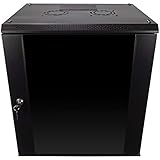
- DURABLE BUILD: Constructed from high-quality Cold Rolled Steel, the NavePoint Consumer Series 12U network cabinet boasts a sturdy, welded frame. Fitting EIA standard 19” networking equipment, this server cabinet confidently supports up to 110 lbs, providing a resilient base for your vital IT gear and equipment
- CONVENIENT DESIGN: This 12U cabinet features a reinforced, heat-treated, tempered glass front door with a security lock. Perfect for applications requiring both security and accessibility, its compact design of 17.72"L x 21.65"W x 24.42"H offers a practical solution for space-constrained settings.
- EASY & CUSTOMIZABLE EQUIPMENT SET UP - The 12U IT cabinet, with removable side panels and security locks, offers customization at its finest. Whether it's for an efficient device or cable management, this data cabinet ensures secure, adaptable configurations that suit your networking server requirements
- ENHANCED VENTILATION & SECURITY - Built-in fans and flow-through ventilation work to prevent overheating, ensuring optimal operation of your equipment. The reinforced, lockable tempered glass front door not only boosts security but also facilitates easy monitoring of installed equipment.
- SAFETY & COMPLIANCE - All NavePoint products are built to industry standards.
| Decision dimension | What to verify |
|---|---|
| Measurement granularity | Whether rack-, PDU- or device-level readings are needed and supported. |
| Electrical compatibility | Fit with the installation’s voltage, phase, current, connectors and redundancy scheme. |
| Operating environment | Temperature rating for the expected location, including warmer rear exhaust conditions. |
| Physical installation | Mounting, outlet configuration and cable routing requirements. |
| Environmental monitoring | Sensor placement and whether temperature or other relevant readings represent the rack conditions to be managed. |
| Airflow and cooling | Whether the proposed arrangement fits the cooling design and preserves required airflow. |
| Operational integration | Whether asset records, change processes and existing monitoring or DCIM systems can use the information. |
Rack cable-management hardware, blanking panels and temperature sensors may be useful where the rack layout and cooling design call for them. Their suitability is installation-specific; they are not universal fixes for cooling or capacity problems. Confirm electrical, mounting, temperature, outlet and redundancy compatibility before selecting a PDU or other rack hardware.
Make rack observations part of facility operations
A rack record is most valuable when it is connected to documented operations. Uptime Institute guidance links capacity management and operating conditions with airflow and electrical monitoring. Use rack observations to support site-level maintenance, capacity reviews and change control, rather than allowing separate rack records to drift from facility documentation.
The BICSI 2019 text consulted discusses the interaction of rack layout, cabling, power and heat loads. Because that copy is hosted outside BICSI, verify any normative requirement against an authorized, current edition before relying on it. For engineering decisions, check current standards, local requirements, facility documentation and manufacturers’ specifications.
Quick Recap
Product prices and availability are accurate as of the date/time indicated and are subject to change. Any price and availability information displayed on Amazon at the time of purchase will apply.

