
Recommended Free Tools
60 GHz wireless can provide a high-capacity backbone inside a building when routing cable is difficult, disruptive, or expensive. It works best when the chosen equipment matches the actual route: a conventional point-to-point bridge needs a suitable radio path, while links through concrete or around corners require equipment designed and tested for those conditions. Treat throughput and obstacle-handling figures as product-specific claims, not guarantees for every building.
What 60 GHz wireless can—and cannot—do
IEEE 802.11ad defines physical- and media-access-layer changes for very high throughput in the 60 GHz band, typically 57–66 GHz, according to the IEEE 802.11ad task group. A 2025 IEEE 802.18 submission says 802.11ay-2021 extended WiGig operation up to 71 GHz and added mechanisms including channel bonding and MU-MIMO. It also cites a theoretical peak capability of 176 Gbps for 802.11ay, compared with 7 Gbps for 802.11ad; those are standards-level figures, not expected user throughput from an indoor product. The IEEE submission is not a product benchmark.
Not every product supports the same amendment or frequencies. Cambium, for example, lists 802.11ay and 57–66 GHz for its Bridge-in-a-Box 2GB product. Confirm the exact model’s band, regulatory configuration, and local frequency rules before specifying equipment.
Start with the route, not the advertised speed
Draw the intended path between network equipment and identify what lies between the endpoints: open space, corridor turns, floors, concrete walls, doors, or other obstructions. A directional point-to-point bridge is most straightforward when its radios can be mounted, aligned, and connected along a suitable path. Directional beams focus the link; they do not make obstacles irrelevant.
#1 Best Overall
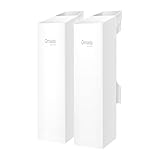
- 𝐓𝐏-𝐋𝐢𝐧𝐤 𝐎𝐌𝐀𝐃𝐀 𝐄𝐬𝐬𝐞𝐧𝐭𝐢𝐚𝐥 𝐑𝐞𝐦𝐨𝐭𝐞 𝐂𝐥𝐨𝐮𝐝 𝐌𝐚𝐧𝐚𝐠𝐞𝐦𝐞𝐧𝐭 𝐏𝐥𝐚𝐭𝐟𝐨𝐫𝐦: Managable over TP-Link OMADA cloud platform. Enjoy the uniform network management experience everywhere in one system, including CPE, Access Point, Network Switch, Gateway
- 𝐄𝐚𝐬𝐲 𝐒𝐞𝐭 𝐮𝐩 𝐰𝐢𝐭𝐡 𝟐𝐩𝐜𝐬 𝐊𝐈𝐓 𝐏𝐫𝐞-𝐜𝐨𝐧𝐟𝐢𝐠𝐮𝐫𝐞𝐝: Save significant deploying time and effort by auto-pairing and agile LEDs
- 𝐖𝐢𝐅𝐢 𝟓, 𝟖𝟔𝟕𝐌𝐛𝐩𝐬 𝐒𝐩𝐞𝐞𝐝: Up to 867 Mbps on the 5 GHz wireless data transfer rate
- 𝐋𝐨𝐧𝐠 𝐑𝐚𝐧𝐠𝐞 𝐭𝐫𝐚𝐧𝐬𝐦𝐢𝐬𝐬𝐢𝐨𝐧: Utilize 5GHz, Ideal for long-range wireless transmission up to 0.6 mile, 1km
- 𝟯 𝐆𝐢𝐠𝐚𝐛𝐢𝐭 𝗣𝗼𝗿𝘁𝘀:: 3× 1000M ports to provide more possiblity for your flexible connection options
MikroTik warns that atmospheric attenuation is high at 802.11ad frequencies and says clear line of sight remains important for longer links. Its documentation gives tested distances for specific devices, so those distances should not be transferred to other radios or treated as universal indoor ranges. See the MikroTik W60G documentation for device-specific guidance.
Match the topology to the building
- Point-to-point: Connect two locations, such as a network closet and a remote switch, where the route and mounting positions suit a radio link.
- Multi-node indoor distribution: Use a system designed to distribute connectivity across a floor or navigate specified indoor obstacles if a single aligned link cannot serve the route. Verify the vendor’s architecture and the placement each node requires.
Ask vendors for evidence that matches your path
- What throughput was measured or specified, and is it peak, aggregate, or observed traffic?
- What distance, barrier material, and barrier thickness applied to the stated result?
- Does the equipment support the required Ethernet handoff, power method, mounting, and alignment?
- Does the exact model provide the needed management, VLAN, encryption, monitoring, and failover features?
The sources cited here do not establish a neutral, independently measured performance comparison between the named systems. Their figures cannot support a controlled ranking.
Rank #2
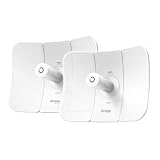
- TP-Link Omada Remote Cloud Management Platform: Enjoy all networks managed in one OMADA platform, including bridges, access points, switches, gateways etc. Remote access, batch management, easy monitoring, smart troubleshooting
- 9.3 mi(15km) Ultra-Range Wireless Transmission: With 23dBi high-gain directional antennas, it can bring your internet to sites 15km away, like "invisible fiber" but without laying any cable
- 867Mbps over 5 GHz: With stable 5GHz transmission and 867Mbps fast connection, it unlocks more possibilities of what can happen on each site
- Plug-and-Play with Preconfigured Kit: Preconfigured for instant PtP auto-pairing, the bridges deliver instant connectivity right out of the box
- PoE Powered, Flexible Deployment: Gigabit PoE port supports both 802.3af PoE and Passive PoE for simplified wiring and lower deployment costs. Passive PoE adapters included
How the available product examples differ
These examples illustrate different design approaches, not a head-to-head test. Confirm current model specifications and suitability with the manufacturer before planning an installation.
| Example | Approach | Published performance or use case | What the figure establishes |
|---|---|---|---|
| Cambium Bridge-in-a-Box 2GB | Pre-paired 60 GHz 802.11ay kit for network extension; Cambium lists 57–66 GHz for this product. | Up to 3.6 Gbps total throughput and up to 500 meters. | Manufacturer specifications, not guaranteed indoor performance at a particular distance or through an obstruction. |
| Airvine WaveCore and WaveTunnel | Indoor products positioned for difficult paths: Airvine describes WaveCore for links through concrete and WaveTunnel nodes for corridor and around-corner coverage. | Airvine reported 3 Gbps through 8 inches of concrete over a 54-foot link, and 4 Gbps through a 12-inch wall within a 6-foot link. | The two results were selected-customer test results reported by Airvine in its September 5, 2024 announcement; they are not independent comparative results or universal guarantees. See the announcement. |
| MikroTik W60G | Device-specific 60 GHz radio options, including point-to-point use. | The documentation distinguishes tested distances by device. | Use the figures only for the documented devices and conditions; the cited material does not provide a common benchmark against the other examples. |
Airvine CEO Vivek Ragavan said in the company’s September 5, 2024 announcement: “We have proven with customers for more than a year now that the WaveTunnel provides cost-effective Gigabit-speed connectivity in MDUs, factories, warehouses, conference centers and other similarly large properties.” This is a vendor executive’s characterization, not independent validation.
What’s actually slowing this PC down?
Pick the symptom - the matching free tool is one click away.
Rank #3
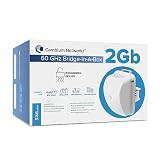
- BRIDGING THE GAP: The 60 GHz Bridge in a Box 2 Gb effortlessly and wirelessly extends networks by simply and easily connection point A to point B. Optimal for enterprise and prosumer use, the 2 Gb features a range of 0.3 mi and comes with two wireless radio modules and Power over Ethernet (PoE) supplies that can be used to extend your network from wherever you have an Ethernet port to wherever you need one. Includes US/Canada cord only.
- READY TO GO: Pre-paired and pre-configured, each Bridge-in-a-Box is extremely easy to deploy, as they come with two wireless radio modules and Power over Ethernet (PoE) supplies that can be used to extend your network from wherever you have an Ethernet port to wherever you need.
- SECURE & EASILY MANAGED: Bridge-in-a-Box solutions can easily be managed with our Cambium Networks cnMaestro cloud-based management system or even cnMaestro, HTTP, HTTPS, SNMP v2c &v3. Bridge-in-a-Box solutions also come with built-in 128-Bit AES Encryption, along with WEP and Password-protected HTTPS for added security.
- CONNECTING COMMUNITIES: The Bridge-in-a-Box is an ideal solution for connecting a wide range of applications such as remote Wi-Fi hotspots, buildings, education applications, video cameras, and construction sites. Wirelessly extend your networks and communities by simply connecting point A to point B.
- THE CAMBIUM DIFFERENCE: When people are able to reliably and effortlessly connect to the internet, great things happen. Businesses grow. Education is enhanced. Healthcare improves. That’s why as a company, we commit ourselves to developing and deploying wireless solutions that deliver outstanding, un-rivaled user experiences. Leaders in hardware, software and management interfaces continuously shatter the status quo, and redefine industry and customer expectations.
Plan the installation and compare it with cabling
A wireless backbone avoids some cable-routing work, but it still needs an engineered path and accessible mounting locations. Before choosing it, check the full deployment tradeoff: equipment and commissioning against cable, drilling, permits, disruption, and future maintenance. A site assessment should account for the actual obstacles and positions, not just a product’s maximum-range specification.
- Power and handoff: Confirm PoE or DC input, Ethernet ports, cable runs to each radio, and whether local power is available.
- Placement and alignment: Confirm that installers can reach endpoints and align radios, and that the intended route remains viable with the building’s walls, doors, and layout.
- Operations: Validate management, VLAN support, encryption, monitoring, and failover on the exact model rather than assuming features are shared across a product family.
- Acceptance testing: Test the installed link under the conditions that matter to your network, including the intended traffic and route; do not substitute vendor maximums for a site result.
Do not confuse WiGig adapters with backbone equipment
Older Intel WiGig products served short-range docking and VR use, a different category from a new building backbone. Intel’s FAQ, last reviewed March 23, 2026, describes Intel WiGig as 60 GHz 802.11ad and says the products it cites are discontinued and no longer supported. Check the Intel WiGig FAQ if evaluating one of those legacy products; its status does not describe current purpose-built bridge systems.
Quick Recap
Product prices and availability are accurate as of the date/time indicated and are subject to change. Any price and availability information displayed on Amazon at the time of purchase will apply.

