
Building a PC again after years away is familiar in one sense: the same core pieces still have to fit together and start reliably. What has changed is the decision-making around them. DDR5, firmware support, Windows 11 security requirements, larger graphics cards and their power connectors, and platform upgrade paths all deserve attention before you buy. The useful first step is not picking a processor; it is deciding what the computer must do, what can be reused safely, and what would make a rebuild worthwhile.
Why rebuild instead of upgrading?
A complete rebuild makes sense when several core parts are due for replacement at once: an old CPU platform, inadequate graphics performance, an aging power supply, or a case that restricts cooling and card clearance. If the graphics card is the only real bottleneck and the existing board, PSU, case, memory, and cooling remain suitable, a targeted upgrade may be the better use of money.
Reuse is not all-or-nothing. A monitor, keyboard, mouse, case, storage drive, or fans may carry over, but assess each item for condition, compatibility, and age. Treat an old power supply especially cautiously: wattage alone does not establish that its connectors, condition, warranty, or behavior under modern GPU loads are appropriate.
A prebuilt or local-shop build is also a valid alternative. A custom build offers control over parts, cooling, and upgradeability, but troubleshooting and support are divided among component makers. A prebuilt can simplify assembly and warranty support; compare its actual parts and upgrade path rather than assuming either route is automatically cheaper.
Quick wins for a faster PC:
Scan for outdated or missing drivers - takes under a minuteDriver Scan →Repair Windows errors before they cause bigger problemsFix Now →Fix the driver behind crashes, sound loss and screen glitchesFind Drivers →#1 Best Overall

- [INTEL POWERED CONTENT] - Built with a 8th Generation Hexa-Core Intel i5 and 32GB of DDR4 RAM; Modern, Windows 11 ready, with 4K support, Executive multitasking, media streaming and smooth, multi-tab web browsing; Perfect as an all-purpose multimedia computer; built for content creators; Plenty of RAM and Mass storage for photo and video editing powered by Intel HD 630
- [LATEST WIRELESS TECH] - This Dell Desktop Computer easily connects to the internet through the Built In WiFi / Bluetooth
- [SOLID STATE STORAGE] - This Dell Computer setup comes with an ultra-fast 1TB Solid State Drive (SSD); Setup as the primary boot device; Boot and load programs with lightning speed ; Additional expansion available
- [BUY & OWN WITH CONFIDENCE] - From the world's largest Microsoft Authorized Refurbisher; Quality Guarantee and Free Tech Support; Award-winning Customer Service; | Support Sustainable Business
- [MODERN HI-SPEED PORTS] - USB 3.0 (x4) | USB 2.0 (x4) | DisplayPort (x1) | HDMI Port (x1) | Audio Combo Jack (x1) | Audio Out (x1) | RJ-45 Ethernet (x1) | Internal SATA (x3)
Set the brief before choosing parts
Write down the work the machine will do and the experience you want from it. Gaming at 1080p and a high refresh rate, 4K gaming, video editing, programming, virtualization, and general desktop use place different demands on the CPU, GPU, memory, and storage.
- Specify the monitor resolution and refresh rate; the display is what makes a graphics upgrade visible.
- List applications, games, or features that matter, such as ray tracing, frame generation, CUDA, AV1 encoding, or large project files.
- Set goals for noise, case size, and ownership period, plus a realistic budget that includes tax, shipping, storage, and any license or peripherals still needed.
- Decide what you may upgrade later. A plausible upgrade path depends on board support, power delivery, PSU capacity and connectors, case clearance, and cooling—not just the socket name.
Do not buy around a vague promise of being “future-proof.” Define the likely first upgrade and check whether the rest of the system can support it.
Choose the platform around the workload
CPU and motherboard
Compare processors in the applications you use, not by core count alone. A gaming-focused system and a rendering or encoding workstation can justify different CPU choices. Integrated graphics can be useful for troubleshooting or as an emergency display output, even when a discrete graphics card is planned.
Platform choice often matters more than buying the most expensive processor. Check the exact motherboard’s CPU-support list and BIOS requirements, memory support, power delivery, M.2 slots, USB layout, networking, fan headers, and diagnostic features. Chipset labels describe feature differences, not a guarantee of better everyday performance. AMD’s AM5 quick-reference guide distinguishes chipset families by connectivity and expansion resources; consult the specific board manual for lane sharing and supported configurations.
Free tools Windows power users keep installed
One-click scans. No signup required.
Rank #2

- Model: Dell OptiPlex 7050 Small Form Factor (SFF)
- Processor: Intel Core i7-7700 3.60 GHz
- Memory: 32GB DDR4 Ram
- Storage: 1TB Solid State Drive (SSD) Fast Boot + Storage
- Operating System: Windows 11 Pro (64-bit)
A newer socket can offer a plausible path to a later CPU, but that is not a promise that every future processor will work without a BIOS update, suitable board power delivery, or adequate cooling.
Memory
DDR4 does not fit a DDR5 motherboard, so old memory usually cannot transfer to a new DDR5 platform. Choose capacity for the workload and budget, then weigh speed, latency, board support, and stability. Two matched modules are generally a simpler starting point than four, particularly when using a high-speed profile.
Memory kits may run at a conservative default until the intended XMP or EXPO profile is enabled in firmware. Enable it only after confirming the system works at defaults, then test stability. The highest advertised speed is not automatically the best value.
Balance graphics, power, cooling, and storage
Graphics card
Choose the GPU for the monitor and applications. Consider performance at the target resolution, ray tracing and upscaling support, VRAM, video encoding, dimensions, connector type, power needs, cooling, and noise. A high-end card can be sensible for 4K or GPU compute but poorly matched to office work or a low-refresh 1080p display.
Recommended Free Tools
Rank #3

- IMMERSIVE 24 INCH DISPLAY: Experience stunning clarity on a Full HD IPS screen with ultra-thin bezels, offering a 90% screen-to-body ratio that makes everything from spreadsheets to streaming come alive with vibrant colors and crisp details.
- POWERFUL INTEL PROCESSING: Tackle demanding tasks with ease thanks to the Intel processor and 16GB of high-speed memory, delivering smooth performance whether you're multitasking between applications or running productivity software.
- GENEROUS STORAGE: Store all your important files, photos, and programs with blazing-fast solid state drive technology that ensures quick boot times, rapid file access, and plenty of space for your digital life.
- ENHANCED PRIVACY AND COLLABORATION: Work confidently with the pop-up privacy camera that tucks away when not in use, plus dual microphones with noise reduction for crystal-clear video calls that keep you connected professionally.
- ECO-CONSCIOUS DESIGN: Feel good about your purchase with an EPEAT Gold registered and ENERGY STAR certified computer that combines premium performance with responsible environmental manufacturing practices.
Vendor performance pages describe the vendor’s own test configurations. For example, AMD identifies its comparisons as AMD Performance Labs data; treat those as vendor results rather than independent testing. Any performance claim is meaningful only with the game or application, settings, resolution, driver, and relevant upscaling or frame-generation state specified.
Power supply and cooling
Assess a PSU by its model, age, condition, connectors, protections, warranty, and suitability for the chosen components—not its wattage label alone. Leave sensible headroom without oversizing by default, and verify that the card’s required power connection can be supplied appropriately.
An air cooler is usually simpler and avoids adding a pump. An all-in-one liquid cooler can suit a high-power CPU, clearance constraint, or aesthetic goal, but adds installation steps and another possible failure point. Check cooler height or radiator fit, GPU clearance, fan direction, and whether the case has an unobstructed intake path.
Storage and case fit
Plan storage by role: operating system and applications, games or active projects, bulk files, and a separate backup. NVMe drives are standard in many current builds, but a higher synthetic transfer score does not necessarily make routine desktop use perceptibly faster. Capacity, reliability, sustained workload behavior, heatsink needs, and backup matter too. Microsoft notes NVMe storage for DirectStorage scenarios; an NVMe drive alone does not guarantee a visible improvement, which also depends on the game and GPU.
Rank #4
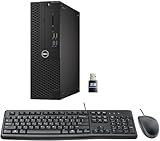
- This Certified Refurbished product is tested and certified to look and work like new. The refurbishing process includes functionality testing, basic cleaning, inspection, and repackaging. The product ships with all relevant accessories, a minimum 90-day warranty, and may arrive in a generic box. Only select sellers who maintain a high-performance bar may offer Certified Refurbished products on Amazon.com.
- Dell Optiplex 3050 SFF Desktop computer PC, Intel Quad Core i5-6500 up to 3.6GHz, 16GB DDR4, 256GB SSD
- Includes: USB Keyboard & Mouse, USB WiFi adapter, Microsoft office 30 days free trail.
- Port: Front: USB 3.0(2), USB 2.0(2); Rear: DP, HDMI, USB 3.0(2), USB 2.0(2), RJ-45.
- Support 4K (3840x2160) Dual display, makes it easy to connect two monitors at the same time, and you can expand working Windows, mirror content, or expand a single window across multiple monitors.
Before buying, compare the exact case and component dimensions: motherboard form factor, GPU length and thickness, cooler or radiator clearance, drive cages, cable-routing space, and front-panel headers. A compatibility checker can flag obvious conflicts, but it does not replace the board and case manuals.
Assemble in a deliberate order
- Prepare a clean workspace and read the motherboard and case manuals.
- With the motherboard accessible, install the CPU without forcing it, fit the M.2 drive, place memory in the recommended slots, and prepare the cooler mounting hardware.
- Install a separate I/O shield if required, then secure the motherboard in the case.
- Fit the PSU and route the 24-pin motherboard and CPU EPS cables, followed by case power, fan, USB, storage, and GPU connections as appropriate.
- Install the cooler according to its instructions, connect the specified fan or pump header, and orient case fans deliberately for intake and exhaust.
- Install and secure the graphics card, then check clearances and cable bends.
- Before first power-on, inspect for loose screws, trapped wires, unseated memory, and missing power connectors. Test before spending time on final cable management.
First boot, firmware, and Windows 11
For a first test, keep the configuration minimal: motherboard, CPU and cooler, one memory kit, required graphics output, and PSU. Confirm the 24-pin and CPU EPS connections. Enter firmware setup and check that the processor, memory, storage, temperatures, and fans are detected. Update firmware only using the motherboard maker’s documented process; menu names and steps vary by board and firmware version.
Once the machine is stable at default settings, enable the memory profile you intend to use, set the boot device, and install the operating system. Windows 11’s published baseline includes a compatible 64-bit processor, 4 GB RAM, 64 GB storage, UEFI firmware, Secure Boot capability, TPM 2.0, and DirectX 12-compatible graphics. Those are minimum requirements, not a recommendation for a comfortable new build. Windows 11 Home also requires internet access and a Microsoft Account during initial setup. See Microsoft’s Windows 11 requirements.
Processor eligibility depends on the Windows release: Microsoft’s support documentation is version-specific, so check the list for the release being installed rather than treating “Windows 11 compatible” as timeless. For example, Microsoft maintains a Windows 11 version 25H2 supported AMD processor list.
Crashes, No Sound, or Screen Glitches?
Random freezes, missing sound and display glitches usually trace back to one bad driver. Find and replace yours safely.Free scan · under a minutePC Slower Than It Used to Be?
A free scan shows the junk files, broken settings and background clutter dragging Windows down - then fixes them in one click.Free scan · Windows 10 & 11Best Value

- Connectivity: Includes WiFi, Bluetooth, and LAN for wireless and wired connections
- Memory: Features 16GB DDR4 RAM for smooth multitasking and performance
- Storage: Combines 500GB SSD and 1TB HDD for ample storage space
- Graphics: Integrated Intel UHD Graphics 630 for crisp visuals and video playback
- Design: Sleek desktop tower with black color and slim profile for modern look
After installation, install current chipset, graphics, network, and audio drivers as needed, run system updates, and verify display resolution and refresh rate. Keep licensing distinct from activation: a hardware change can prompt reactivation, and a successful installation does not by itself establish that a particular license is eligible for transfer. Have recovery information available if the previous drive used BitLocker, since a major hardware change can trigger a recovery prompt.
Independent reader supportYour contribution helps us test, update, and keep practical guides available for everyone.Validate the system before calling it finished
Start with basic checks: firmware detection, temperatures at idle, memory stability, storage health, network and audio, USB ports, front-panel connectors, sleep and restart, and fan behavior. Then test CPU, GPU, and memory under load, followed by the games or applications that motivated the build. Observe noise and temperatures during realistic use.
Do not present a single benchmark as a universal verdict. A useful result records the application or game version, driver, resolution, settings, repeat count, and whether the figure is an average, low, or one-off observation. If temperatures, power, frame rates, or noise were not measured consistently, describe subjective impressions as impressions rather than measurements.
If the first boot fails
- Power off and disconnect power before reseating parts. Check the motherboard 24-pin and CPU EPS connectors first.
- Reseat the memory and try one module in the board-recommended slot. Remove unnecessary USB devices and expansion cards.
- Confirm the display cable is connected to the graphics card when a discrete GPU is needed for output. Read the board’s diagnostic LEDs or error display.
- Clear CMOS only as described in the motherboard manual, then try the minimum bootable configuration.
- Recheck CPU support and any BIOS requirement for that exact board. Do not repeatedly power-cycle a system showing overheating, an electrical smell, or arcing.
What a build total should include
A credible total needs the purchase date and country, currency, tax treatment, and whether each part was new, reused, open-box, or bought in a bundle. Include CPU, board, memory, GPU, cooler, case, PSU, storage, operating-system license, fans, shipping, tax, monitor and peripherals if they are part of the project, then account for rebates and replacement parts. State whether the number is the price actually paid or the current replacement cost.
Do these 3 things before closing this tab:
1Fix the driver behind crashes, sound loss and screen glitches2Clear out junk files and repair common Windows errors3Scan for outdated or missing drivers - takes under a minuteRetailer build pages and bundles can change, so a configuration shown at one price may not be reproducible later. Micro Center’s user-submitted builds page illustrates why a displayed configuration should not be mistaken for a guaranteed current quote. Without dated item-level prices and purchase conditions, a precise total would be misleading.
What feels different after years away
The physical assembly is still recognizable; the planning has become more interconnected. Memory settings can require deliberate firmware configuration, platform choice affects the cost of later upgrades, GPU size and power delivery influence case and PSU decisions, and airflow is part of performance rather than decoration. Windows setup also asks builders to account for TPM, UEFI, Secure Boot, and online first-use requirements.
The practical lesson is to spend less time chasing a headline component and more time checking how the whole system fits the workload. If the old machine’s shortcoming is isolated, upgrade it. If several foundational parts are limiting the result, compare a carefully specified rebuild with a prebuilt or shop-built option—and buy only when the system meets a real need or a clear target.
Quick Recap
Product prices and availability are accurate as of the date/time indicated and are subject to change. Any price and availability information displayed on Amazon at the time of purchase will apply.

