
Usually, no: ordinary subwoofer use is unlikely to damage a computer, monitor, or SSD. The practical risks are vibration transferred through a desk or shelf, equipment being shaken or knocked over, and an overloaded electrical circuit—not bass or a subwoofer magnet simply being nearby. Keep the subwoofer off the computer desk and away from external hard drives, and investigate any rattling, drive errors, or unexpected restarts.
What could actually cause damage?
Four different mechanisms are often confused. Separating them makes it easier to judge whether a setup is safe.
| Mechanism | What happens | Practical concern |
|---|---|---|
| Airborne sound pressure | Bass travels through the air to nearby equipment. | Ordinary room listening is not a credible everyday threat to computer electronics. |
| Structure-borne vibration | Vibration travels through the floor, desk, shelf, or cabinet. | Can make equipment rattle or move, and can affect a mechanically mounted hard drive in a strongly vibrating setup. |
| Direct mechanical coupling | Equipment touches the subwoofer or rests on its enclosure. | Raises the chance of sustained vibration and movement; avoid it, especially for hard drives. |
| Electrical disturbance | The amplifier and other devices draw power from the same circuit. | An overloaded or unstable circuit can cause shutdowns, reboots, or other power-related problems. |
Drive-engineering literature describes how external vibration can affect hard-drive head tracking and performance, with susceptibility influenced by drive design and mounting: USENIX/Seagate research on vibration in hard drives. Dell advises keeping equipment on a stable surface and avoiding severe vibration or impacts: Dell safety precautions.
Which computer components are most vulnerable to vibration?
Mechanical hard drives
A hard-disk drive (HDD) contains spinning platters and moving read/write heads. External vibration can make precise head positioning harder, potentially reducing performance or causing retries. In an unusually vibration-prone arrangement, symptoms may include errors, intermittent noise, or slowdowns; a nearby subwoofer does not mean a healthy drive will suddenly fail.
Do these 3 things before closing this tab:
1Repair Windows errors before they cause bigger problems2Fix the driver behind crashes, sound loss and screen glitches3Clear out junk files and repair common Windows errors#1 Best Overall

- 10" front-firing spun-copper IMG woofer
- All-digital amplifier with 300 watts peak power
- Volume low pass crossover and phase control
- Line level LFE RCA inputs for maximum receiver compatibility
- Dimensions 14 5" x 12 5" x 16 4"
Risk is higher when an HDD is mounted directly on a vibrating enclosure or placed loosely on resonant furniture. A properly secured drive inside a stable case is better isolated than an external HDD sitting on a shelf beside the subwoofer. There is no universal safe decibel limit: frequency, distance, mounting, vibration amplitude, drive model, and exposure time all matter.
Solid-state drives
An SSD has no spinning platters or moving heads, so it is much less vulnerable to mechanical vibration. It can still be damaged by a fall, electrical problems, overheating, or other failures; vibration resistance is not a substitute for backups.
Desktop PCs, monitors, and laptops
Ordinary bass is not expected to harm a computer’s electronic components. More plausible issues are a rattling side panel, loose drive bracket, cable or fan touching the case, or a tower shifting on an unstable surface. A monitor may shake, rattle, or be knocked over if its stand or desk is unstable. Modern flat-panel LCD, LED, and OLED displays are not magnetically vulnerable in the way older CRT displays could be, but physical movement still matters.
Rank #2
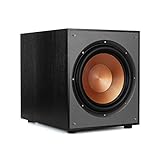
- 12" high excursion spun-copper Imp woofer
- 29 hertz – 120 hertz plus /- 3 dB
- 400 watt
- Max acoustic output 116dB
- Bass-reflex via rear firing port. Amplifier power (control/peak): 200 watts/400 watts
Most current laptops use SSD storage, but older models may contain an HDD. Do not place a laptop directly on a subwoofer. A laptop or dock can also vibrate against a hard surface, and a loose external drive connected to it may be more exposed than the laptop itself.
External HDDs and NAS devices
Check these separately from the computer: an external drive or network-attached storage (NAS) unit may still use spinning HDDs even if the PC has an SSD. Keep them on a stable, rigid surface, out of a resonant cabinet, and never stacked on a subwoofer. Follow the enclosure or NAS manufacturer’s mounting guidance. For portable or vibration-prone storage, an SSD avoids moving drive parts, though important files still need a backup.
Can the subwoofer magnet erase data?
Not under normal household conditions. A subwoofer has a permanent magnet, but its field falls with distance and is not a practical everyday data-erasure threat to a computer beside it. SSDs do not store data magnetically, and casual exposure to a household subwoofer is not a plausible way to erase data on a hard drive.
Rank #3
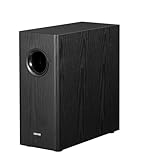
- [ Deep & Powerful 8-Inch Bass ]: Experience 35Hz deep bass with the T5s powered subwoofer, which features an 8-inch long-throw woofer and a powerful 70W RMS output (driven by Class-D amplifier). Perfect for home audio and home theater.
- [ Precision Control, Seamless Integration ]: Adjust the low-pass filter (30Hz–160Hz) and phase selector (0°/180°) to match any home stereo or active speaker setup.
- [ Slim Design, Low Distortion ]: This space-saving compact subwoofer fits into any spaces. The 18mm MDF cabinet with a front-firing driver and right-firing acoustic port minimizes resonance for clean, tight bass. Its wood grain finish and low-profile grille blend seamlessly with home decor.
- [ Smart & Energy-Efficient ]: Auto-standby saves power after 15 minutes of inactivity. The built-in amplifier ensures plug-and-play operation – no external receiver needed! Includes 3.5mm-to-RCA and RCA cables for instant setup.
- [ Two Connections ]: ① Sub out-equipped speakers/amps: RCA to T5s’ Signal In; main speaker connects directly to audio source. ② No sub out: Connect T5s in series (audio source → T5s’ Signal In → T5s’ Signal Out → main speaker). Note: For ②, main speaker requires LINE IN (Bluetooth/USB/optical/non-wired not supported).
That does not mean every magnet is harmless to every device. A very strong magnet placed directly against a sensitive magnetic component, sensor, or old magnetic medium is a different situation. For a typical computer-and-subwoofer setup, vibration—not magnetism—is the concern worth addressing.
Can a powered subwoofer overload the same circuit?
Potentially. A powered subwoofer has an amplifier and power supply, and its wall consumption varies with the model, volume, program material, and efficiency. An advertised peak amplifier-watt figure is not the same as continuous electricity drawn from the outlet. Use the subwoofer’s input-power or current specification where available, and consider the other equipment on the circuit.
A powerful gaming PC, several displays, other amplifiers, or high-load appliances such as space heaters and air conditioners can add to circuit demand. Power sags and related disturbances can cause computer shutdowns, lockups, data loss, or equipment damage; NIST discusses these effects in its computer power-protection guidance.
Rank #4

- POWERED SUBWOOFER FOR EXTRA BASS & PUNCH – 10-inch Dynamic Balance woofer and configured directed port provide accurate bass depth that brings music and movies alive. The perfect home theater subwoofer for small-to-mid size rooms. Waterproof : No
- LOUDER CLEARER SOUND EVEN AT HIGH VOLUME – Enjoy a thrilling balanced audio experience with rich, deep sound, even at low frequencies, when using the 10 inch subwoofer. BLENDS EASILY WITH ANY SPEAKER & plays demanding nodes without distortion
- DOUBLE THE AMPLIFIER POWER TO 100 Watts of Power with its in-built 50-watt RMS amp. Sophisticated engineering featuring best in class resonance-free driver materials makes this subwoofer with built in amp highly durable and FIT FOR EXTENDED USE
- EASY TO INTEGRATE WITH EXISTING SYSTEMS – Hook up this compact subwoofer to the receiver and upgrade your music sound instantly. Features continuously variable 80-160 Hz crossover and 40-160 Hz (-3dB) frequency response
- A sleek detachable grille on the front, speaker and line-level inputs, speaker-level outputs on the back, plus a Phase Toggle Switch for multiple subwoofers, make this home subwoofer cohesive and complete
- Possible power symptoms: a breaker trips, the computer reboots when audio is loud, a UPS signals overload, lights flicker, or several devices shut down together.
- Do not assume a surge strip solves overload: surge protection does not make an overloaded circuit safe or stop vibration.
- Use a UPS carefully: size it for both watt and VA capacity. APC recommends roughly 20–25% spare UPS watt capacity over the total connected load; that is APC buying guidance, not an electrical-code requirement. See its UPS sizing guide.
- Check load compatibility: a small computer UPS may not suit a large amplifier or another high-inrush load. APC gives a general warning about some non-IT loads in its UPS compatibility guidance; this is not a claim that every subwoofer is incompatible.
A computer and subwoofer can share a properly rated wall circuit when its total load and wiring are suitable, but do not daisy-chain power strips. If practical, keep the computer on a correctly rated surge protector or UPS and plug the subwoofer into a suitable wall receptacle or rated strip. Do not put a large powered subwoofer on a computer UPS without checking that unit’s watt, VA, and load guidance. APC also advises against connecting a generic power strip or surge protector to an APC UPS output because it can interfere with load reporting, overload the UPS, or contribute to dropped loads: Schneider Electric/APC guidance.
Could bass interfere with Wi-Fi, Bluetooth, USB, or loosen components?
Acoustic output should not normally interfere with Wi-Fi or Bluetooth. If connectivity or audio problems coincide with subwoofer use, consider electrical noise, a ground loop, a damaged or poorly routed cable, or a shared power problem rather than assuming the bass itself is disrupting wireless signals.
Vibration may expose an already loose part: a side panel, fan grill, cable bundle, drive bracket, or inadequately supported graphics card. Audible buzzing is more often a loose panel, fan, cable, drive mount, desk, or shelf than a failed electronic component. Ordinary home subwoofer vibration is not a reason to assume solder joints have been damaged.
What’s actually slowing this PC down?
Pick the symptom - the matching free tool is one click away.
Best Value

- New twisted flare port contributes to clear and tight bass
- Advanced YST II (Yamaha Active Servo Technology II)
- 10” cone woofer
- Stylish addition to any room
How to make a setup safer
- Put the subwoofer on the floor. Do not place it on the computer desk or directly under a computer, laptop, monitor, external drive, or NAS.
- Keep a gap between equipment. Make sure the subwoofer does not touch the desk, tower, drive enclosure, or cabinet holding the equipment.
- Stabilize the equipment. Use a level, stable surface; secure the monitor and tower so they cannot walk or tip, and keep cables from being pulled tight or caught.
- Check storage types. Find out whether the computer, external drives, and NAS contain HDDs. Secure HDDs using the manufacturer-approved mounts.
- Address resonance, not just volume. If furniture rattles, move the subwoofer first. Proper isolation feet or a suitable platform may reduce vibration transferred to the floor or furniture, but they must be stable and rated for the load.
- Check the electrical setup. Note the computer power-supply rating, the subwoofer’s input specification, any UPS watt and VA ratings, and other high-load devices on the circuit.
- Keep backups. A backup protects against drive failure from any cause, not just vibration.
- Respond to symptoms. If a drive clicks, equipment moves, the computer restarts, or a breaker trips, reduce the volume and relocate or isolate the subwoofer while you investigate.
How to diagnose a suspected problem
Test for structure-borne vibration
- With audio paused, lightly check whether the desk, shelf, case, and external-drive enclosure are already loose or rattling.
- Play bass at the loudest level normally used and compare how much those surfaces vibrate.
- Move the subwoofer to the floor if it is on or against furniture, then compare the vibration again.
- Listen for rattles or intermittent drive noise. If an external HDD visibly moves or rattles, relocate it.
This is a practical check, not a manufacturer-certified test. It can help identify a resonating surface; it cannot establish that a drive is healthy.
Check drive health when errors or noises appear
If the computer freezes, reports I/O errors, or a drive clicks, grinds, or whines abnormally, back up important files first, then use the drive maker’s diagnostic tool. Check that drive brackets, screws, and SATA and power connections are secure. Seagate recommends backing up and diagnosing drives with abnormal noises and notes that mounting can contribute to vibration: Seagate internal hard-drive troubleshooting. If the noise continues with the subwoofer off, investigate ordinary drive failure rather than blaming the audio system.
Check power symptoms separately
If the computer reboots, the breaker trips, or a UPS reports overload when the system is loud, stop increasing volume and review the circuit and connected loads. Repeated trips, flickering, or unexplained shutdowns warrant investigation of the power arrangement. A surge strip is not a fix for an overloaded branch circuit; have a qualified electrician assess suspected wiring or circuit problems rather than opening mains equipment or altering household wiring yourself.
What acoustic-interference research does—and does not—show
Security researchers have demonstrated that deliberately engineered acoustic interference can disrupt or damage hard-drive availability and integrity: see the study on acoustic attacks against hard drives and its USENIX Security presentation. These specialized experiments are not evidence that ordinary home listening will destroy a drive. The research supports treating sound-based interference as a real but unusual edge case, not equating any audible bass with a threat.
Quick Recap
Product prices and availability are accurate as of the date/time indicated and are subject to change. Any price and availability information displayed on Amazon at the time of purchase will apply.

