
Not for most people. U.2 and U.3 can be better than M.2 for sustained heavy writes, enterprise endurance, power-loss protection, high-capacity drives and hot-swappable storage. But they are not inherently faster, cooler or more reliable just because they use a larger enclosure. For a laptop or ordinary desktop, a well-chosen M.2 NVMe SSD remains the simpler, cheaper default.
The choice is about workload and platform, not a contest between “NVMe” and “M.2”: NVMe is a storage interface, while M.2, U.2 and U.3 describe different form-factor and deployment arrangements. NVM Express lists both M.2 and U.2 among the form factors used with NVMe.
What M.2, U.2, U.3 and NVMe actually mean
These labels describe different layers of an SSD. Mixing them up leads to misleading claims about speed and compatibility.
M.2 is a compact module
M.2 SSDs are small circuit-board modules that fit directly into a motherboard or laptop slot. Depending on the drive and slot, an M.2 device can use SATA or PCIe/NVMe; the label alone does not guarantee NVMe. Module lengths include 2230, 2242, 2260 and 2280. Check the motherboard manual for supported protocol, keying, length and PCIe lane configuration. Seagate’s SSD overview distinguishes the M.2 form factor from the interfaces it can use.
Quick wins for a faster PC:
Repair Windows errors before they cause bigger problemsFix Now →Fix the driver behind crashes, sound loss and screen glitchesFind Drivers →#1 Best Overall

- Simplicity | Tool-free and easy to use: Easily access your 2.5" & 3.5" SATA SSDs and HDDs or your U.2 (SFF-8639) SSDs with this convenient, tool-less USB adapter. This adapter makes it simple to work with a variety of drives
- Compatibility | USB with TRIM & UASP: The adapter connects through a USB 3.2 Gen 2x1 (USB 3.1) interface for up to 10Gbps of bandwidth. It is backward compatible with older USB ports at respective protocol speed limits. This adapter supports TRIM and UASP for maximum device endurance and performance
- Power | Handles Hungry Drives: A power adapter is included to provide power for 3.5" HDDs and U.2 SSDs. This helps make sure your drives have sufficient power to remain stable during prolonged use
- Convenience | Everything you need in one package: An integrated USB cable makes your life a little bit easier. Know when the adapter is working by checking the LED power indicator. Plug in the adapter and then the drive, and off you go; it couldn't be simpler
- Support | Backed by Sabrent: Designed for Windows and macOS but may work with other devices. Contact technical support team if you need any assistance
U.2 is a 2.5-inch enterprise-oriented drive arrangement
U.2 SSDs are typically 2.5-inch drives connected to a host through a cable or backplane. Most modern examples are NVMe over PCIe. The enclosure has room for more NAND packages and components such as a controller, DRAM and, on models designed for it, power-loss-protection circuitry. That space can help with cooling and serviceability; it does not itself dictate speed or features.
U.3 is an ecosystem for compatible tri-mode systems
U.3 is associated with the SFF-TA-1001 connector ecosystem and is intended for enterprise systems that can support NVMe, SAS and SATA devices through an appropriate tri-mode backplane and controller. A similar-looking connector does not ensure that a drive will work in a particular U.2 or U.3 bay. Drive protocol, backplane wiring, controller and firmware all matter. The U.2/U.3 distinction depends on the supported system architecture, not just the drive’s shape.
NVMe and PCIe describe other parts of the connection
NVMe is a command interface for storage devices, commonly carried over PCIe; it is not a physical drive shape. PCIe generation and lane width influence the link’s potential bandwidth, while the controller, NAND, firmware, workload and thermal conditions influence real performance. The NVMe specification set covers multiple form factors and capabilities; the NVMe 2.3 specification set was released on August 5, 2025, according to NVM Express.
What M.2 does well—and where it can become limiting
M.2 became the default in consumer computers because a small module can sit directly on the motherboard, fits laptops, needs no drive cable and is broadly supported. Retail choice and competition are strong, installation is straightforward, and modern consumer models can deliver excellent burst performance. These advantages matter for boot drives, games, applications and everyday file access.
Rank #2

- Mount two 2.5-inch U.2 NVMe SSDs into the computer via PCIe 3.0 x8 interface. (NOT support hot swapping!)
- 2x SSD requires motherboard BIOS support for bifurcation; otherwise, only drives close to the PCIe interface will be recognized.
- It can be used as a system disk by configuring the motherboard BIOS to boot from PCIe. NVMe SSDs offer significantly faster read and write speeds compared to traditional SATA-based SSDs due to their low latency and efficient utilization of the PCIe interface.
- This adapter enables users to leverage the high performance and low latency capabilities of NVMe SSD technology, making it ideal for applications that require fast storage, such as high-end gaming, professional content creation, data analytics, or enterprise-level storage arrays.
- Only Full-Height Bracket included.
Heat can concentrate around the slot
An M.2 controller and NAND occupy a small area, often close to a graphics card or beneath a motherboard heatsink. Long writes, several closely packed drives or high-power PCIe 5.0 models can challenge cooling. A properly placed and cooled M.2 slot may perform perfectly well; the form factor alone does not mean a drive will throttle.
Consumer endurance and power-loss protection vary by product
Many consumer M.2 SSDs are designed for client workloads and do not include enterprise-grade power-loss protection (PLP). That can matter for databases, active virtual machines and write-heavy services, where protecting in-flight data and metadata during an abrupt power loss may be important. But neither “M.2 lacks PLP” nor “U.2 has PLP” is universally true: verify the exact model’s datasheet. Some enterprise M.2 drives have PLP, and product features differ within U.2/U.3 as well.
A UPS can reduce the risk of a power interruption, but it does not replace drive-level PLP: it cannot prevent every abrupt power, controller or cable event.
Motherboard mounting can complicate servicing
Replacing an M.2 drive may require removing a heatsink, graphics card or other components, depending on the board layout. Most M.2 slots are not designed for front-access hot swapping. This is usually inconsequential in a personal computer but inconvenient in a system expected to run continuously or be serviced frequently.
Free tools Windows power users keep installed
One-click scans. No signup required.
Rank #3
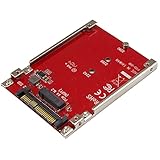
- BOOST SYSTEM PERFORMANCE: Add the fast performance of a PCIe M.2 NVMe or AHCI SSD to your desktop computer or server, this adapter converts the drive to fit into a 2.5" drive bay and connect to a U.2 (SFF-8639) compatible host interface
- PCIe M.2 SSD TO 2.5" U.2 ADAPTER: Increase your system speed and performance cost-effectively, by adding an M.2 PCIe NVMe/AHCI SSD to your PC or server with data transfer speeds up to 7.8GBps when used with a PCIe Gen 4 slot/system
- HASSLE-FREE SETUP: This M2 to U.2 adapter offers a fast and easy setup with native OS support
- COMPATIBILITY: M.2 NVMe SSD converter adapter is backward compatible with earlier versions of PCIe NVMe drives and fits in standard 2.5" drive bays; Not compatible with SATA or SAS host controllers / Not compatible with M.2 SATA based drives
What U.2/U.3 can improve
More room for sustained operation and cooling options
A 2.5-inch enclosure gives manufacturers more physical space for components and gives system designers more options for airflow and drive placement. It can move storage heat away from a motherboard hotspot. Enterprise drives may also be designed for more consistent performance during prolonged writes than a client drive that relies on a short-lived write cache. Still, enterprise SSDs can draw more power than low-power M.2 models, so a larger enclosure does not guarantee lower temperatures or quieter operation. Compare actual model specifications and the cooling available in your case. Form factor, power and workload all affect thermal behavior.
Endurance and predictable heavy-write behavior
Enterprise SSD families commonly offer endurance ratings and firmware aimed at data-center workloads, along with stronger error-management specifications or more overprovisioning than typical client models. The relevant measure is the specific drive’s endurance rating—often expressed in drive writes per day (DWPD) or total bytes written—and its performance under the workload you expect. A rating describes a defined workload and warranty period, not a promise that a drive cannot fail.
PLP, when the exact model includes it
Some enterprise U.2/U.3 models use onboard energy reserves to complete in-flight writes and protect internal metadata if external power disappears. That is useful for systems where storage consistency matters more than a consumer benchmark result. Confirm the datasheet’s definition of PLP: protection scope is product-specific, and the connector or form factor is not proof that a drive has it.
Higher-capacity options and front-access replacement
More enclosure volume lets manufacturers fit more NAND, and enterprise families include capacities that may be uncommon or costly in consumer M.2 products. Micron’s 7600 and 7500 enterprise product documentation is an example of U.2/U.3-class offerings. Availability and capacity vary by model; a larger drive is not automatically economical if you do not need the capacity or cannot back it up.
What’s actually slowing this PC down?
Pick the symptom - the matching free tool is one click away.
Rank #4

- U.2 to PCIe 4.0 X4 adapter: converts one PCIe X4/X8/X16 slot on your motherboard into a U.2 (SFF-8639) port for a 2.5" U.2 NVMe SSD.
- Direct-to-CPU design with no bridge chip: FCC and CE certified for highly reliable, stable PCIe X4 full speed - the U.2 SSD performs exactly as if it was installed on the motherboard.
- No capacity limit for U.2 SSDs: 4TB / 6TB enterprise-class drives work, ideal for bringing datacenter SSDs to a desktop, workstation or home server.
- To reach PCIe 4.0 X4 (64Gbps) full speed, the CPU, motherboard PCIe slot and U.2 SSD must all support PCIe 4.0 (Intel CPUs below 11th generation do not support PCIe 4.0).
- OS boot supported: reinstall the OS and set BIOS/UEFI boot from the U.2 SSD (some older motherboards only support storage mode). Backed by GLOTRENDS lifetime tech support.
In a compatible chassis, U.2/U.3 drives can sit in front-access carriers or bays, making replacement and multi-drive layouts easier. Hot swap requires support from the drive, backplane, controller and system configuration; a 2.5-inch drive alone does not make a system hot-swappable.
How the formats compare
| Attribute | M.2 NVMe | U.2 NVMe | U.3 / tri-mode system |
|---|---|---|---|
| Typical setting | Laptops, desktops and gaming PCs | Servers, workstations and homelabs | Enterprise servers and storage systems |
| Physical arrangement | Compact module on a motherboard | Typically 2.5-inch cabled drive | Typically 2.5-inch drive in a compatible enterprise bay |
| Cooling and placement | Depends on slot location and heatsink | More enclosure volume and airflow options | Depends on drive, bay and platform |
| Hot swap | Usually not | Possible with suitable hardware and configuration | Possible in supported systems |
| Power-loss protection | Product-dependent; uncommon on consumer models | Product-dependent; common in enterprise models | Product-dependent; verify the model |
| Speed | Depends on PCIe generation, lane width, drive design, workload and thermals—not the form factor alone. | ||
| Installation | Usually simplest | May require a cable, adapter or backplane | Requires a compatible tri-mode platform |
| Consumer availability | Broad | More limited | Primarily enterprise-oriented |
“U.2 is faster” is not a safe general rule. A U.2 and M.2 SSD with the same PCIe generation and x4 link can have similar interface limits; a newer M.2 drive can beat an older U.2 drive in burst tests. An enterprise U.2 model may instead be the better fit for sustained writes, endurance or PLP. Compare equivalent workloads, not just peak sequential figures. The interface and workload are central to the comparison.
Check compatibility before buying a U.2/U.3 drive
A U.2/U.3 SSD can turn into a costly non-working component if the host path is wrong. Verify each link in the chain before ordering.
- Confirm the host’s PCIe lanes and slot wiring. Look for a motherboard U.2 connector, a compatible M.2-to-U.2 route or an available PCIe add-in-card slot. Check the manual for lane sharing: occupying one M.2 slot can disable another slot or reduce lanes. A passive adapter cannot create lanes, and multi-drive cards may require PCIe bifurcation or an onboard switch.
- Match the adapter to the source slot. Check M.2 keying, PCIe lane count and power delivery. An M.2 SATA-only slot cannot drive a U.2 NVMe SSD. Confirm whether the adapter is intended for an NVMe host and whether the drive receives adequate power as well as PCIe signaling.
- Match the drive, backplane and controller protocols. Identify whether the drive is U.2 or U.3 and whether the bay is wired for PCIe/NVMe, SAS, SATA or tri-mode operation. Consult the motherboard or server manual, backplane documentation, controller compatibility list and drive datasheet. Do not assume a U.3 drive will work in any U.2 slot, or that any U.3-branded bay supports every protocol.
- Check power, space and airflow. Review the drive’s active and idle power, adapter or backplane input, PSU capacity and cooling requirements. Confirm the carrier or enclosure fits the drive’s dimensions. Greater storage performance can bring higher system power and fan noise.
- Confirm firmware and operating-system support. Check boot support if the SSD will be a boot drive, and verify any vendor firmware requirements, OEM restrictions, RAID/HBA compatibility and hot-plug settings. A drive recognized as secondary storage may not be bootable on a particular consumer board.
Pick the storage format that fits the workload
| Use case | Practical starting point | Why |
|---|---|---|
| Laptop, office PC or general desktop | M.2 NVMe | Simple installation, broad support and ample performance for typical client workloads. |
| Gaming PC | M.2 NVMe | Usually the most convenient choice; U.2 is justified only by unusual capacity, sustained-write or serviceability needs. |
| Video editing or large scratch/ingest workload | Compare sustained-write behavior; consider enterprise M.2 or U.2/U.3 | Workload duration, cache exhaustion, cooling and endurance matter more than burst speed alone. |
| Database, virtualization or active services | Enterprise SSD with documented PLP and endurance | Data protection and sustained behavior can be more important than compactness; enterprise M.2 is also an option. |
| NAS, server or homelab with compatible bays | U.2/U.3 where the platform supports it | Front access, multi-drive layouts and serviceability may be valuable. |
| Large, infrequently accessed archive | Consider SATA SSDs or hard drives alongside an SSD tier | Not every capacity problem needs an enterprise NVMe drive; cost and access pattern matter. |
When U.2/U.3 is a strong fit
- You write continuously or unpredictably and need drive specifications for sustained workloads.
- You need documented PLP, higher rated endurance or high-capacity enterprise options.
- Your workstation, NAS or server has compatible bays, lanes and cooling.
- You value front-access replacement and can support the extra cabling, adapters, power and system complexity.
When M.2 is the better choice
- You are building a laptop or ordinary desktop for gaming, office work, browsing or typical application storage.
- Your workload is mostly read-heavy or consists of intermittent writes.
- You want broad retail availability, simple installation and a straightforward warranty path.
- Your board has no compatible U.2/U.3 connection, spare PCIe slot or suitable chassis.
Enterprise M.2 is a useful middle ground
The decision is not limited to consumer M.2 versus U.2/U.3. Enterprise M.2 models can offer features such as PLP, higher endurance ratings or data-center firmware while retaining a compact module. They can be harder to source, may cost more than consumer models and still face the same thermal constraints as other M.2 drives.
Best Value

- HIGH PERFORMANCE U.2 STORAGE: Add a 2.5 inch U.2 NVMe SSD into a PCIe 4.0 x4/x8/x16 slot in a desktop or server, enabling ultra-fast data access; Supports SFF-8639 drives up to 15mm in height; For NVMe U.2/U.3 drives only; SATA/SAS protocols not supported
- UNIVERSAL COMPATIBILITY: Backwards compatible with PCI Express 3.0 motherboards that have an available x4, x8, or x16 PCIe slot; U.2 Adapter works with all workstation and server operating systems such as Windows, Windows Server, and Linux
- PREVENT OVERHEATING: Vented full-profile bracket and a large cutout in the PCB allow for better airflow and heat dissipation, which helps maintain optimal and reliable performance while reducing potential thermal throttling
- HASSLE-FREE SETUP: Pre-installed full-profile bracket & included drive mounting screws enable the connection of a U.2 drive to a PCIe slot, without the need of a drive backplane or additional cables; The U.2 to PCIe Card requires no drivers or software
- THE IT PRO'S CHOICE: Designed and built for IT Professionals, this U.2 to PCI Express Adapter Card is backed for two years, including free lifetime 24/5 multi-lingual technical assistance
Account for the hidden system cost
U.2/U.3 is often an ecosystem purchase, not simply a different SSD. The total setup may need a cable, PCIe adapter, power connection, carrier or compatible backplane, plus a free slot and enough airflow. Multi-drive cards can add bifurcation or controller requirements. These costs, along with chassis space, noise and firmware qualification, can outweigh an attractive used-drive price.
Enterprise products are often sold through distributors or quote-based channels, and pricing varies by capacity, endurance class, firmware, warranty and condition. There is no stable universal per-terabyte comparison that makes U.2/U.3 automatically cheaper. Calculate the complete, supported system rather than comparing drive-only prices.
Buying a used enterprise SSD: inspect its history
A used data-center drive can be a good fit, but “enterprise” does not mean unused or indestructible. Before relying on one, check the health log exposed by the drive and the seller’s return terms.
- Percentage used or remaining life, and remaining spare capacity.
- Data units written or total bytes written, compared with the model’s endurance specification.
- Power-on hours and unsafe shutdown count.
- Media and data-integrity error counts.
- Firmware revision and whether the drive is an OEM-specific model.
- Warranty status, provenance and return policy.
- Whether it is locked to a vendor platform or needs particular firmware or controller support.
Health indicators help assess a drive’s history; they do not guarantee future reliability. Keep independent backups for important data regardless of SSD format.
Is U.2/U.3 the future beyond M.2?
U.2/U.3 remains useful in enterprise and workstation infrastructure, but it is not clearly the universal next consumer socket. SNIA describes 2.5-inch SSDs as a common deployment form factor and also points to EDSFF in newer enterprise designs. SNIA’s form-factor overview covers 2.5-inch and EDSFF storage. A 2024 Future Memory Storage presentation describes M.2 as the de facto consumer socket and EDSFF as a direction for enterprise systems. That presentation is an industry outlook, not a guarantee of future adoption.
For a consumer, the most effective fix for an M.2 problem may be better slot placement or heatsinking, a suitably specified enterprise M.2 drive, a PCIe add-in card, or a tiered storage setup. U.2/U.3 is a valuable escape hatch when its endurance, protection or serviceability solves a real need—and the host can support it.
Quick Recap
Product prices and availability are accurate as of the date/time indicated and are subject to change. Any price and availability information displayed on Amazon at the time of purchase will apply.

