
Free tools Windows power users keep installed
One-click scans. No signup required.
There is no single product called “PCBs Calculators.” The term covers tools for estimating trace width, impedance, via behavior, heat, power delivery, circuit values, and manufacturing geometry. Match the calculator to the problem: Saturn PCB Toolkit offers the broadest PCB-focused set in this guide; DigiKey is convenient for quick browser calculations; TI and Analog Devices offer tools tied to analog and component-design workflows. For controlled impedance or demanding power and thermal designs, treat calculator output as a starting estimate and validate it against the actual board stackup, manufacturer guidance, or simulation.
Choose a calculator by the problem you need to solve
| Engineering need | Useful tool type | Inputs that matter most | Important next step |
|---|---|---|---|
| Quick trace-width estimate | Browser trace-width calculator | Current, copper thickness, layer, temperature rise | Check voltage drop, vias, and narrow sections |
| Production power routing | PCB toolkit plus fabricator review | Resistance, trace length, vias, thermal environment, current profile | Verify bottlenecks and transient heating |
| Single-ended controlled impedance | Transmission-line calculator | Actual stackup, trace width, copper, dielectric spacing and properties | Confirm geometry with the fabricator |
| Differential interface routing | Differential-impedance calculator | Target impedance, pair width and spacing, layer geometry | Review return path, transitions, and skew |
| Power or signal vias | Via-current, thermal, or signal-integrity calculator | Finished hole, plating assumptions, pads, antipads, layer transition | Check current sharing or via stubs as applicable |
| Device heating | Thermal calculator | Power, ambient or case temperature, thermal path | Use package data and board-specific conditions |
| Analog circuit design | Electronics or vendor design calculator | Loading, component values, tolerances, operating conditions | Check datasheets and circuit behavior |
| Manufacturing geometry | Padstack and unit-conversion tools | Drill, copper, annular ring, clearance and process rules | Use the selected fabricator’s capability limits |
PCB calculators worth considering
Saturn PCB Toolkit: broad PCB-focused coverage
Saturn PCB Toolkit groups many PCB calculations in one desktop application. Its official page lists version 8.47 and functions including trace width and resistance, via current and voltage drop, microstrip and stripline impedance, differential pairs, crosstalk, maximum trace length, power-delivery-network impedance, thermal resistance, padstacks, BGA lands, and basic circuit calculations. It is a strong first choice when you need multiple PCB-specific calculators rather than one formula. Its results still depend on the inputs and models selected; it is not a field solver or a manufacturing guarantee.
DigiKey: quick browser-based calculations
DigiKey’s trace-width calculator estimates conductor width from current and allowable temperature rise, and can calculate resistance, voltage drop, and power loss when trace length is supplied. It identifies IPC-2221 as its calculation basis. DigiKey’s trace-impedance calculator covers impedance and identifies IPC-2141 as its basis. For general electronics, DigiKey also provides online calculators for tasks such as Ohm’s law, dividers, time constants, and filters. These are handy for a quick check, but their convenience does not replace a full stackup or circuit analysis.
TI and Analog Devices: vendor-supported design tools
TI Analog Engineer’s Calculator is a downloadable Windows tool for analog design, passive circuits, PCB parasitics, sensors, and related calculations. TI lists version 2.1.0, released March 23, 2026. TI also offers a voltage-divider calculator for resistor-divider selection and attenuation circuits. These tools are most useful when the calculation fits an analog or TI-centered design workflow, not as substitutes for PCB layout or signal-integrity software.
#1 Best Overall

- Valued Carpenter Pencil Set: You will get 2 pcs solid carpenter pencils with 26 piece 2.8 mm refills, 1 replaceable sharpener, 1 plastic storage box.The complete carpenter pencils combination allows you to finish your work faster and more easily
- Deep Hole Marker Pencil: The deep-hole construction pencils adopts 45mm elongated tip design, which is more convenient to mark in the small hole or in other tight areas that other carpenter markers cannot reach
- Carpenter Pencils with Sharpener: The sharpener is screwed into the top of the work pencil, which won't get lost either. Built-in pencil sharpener that keep the lead with pointed and smooth to Improves line of sight in fine work
- Stronger Solid Lead: This work pencil is matched with a 2.8 mm thick lead , which is much thicker and stronger during the drawing process of construction work, it will not break or damage easily
- Marks on Various Surfaces: 3 colors solid construction pencil can marks on various surfaces,such as metal, plastic, wood, paper etc. Ideals for woodworkers, contractors, craftsmen, builders, merchants and masons
Analog Devices’ design-tools directory and its toolbox collect tools for analog, RF, amplifier, power, and product-selection problems. Individual tools may have different availability or requirements, so check the specific tool rather than assuming the entire directory has one platform or license model.
Trace width, resistance, voltage drop, and power loss
A trace-width result answers a thermal question only under the calculator’s assumptions: how wide a conductor should be for a specified current and allowable temperature rise. It does not, by itself, prove that the rail has acceptable voltage drop or that the entire current path is adequately sized. Saturn lists trace calculations based on IPC-2152, while DigiKey identifies IPC-2221 for its trace-width tool; those methods should not be expected to return identical values.
For a DC path, voltage drop and resistive loss follow:
Vdrop = I × R
Ploss = I²R
A trace can remain within a thermal limit while losing too much voltage, particularly on low-voltage rails, battery-powered boards, LED drivers, or motor and actuator supplies. Include trace length when assessing resistance and check the narrowest section, component-pad neck-downs, connectors, fuses, protection devices, and vias. A wide surface trace can still be bottlenecked by a small plated hole or pad connection.
Inputs to check before accepting a trace result
- Enter whether the current is continuous or transient, including pulse duration and duty cycle where relevant.
- Select the correct internal or external layer and use the intended copper thickness; finished and base copper thickness are not necessarily interchangeable.
- Use a realistic allowable temperature rise and thermal environment. Airflow, copper spreading, board construction, and heat sinking affect the result.
- Include trace length if the tool calculates resistance, voltage drop, or power loss.
- Model the actual current path: a trace, plane, pour, or parallel routes may not behave like one isolated conductor.
- Check vias and other constrictions separately, and add design margin for manufacturing tolerances and operating variation.
Saturn’s listed trace functions include resistance, voltage drop, power dissipation, and skin-depth-related outputs. Those additional values are useful, but they do not make the selected geometry automatically appropriate for every board or frequency.
Rank #2

- Ergonomically Designed: Work in tight areas with a compact design that gets into tough spots
- Compact and Lightweight: Both tools are designed to fit into difficult to reach spaces. The 1/4" impact driver has a length of 5.55 in. and weighs just 2.8 lbs, while the 1/2" drill/driver measures only 7.5 in. and weighs 3.6 lbs
- Both the DEWALT impact driver and electric drill driver feature integrated LED work lights with a convenient 20-second delay, ensuring enhanced visibility in dimly lit or challenging work areas
- One-Handed Loading - Keep one hand free with a 1/4 in. hex chuck that accepts 1 in. bit tips
- Power drill cordless with 1/2" single sleeve ratcheting chuck provides tight bit gripping strength, making bit changes faster and more secure
Trace impedance: use the real stackup
Impedance calculators estimate characteristic impedance for structures such as microstrip, embedded microstrip, stripline, coplanar waveguide, and coupled lines. The result changes with conductor width and thickness, distance to the reference plane, dielectric properties, pair spacing, solder mask, and layer geometry. Saturn lists several of these structures; its help documentation describes how geometry, frequency, dielectric assumptions, and structure selection affect impedance and related propagation calculations.
“FR-4” does not specify one exact dielectric constant, and a nominal CAD layer spacing may not match the fabricator’s pressed and finished stackup. A calculator can therefore show a precise-looking result from inaccurate inputs. For controlled-impedance routing, use this workflow:
- Set the target impedance from the relevant interface specification, component vendor guidance, or design requirement.
- Ask the chosen fabricator for a controlled stackup and its actual dielectric thickness and copper assumptions.
- Enter those values and the correct structure—such as microstrip or stripline—in the calculator.
- Solve for trace width and, for coupled structures, spacing.
- Send the proposed geometry to the fabricator for review and follow its impedance-coupon or test process when required.
The calculation does not guarantee final manufactured impedance, acceptable insertion loss, correct connector or package behavior, or a clean via transition. Use a fabricator’s stackup guidance for production geometry; use field solving, simulation, or measurement when the design’s risk warrants it.
Differential-pair calculators
A differential calculator estimates pair impedance from the target and geometry: trace width, spacing, copper thickness, reference-plane distance, dielectric properties, and whether the pair is edge-coupled, embedded, or broadside-coupled. Saturn lists several differential structures, including edge-coupled and broadside-coupled arrangements. Do not assume one target impedance applies to USB, Ethernet, LVDS, HDMI, DisplayPort, or PCIe; take the target and tolerance from the applicable interface requirement or device guidance.
Correct calculated impedance is only one part of a working pair. Keep the routing geometry consistent, preserve a suitable reference path, and assess transitions through vias and connectors. Plane interruptions can disrupt return current; via transitions can introduce impedance discontinuities and skew. Length matching should follow the interface timing budget, rather than an arbitrary rule that every segment must be identical.
Rank #3

- 【Great Compatibility】This Katerk 1/4 inch hex shank bit holder is specifically designed for 1/4 inch hex shank drill bits. It's compatible with most 1/4 fast hex handles, hex sockets, various electric screwdrivers, and handheld screwdrivers. The bit holder makes it a valuable addition for any handyman.
- 【Secure and Safe】Built with a secure backup nut design, each drill bit holder securely locks onto your bits, ensuring they stay firmly in place. Additionally, our bit holder incorporates a high-quality steel ball rolling design that holds up to several kilograms of weight, ensuring your various drill bits don't fall off.
- 【Easy One-Handed Operation】The bit holder for impact driver allows you to change bits single-handedly, simplifying your workflow. Its multi-color design further allows for quick identification of the drill bit you need.
- 【Compact and Convenient】Thanks to its compact size, this 1/4 inch bit holder is easy to carry around. The bit holder allows for easy attachment to various tools, making this a convenient addition to your construction accessories. The Katerk bit holder is cast from high-quality alloy material, promising a long product lifespan. Despite its rugged strength, the bit holder remains lightweight, making it portable.
- 【Cool Christmas Gift For Men Stocking Stuffers】 This screwdriver bit holder, driver bit holder, impact bit holder, can be given as a gift to your loved one, especially for anyone involved in construction or electrical work. It's a must-have for stocking stuffers for men and women, tools gifts for dad, tech gadgets for men, gifts for dad, gifts for him, gifts for husband, gifts for boyfriend, cool gadgets for men, and cool gifts for dad.
Via calculators: current capacity and signal behavior
A via is a short plated conductor with electrical and thermal constraints. Saturn’s listed via functions include current, capacitance, inductance, impedance, step response, DC resistance, resonant frequency, thermal resistance, voltage drop, and power dissipation. Its help documentation describes inputs such as finished hole diameter, inner-layer pad diameter, reference-plane opening, layer set, and via type.
For power vias
- Estimate current per via and the number of vias needed, then examine whether current will actually divide evenly.
- Check temperature rise, voltage drop, and resistance, including narrow pad connections and antipad-related constrictions.
- Use realistic finished-hole and plating assumptions; manufacturing tolerances and the thermal path affect the result.
For high-speed vias
- Consider barrel inductance, pad and antipad dimensions, reference-plane clearances, and return-current continuity.
- Assess layer transitions, via stubs, and whether back-drilling is appropriate for the signal and stackup.
- Do not interpret a via-current value as a blanket rating for every via pattern or operating condition.
Thermal calculators and junction temperature
A simple thermal estimate relates power to temperature rise. With ambient temperature and junction-to-ambient thermal resistance:
PC Slower Than It Used to Be?
A free scan shows the junk files, broken settings and background clutter dragging Windows down - then fixes them in one click.Free scan · Windows 10 & 11Crashes, No Sound, or Screen Glitches?
Random freezes, missing sound and display glitches usually trace back to one bad driver. Find and replace yours safely.Free scan · under a minuteTJ = TA + PDθJA
Where case temperature and junction-to-case resistance are the more useful path:
TJ = TC + PDθJC
Saturn includes a thermal-resistance calculator for estimating junction temperature from thermal resistance and power dissipation. TI’s thermal-calculation application report provides further context and references PCB thermal calculation. Thermal-resistance values depend on test board, copper area, airflow, package, orientation, and measurement method; a datasheet’s θJA is not a universal package property for every layout.
Thermal vias can help conduct heat into other copper layers, but their benefit depends on the board stackup and thermal path. A calculator may also miss nearby heat sources, enclosure temperature, restricted airflow, or transient heating. For a crowded or high-power assembly, use board-specific thermal analysis or measurement rather than relying only on a steady-state estimate.
Rank #4

- Long Nib and Deep Hole Marker: Our mechanical carpenter pencil with 45mm nib is designed for easy marking of deep holes or narrow areas. These construction pencils are the great choice for woodworking tools, construction tools, carpenter tools, contractor tools, wood carpentry tools and architect tools
- Extra Refills in 2 Colors for Versatile Marking: The construction mechanical pencil comes with 12 extra 2.8mm refills, including 6 red and 6 black refills. The black refill is suitable for light surfaces, while the red wax is perfect for dark surfaces. Our carpenter mechanical pencil makes sure that you'll have an ample supply for extended use
- Built-in Sharpener: Our construction pencil comes with a built-in sharpener to ensure the mechanical pencil tip is always sharp and ready for use. Never buy an extra pencil sharpener again. A great tool for any woodworker pencil, contractor pencils. The refill can easily be extended or retracted with a simple click of the pencils mechanical, allowing you to work more efficiently and accurately
- Portable Clip Design: Our deep hole construction pencil features a portable clip design, easy to carry and attach to your pocket or tool box, so that you can keep the carpenter pencils mechanical close at hand, making it a convenient tool to have on the go. Great gifts choice for carpenters
- Stronger Pencil Lead: The black refills are made of lead, sturdy and smooth. The red refills are made of wax, clear and light. These marking pencils are much thicker and stronger than normal pencils during the marking process of construction work, suitable for various surfaces, such as glasses, metal, boards, floors, walls, furniture, etc. The written marks can be easily wiped with a wet paper towel when needed
Power-delivery-network calculators
A power-delivery-network (PDN) calculator helps estimate target impedance and assess supply impedance over frequency. Saturn lists a Power Delivery System Impedance Calculator. Useful analysis may require load-current step size, allowed ripple, regulator output impedance, effective capacitance, capacitor ESR and ESL, mounting and via inductance, plane behavior, and anti-resonance.
Quick wins for a faster PC:
Repair Windows errors before they cause bigger problemsFix Now →Scan for outdated or missing drivers - takes under a minuteDriver Scan →Clear out junk files and repair common Windows errorsFree Scan →A simple capacitor-value calculation is not enough for a fast digital load or a sensitive switching-regulator design. Start with the IC vendor’s reference design, account for real capacitor parasitics and placement, and use frequency-dependent simulation or measured impedance when the design is sensitive to ripple or transients.
Independent reader supportYour contribution helps us test, update, and keep practical guides available for everyone.Maximum trace length and edge-rate behavior
Whether a trace needs transmission-line treatment depends more on signal rise time and propagation delay than on the clock’s repetition rate alone. A low-frequency clock with fast edges can still make a long interconnect electrically significant. Package, connector, via, receiver threshold, and topology also affect the result.
Saturn lists a bandwidth and maximum PCB trace-length calculator using IPC-2251 or a frequency-domain method. Treat any calculated length threshold as a screening aid, not a universal rule or compliance test. For a fast interface, review the complete channel—including launches, vias, connectors, and termination—and use simulation or measurement when needed.
General electronics calculators
PCB design also relies on circuit calculators that do not describe board geometry. Common tasks include Ohm’s law and power, resistor and capacitor combinations, LED resistor selection, RC and RL time constants, filter cutoff, reactance, resonance, decibels, op-amp gain, ADC resolution, sensor conversion, crystal-load capacitance, regulator feedback, and resistor tolerance or E-series selection.
What’s actually slowing this PC down?
Pick the symptom - the matching free tool is one click away.
Best Value
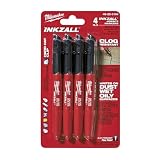
- Milwaukee Ink all Fine Point Marker, Black, 4 Per Pack
- 4 per pack Features Clog Resistant Marker Tip Writes through Dusty, Wet and Oily Surfaces Durable Marker Tip for Writing on Concrete, OSB and Rough Surfaces
- Clog resistant tip writes on dusty, wet and oily surfaces and is optimized for rough surfaces such as OSB, cinderblock and concrete
- Hard hat clip- attaches for easy access
- Quick dry time with reduced smearing and marking
TI’s Analog Engineer’s Calculator covers analog and passive-circuit calculations, sensors, PCB parasitics, and related design work. DigiKey’s calculator directory includes common electronics calculations such as voltage dividers, time constants, filters, and Ohm’s law. Analog Devices’ design tools and toolbox are useful starting points for calculations tied to analog, RF, power, or specific products.
Voltage dividers: account for the load
A basic divider calculation often assumes that nothing draws current from its output. If the load resistance is connected across the lower divider resistor, the effective lower resistance is:
Reffective = R2 ∥ RL
Ignoring ADC input behavior, bias current, pull resistors, or a downstream circuit can make the predicted output materially wrong. TI’s voltage-divider tool supports resistor-divider selection and noninverting attenuation; precision designs still need component tolerances and actual loading included.
Manufacturing geometry and electrical clearances
Supporting tools can convert millimeters and mils, convert copper thickness or drill sizes, and calculate AWG, padstacks, annular rings, BGA lands, conductor-to-pad geometry, and via arrays. Saturn lists unit conversion, drill charts, AWG conversion, padstack calculations, BGA-land calculations, and conductor-to-pad functions.
Recommended Free Tools
Generic calculators do not replace the selected fabricator’s capability table or applicable safety rules. Distinguish electrical clearance from creepage, solder-mask clearance, fabrication minimums, assembly minimums, and regulatory insulation requirements. Mains and other high-voltage designs need requirements appropriate to their voltage, environment, and applicable standards—not just a generic spacing result.
How to use a calculator responsibly
- Define the requirement. Decide whether the design question is current capacity, voltage drop, impedance, temperature, circuit behavior, or a manufacturing limit.
- Gather actual inputs. Use the component datasheet and, where relevant, the fabricator’s stackup and process data rather than generic nominal values.
- Select the right model. Choose the actual layer and geometry; check the calculator’s stated method and assumptions.
- Normalize units and operating conditions. Confirm mils versus millimeters, finished versus base copper, peak versus continuous current, and the relevant ambient or transient conditions.
- Check related constraints. Pair a thermal trace check with voltage drop and vias; pair an impedance calculation with transitions and return path; pair a divider with loading and tolerance.
- Validate proportionately to risk. Ask the fabricator to review controlled-impedance geometry, or use simulation, prototype measurement, or specialist analysis when the design is sensitive or safety-critical.
- Record the assumptions. Keep the inputs, model or standard, and result with the design so a later revision does not silently change the basis.
Where calculators can mislead
- Different methods produce different estimates. DigiKey identifies IPC-2221 for trace width and IPC-2141 for impedance; Saturn identifies IPC-2152 for trace and via-current calculations. Do not combine their outputs as if they were a single guaranteed standard.
- Imprecise stackup inputs create false confidence. Wrong dielectric spacing, material properties, layer type, or omitted solder mask can materially change an impedance estimate.
- A thermal estimate may not describe the assembled product. Copper spreading, airflow, enclosure, nearby heat, and transient load can differ from the assumed conditions.
- Current may not divide as assumed. Via arrays and parallel copper paths can have uneven sharing because of geometry and connection resistance.
- Electronics calculators may omit real circuit effects. Divider loading, resistor tolerances, capacitor ESR and ESL, and component operating limits can dominate the result.
Escalate beyond a simple calculator for RF or microwave structures, multi-gigabit links, precision analog circuits, high-voltage insulation, high-current battery or inverter boards, dense thermal assemblies, unusual laminate stacks, or safety-critical and regulated equipment. Depending on the question, the next method may be a fabricator’s impedance service, an electromagnetic field solver, SPICE, thermal simulation, a vendor reference design, TDR testing, or prototype measurement.
Quick Recap
Product prices and availability are accurate as of the date/time indicated and are subject to change. Any price and availability information displayed on Amazon at the time of purchase will apply.

