
Build the MCP layer separately from the automation backend. For browser pages, a Playwright-based server can inspect accessibility snapshots and act on referenced elements. For native Windows applications, use Microsoft UI Automation (UIA) to inspect the element tree, properties, control patterns, and events. These are different adapters behind the same MCP-facing design; browser automation does not automatically control every desktop application.
A dependable server follows an inspect → target → act → verify cycle, exposes only narrowly scoped tools, validates every argument, and treats state-changing calls as privileged operations.
Choose the automation surface before writing MCP tools
First decide what the agent must control. A web application running in Chrome or another supported browser is a browser-automation problem. A Windows desktop program with native windows and controls is a UI Automation problem. Keep the MCP contract stable while swapping the adapter underneath it.
| Decision axis | Browser with Playwright MCP | Native Windows with UI Automation |
|---|---|---|
| Target | Pages rendered in a browser | Controls in Windows desktop applications |
| State access | Accessibility snapshots containing roles, text, and element references | Element trees, properties, control patterns, and events |
| Setup evidence | Playwright’s getting-started guide lists Node.js 20 or newer and an MCP client | Windows UI Automation client/provider interfaces |
| Coverage caveat | The documented implementation is for browser automation, not arbitrary native applications | Standard controls are generally exposed; custom or unsupported third-party controls can require providers |
| Security implication | The Playwright project explicitly says MCP is not a security boundary | UIA supplies inspection and control APIs, not an MCP authorization model |
Do not promise universal coverage. A control is automatable only when the target application exposes usable semantics or you have a separately constrained fallback.
Recommended Free Tools
#1 Best Overall

- [INTEL POWERED CONTENT] - Built with a 8th Generation Hexa-Core Intel i5 and 32GB of DDR4 RAM; Modern, Windows 11 ready, with 4K support, Executive multitasking, media streaming and smooth, multi-tab web browsing; Perfect as an all-purpose multimedia computer; built for content creators; Plenty of RAM and Mass storage for photo and video editing powered by Intel HD 630
- [LATEST WIRELESS TECH] - This Dell Desktop Computer easily connects to the internet through the Built In WiFi / Bluetooth
- [SOLID STATE STORAGE] - This Dell Computer setup comes with an ultra-fast 1TB Solid State Drive (SSD); Setup as the primary boot device; Boot and load programs with lightning speed ; Additional expansion available
- [BUY & OWN WITH CONFIDENCE] - From the world's largest Microsoft Authorized Refurbisher; Quality Guarantee and Free Tech Support; Award-winning Customer Service; | Support Sustainable Business
- [MODERN HI-SPEED PORTS] - USB 3.0 (x4) | USB 2.0 (x4) | DisplayPort (x1) | HDMI Port (x1) | Audio Combo Jack (x1) | Audio Out (x1) | RJ-45 Ethernet (x1) | Internal SATA (x3)
Use a small, testable server architecture
Keep four layers separate
- MCP transport and lifecycle: Accept connections from the host client, advertise tools, validate requests, and return structured results.
- Policy layer: Check the target application, permitted operation, arguments, user identity, and confirmation requirements before dispatching an action.
- Automation adapter: Call Playwright for browser pages or UIA for native Windows controls. Do not mix browser selectors and UIA element references in one adapter.
- Observation and audit: Capture the relevant state before and after an action, record failures, and return enough evidence for the client to decide what happened.
Start with composable tools
A practical first surface has four operations:
- inspect: Return the current page snapshot or UIA subtree, including names, roles, and available capabilities.
- find: Resolve one control using semantic properties such as role, name, automation identifier, or supported pattern.
- act: Perform one bounded operation, such as click, set value, invoke, or submit.
- verify: Read an observable post-action condition, such as a changed label, enabled state, dialog, URL, or event.
Returning a successful input call is not proof that the task completed. Make verification part of the tool workflow or require the client to call it immediately afterward.
Illustrative tool contract
{
  "name": "click_control",
  "description": "Click one approved control and report its resulting state",
  "inputSchema": {
    "type": "object",
    "properties": {
      "application": {"type": "string"},
      "name": {"type": "string"},
      "role": {"type": "string"},
      "confirmation": {"type": "boolean"}
    },
    "required": ["application", "name", "confirmation"]
  }
}
The exact SDK calls and wire details depend on the language and MCP SDK version you select. Keep the schema explicit, reject unknown fields, and return a machine-readable result containing the matched element, action outcome, and verification state.
Browser implementation with Playwright MCP
Prerequisites and launch
Playwright’s getting-started documentation uses Node.js 20 or newer and an MCP client. Its example launches the server with:
npx @playwright/mcp@latestConfigure that command in the MCP client you use (for example, the client’s server configuration file). Treat this as a Playwright-specific setup example, not as a requirement of the MCP protocol itself.
Quick wins for a faster PC:
Fix the driver behind crashes, sound loss and screen glitchesFind Drivers →Repair Windows errors before they cause bigger problemsFix Now →Rank #2

- Model: Dell OptiPlex 7050 Small Form Factor (SFF)
- Processor: Intel Core i7-7700 3.60 GHz
- Memory: 32GB DDR4 Ram
- Storage: 1TB Solid State Drive (SSD) Fast Boot + Storage
- Operating System: Windows 11 Pro (64-bit)
How the browser flow works
- Ask the server for an accessibility snapshot rather than starting with a screenshot.
- Select an element by the role, accessible name, text, or returned reference.
- Perform exactly one action.
- Request another snapshot or a focused read to verify the visible result.
This semantic flow is usually more stable than coordinates. It also makes failures diagnosable: an absent role or name indicates an application-state or accessibility problem, while a stale reference indicates that the page changed and must be inspected again.
Browser-specific safeguards
- Restrict allowed origins and navigation targets in your host policy.
- Do not grant file-system access unless the task requires it.
- Require confirmation before submitting forms, deleting data, purchasing, or changing account settings.
- Expire element references after navigation or a major DOM update; reacquire them from a fresh snapshot.
The Playwright project warns, verbatim: Playwright MCP is not a security boundary.
Its origin lists and file-access guards are convenience defenses, not isolation. Put authentication, authorization, and sandboxing outside the tool descriptions.
Native Windows implementation with UI Automation
Understand the provider model
UI Automation exposes a tree of elements. Clients can inspect properties, query supported control patterns, invoke operations, and subscribe to events. Microsoft documents providers for standard Win32, Windows Forms, and WPF controls. A custom control, or a third-party control without a provider, may expose little or no usable semantic information.
Minimal C# inspection and invocation example
The following example demonstrates the adapter responsibilities: locate a window, inspect a button, check that it supports invocation, invoke it, and report the resulting title. Run it on Windows in a project that references UIAutomationClient and UIAutomationTypes; wrap these calls in your MCP tool handler and enforce your own policy before calling them.
Rank #3

- IMMERSIVE 24 INCH DISPLAY: Experience stunning clarity on a Full HD IPS screen with ultra-thin bezels, offering a 90% screen-to-body ratio that makes everything from spreadsheets to streaming come alive with vibrant colors and crisp details.
- POWERFUL INTEL PROCESSING: Tackle demanding tasks with ease thanks to the Intel processor and 16GB of high-speed memory, delivering smooth performance whether you're multitasking between applications or running productivity software.
- GENEROUS STORAGE: Store all your important files, photos, and programs with blazing-fast solid state drive technology that ensures quick boot times, rapid file access, and plenty of space for your digital life.
- ENHANCED PRIVACY AND COLLABORATION: Work confidently with the pop-up privacy camera that tucks away when not in use, plus dual microphones with noise reduction for crystal-clear video calls that keep you connected professionally.
- ECO-CONSCIOUS DESIGN: Feel good about your purchase with an EPEAT Gold registered and ENERGY STAR certified computer that combines premium performance with responsible environmental manufacturing practices.
using System;
using System.Windows.Automation;

class UiProbe
{
    static void Main()
    {
        var root = AutomationElement.RootElement;
        var window = root.FindFirst(
            TreeScope.Children,
            new PropertyCondition(AutomationElement.NameProperty, "Calculator"));

        if (window == null)
            throw new InvalidOperationException("Target window was not found.");

        var button = window.FindFirst(
            TreeScope.Descendants,
            new AndCondition(
                new PropertyCondition(AutomationElement.ControlTypeProperty,
                                      ControlType.Button),
                new PropertyCondition(AutomationElement.NameProperty, "One")));

        if (button == null)
            throw new InvalidOperationException("Button was not exposed by UI Automation.");

        if (!button.TryGetCurrentPattern(InvokePattern.Pattern, out object pattern))
            throw new InvalidOperationException("Button does not support InvokePattern.");

        ((InvokePattern)pattern).Invoke();
        Console.WriteLine("Invoked: " + button.Current.Name);
    }
}
Production code should avoid hard-coded window titles where possible. Check the process identity, select a stable automation identifier when the application provides one, and handle the possibility that a window or control disappears between lookup and invocation.
Handling controls that expose no provider
- Return a clear unsupported-control error instead of guessing from coordinates.
- Ask the application vendor whether a UIA provider or accessibility setting exists.
- If a visual fallback is unavoidable, isolate it in a separate, explicitly approved tool with a small coordinate region, timeout, and screenshot-based verification.
- Never describe a fallback as equivalent to semantic automation; it has different accuracy and safety characteristics.
Design actions as privileged operations
Validate identity and scope
Every state-changing tool should verify the intended application, window, document or account context, and operation type. Reject a request when the target is ambiguous. Separate read-only inspection tools from mutation tools so a host can apply different approval rules.
Require confirmation for consequential changes
Put explicit confirmation in the host/server workflow for deletion, submission, purchases, permission changes, external messages, and irreversible file operations. Tool annotations can describe risk, but MCP clients must treat annotations as untrusted unless they come from a trusted server. An annotation is not an authorization decision.
Return observable outcomes
Include the selected element’s identifying properties, the operation performed, and a post-action observation. For browser tasks that can be a fresh accessibility snapshot. For UIA tasks it can be a changed property, a newly opened dialog, or an event received within a deadline. Include a timeout status when no confirmation arrives; do not silently retry an action that may already have succeeded.
Rank #4
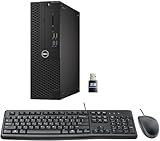
- This Certified Refurbished product is tested and certified to look and work like new. The refurbishing process includes functionality testing, basic cleaning, inspection, and repackaging. The product ships with all relevant accessories, a minimum 90-day warranty, and may arrive in a generic box. Only select sellers who maintain a high-performance bar may offer Certified Refurbished products on Amazon.com.
- Dell Optiplex 3050 SFF Desktop computer PC, Intel Quad Core i5-6500 up to 3.6GHz, 16GB DDR4, 256GB SSD
- Includes: USB Keyboard & Mouse, USB WiFi adapter, Microsoft office 30 days free trail.
- Port: Front: USB 3.0(2), USB 2.0(2); Rear: DP, HDMI, USB 3.0(2), USB 2.0(2), RJ-45.
- Support 4K (3840x2160) Dual display, makes it easy to connect two monitors at the same time, and you can expand working Windows, mirror content, or expand a single window across multiple monitors.
Pin the protocol and SDK versions
MCP maintainers’ 2026-07-28 specification release describes a stateless core, a formal extensions framework, and authorization changes. Pin the protocol and SDK version used by your server, check the negotiated version during initialization, and review compatibility before upgrading. The npx @playwright/mcp@latest command is a convenient Playwright example, but using latest in production can change behavior without a controlled review; pin a tested package version in deployment.
Testing strategy and failure handling
Test the real applications
- Test clean startup, an already-open window, and multiple windows with similar titles.
- Test dynamic pages and controls whose names or enabled states change.
- Test custom and third-party controls separately; verify whether a provider exposes the required pattern.
- Test cancellation, timeouts, disconnected clients, and an action that succeeds just before the timeout.
- Verify the resulting application state, not merely that an input method returned.
Common errors and fixes
| Symptom | Likely cause | Fix |
|---|---|---|
| No browser elements in the result | The page has not loaded, navigation is still in progress, or the element is not exposed in the accessibility tree | Wait for the documented state, inspect again, and use the element’s semantic role and name |
| Element reference is invalid | The page changed after the snapshot | Discard the reference and obtain a fresh snapshot before acting |
| UIA window or control is missing | Wrong process/window, delayed startup, or a control without a provider | Validate process identity, wait with a deadline, inspect ancestors, then report unsupported coverage if no provider exists |
| Pattern is not supported | The control does not implement the requested UIA pattern | Check supported patterns and choose a matching operation; do not cast blindly |
| Action reports success but nothing changed | Focus changed, the action was blocked, or the wrong element matched | Re-read state, include the matched properties in logs, and require verification before proceeding |
| Host accepts a risky tool call automatically | Trust was placed in tool descriptions or annotations | Enforce authorization and confirmation outside the tool metadata |
Performance, reliability, and deployment notes
- Inspection cost: Limit snapshots or UIA subtree walks to the smallest useful scope. Fetch a focused element after the initial discovery.
- Wait policy: Prefer a selector, property, event, or network-idle condition over arbitrary long sleeps. Give every wait a deadline and a cancellation path.
- Concurrency: Serialize actions within one browser page or desktop session unless the target application explicitly supports parallel operations. Keep independent sessions isolated.
- Recovery: After navigation, modal dialogs, window recreation, or a provider event, reacquire targets instead of replaying stale references.
- Observability: Log tool name, validated target, operation, duration, outcome, and verification result. Exclude passwords, tokens, and sensitive document contents.
- Deployment: Run browser automation in a dedicated profile or container where appropriate. Run Windows UIA code under the least-privileged account that can access the target application, and keep the interactive desktop session available.
Or skip the browser setup
If your MCP workflow only needs reliable screenshots of web pages, ScreenshotNeo provides a website screenshot API and MCP server. It is not a native Windows UIA adapter, but it can remove the browser-capture plumbing from an agent that needs page images or PDFs. One GET request is enough:
See the ScreenshotNeo API documentation for parameters and response headers.
curl -G "https://api.screenshotneo.com/v1/shot" -d access_key=YOUR_API_KEY --data-urlencode url=https://stripe.com -o shot.webpimport requests
r = requests.get("https://api.screenshotneo.com/v1/shot", params={"access_key": "YOUR_API_KEY", "url": "https://stripe.com"}, timeout=90)
open("shot.webp", "wb").write(r.content)const q = new URLSearchParams({ access_key: 'YOUR_API_KEY', url: 'https://stripe.com' });
const res = await fetch(`https://api.screenshotneo.com/v1/shot?${q}`);Before capture, ScreenshotNeo accepts cookie or consent banners and removes more than 60 known consent platforms, newsletter popups, and chat widgets; each step can be disabled. Bot checks or CAPTCHAs, blank pages, timeouts, failed loads, and cache hits are not billed, and response headers report the page verdict and billing status. Its MCP server exposes take_screenshot, get_page_info, and capture_pdf for Claude, Cursor, and other MCP clients.
Relevant capture controls include full-page screenshots with lazy images loaded, CSS-selector element capture, dark mode, 12 device presets or custom viewports, retina scale, PDF paper size/margins/landscape/page ranges, HTML/CSS rendering, custom JavaScript and CSS, pre-capture clicks, selector or network-idle waits, ad/tracker/request blocking, custom headers/cookies/user agents/Authorization, timezone and geolocation, transparent backgrounds, resizing, selectable cache TTLs, signed image links, asynchronous jobs with signed webhooks, bulk capture of up to 100 URLs per call, a usage API, and an OpenAPI specification. Parameter names used by other screenshot APIs also work.
Best Value

- Connectivity: Includes WiFi, Bluetooth, and LAN for wireless and wired connections
- Memory: Features 16GB DDR4 RAM for smooth multitasking and performance
- Storage: Combines 500GB SSD and 1TB HDD for ample storage space
- Graphics: Integrated Intel UHD Graphics 630 for crisp visuals and video playback
- Design: Sleek desktop tower with black color and slim profile for modern look
| Plan | Included screenshots | Price |
|---|---|---|
| Free | 1,000 per month | $0, no card |
| Starter | 3,000 | $5 |
| Growth | 15,000 | $15 |
| Pro | 60,000 | $39 |
| Scale | 250,000 | $99 |
| Business | 1,000,000 | $249 |
Yearly billing gives two months free, and every feature is included on every plan. Create a free ScreenshotNeo account to get 1,000 screenshots per month with no card; paid plans start at $5 for 3,000.
Final implementation checklist
- Choose browser Playwright or native Windows UIA before defining tools.
- Expose inspect, find, act, and verify operations with narrow schemas.
- Validate application identity, arguments, permissions, and confirmation state.
- Use semantic properties and supported patterns; report unsupported controls explicitly.
- Reacquire stale references after navigation or window changes.
- Pin and negotiate a known MCP protocol/SDK version.
- Test real applications, custom controls, timeouts, cancellation, and post-action state.
- Keep authorization and isolation outside tool descriptions and annotations.
Frequently Asked Questions
Can one MCP server automate both a browser and a Windows desktop app?
Yes, if it exposes separate Playwright and UI Automation adapters with distinct policies. Do not assume that a browser element reference can identify a native control.
Are screenshots a replacement for accessibility or UI Automation?
No. Semantic APIs provide names, roles, properties, and supported actions. Screenshots are a visual fallback that requires stricter targeting and verification.
The Tool Desk
Outbyte PC Repair FREEClear out junk files and repair common Windows errorsFree Scan →Outbyte Driver Updater FREEScan for outdated or missing drivers - takes under a minuteDriver Scan →What should happen when an application exposes no usable control information?
Return an explicit unsupported-control result, investigate provider support, or place any visual fallback in a separately authorized tool with narrow limits.
Which MCP specification should a new server implement?
Pin the protocol and SDK versions you test, check the negotiated version at startup, and review the MCP 2026-07-28 release changes before upgrading.
Quick Recap
Product prices and availability are accurate as of the date/time indicated and are subject to change. Any price and availability information displayed on Amazon at the time of purchase will apply.

