
Quick wins for a faster PC:
Clear out junk files and repair common Windows errorsFree Scan →Scan for outdated or missing drivers - takes under a minuteDriver Scan →Repair Windows errors before they cause bigger problemsFix Now →The best beamforming wireless access points are not simply the models with the biggest beamforming claim. For most homes and small businesses, the Ubiquiti UniFi U7 Pro is the best-balanced choice; the TP-Link Omada EAP773 offers strong Wi-Fi 7 value, while the NETGEAR WAX630EP remains sensible for compatible Wi-Fi 6E clients. Placement, wired backhaul, PoE, client compatibility, and management determine the result.
Beamforming is useful, but beamforming alone does not guarantee longer range or faster internet. Modern access points combine beamforming with MU-MIMO, OFDMA, band steering, airtime fairness, channel selection, roaming assistance, and centralized management. The right purchase depends on the building, client density, wired network, Wi-Fi generation, and whether you prefer local or cloud management.
Key takeaways
- The Ubiquiti UniFi U7 Pro is the strongest general-purpose prosumer recommendation, with Wi-Fi 7, 6 GHz, six spatial streams, wireless meshing, and a 2.5GbE uplink.
- The TP-Link Omada EAP773 is a strong value-oriented Wi-Fi 7 SMB option, but Omada controller features such as mesh, AI roaming, captive portal, and cloud access require an Omada SDN controller.
- The TP-Link Omada EAP787 is aimed at higher-density deployments and is listed by TP-Link with 10G/2.5G Ethernet, 802.3bt/at PoE, 510+ concurrent connections, and 2,050 square feet of maximum coverage.
- Wi-Fi 7 features such as Multi-Link Operation, 320 MHz channels, Multi-RU, and 4K-QAM require compatible Wi-Fi 7 clients; older Wi-Fi 5 and Wi-Fi 6 devices do not receive the full benefit.
- Ethernet backhaul usually beats wireless mesh for capacity, while multiple correctly placed APs often outperform one expensive, maximum-power AP.
Best beamforming wireless access points: quick comparison
The table compares use-case recommendations rather than claiming that one manufacturer has universally superior beamforming. Specifications, prices, and availability can vary by country, hardware revision, and date.
| Access point | Best for | Wi-Fi and bands | Streams | Ethernet uplink | Power | Management | 6 GHz | Price signal | Main drawback |
|---|---|---|---|---|---|---|---|---|---|
| Ubiquiti UniFi U7 Pro | Prosumer homes and small offices | Wi-Fi 7, tri-band | 6 spatial streams | 2.5GbE | PoE; verify switch budget | UniFi Network | Yes | From $189 in the captured US store listing | 2.5GbE limits the wired path |
| Ubiquiti UniFi U7 Pro Max | Busier homes and SMBs | Wi-Fi 7, tri-band | 8 spatial streams | Refer to current model specification | Verify current PoE requirement | UniFi Network | Yes | $279 in the captured US store listing | Extra capacity may be wasted in a small home |
| TP-Link Omada EAP773 | Value-conscious Wi-Fi 7 SMB deployments | Wi-Fi 7, tri-band | 2×2 downlink/uplink MU-MIMO | 10G/2.5G, depending on revision or catalog | 802.3at PoE or DC | Omada; controller for advanced centralized features | Yes | Check current official or authorized-retailer price | Regional and revision details must be checked |
| TP-Link Omada EAP787 | Higher-density Omada networks | Wi-Fi 7, tri-band | 2+4+2 arrangement | 10G/2.5G | 802.3bt/at PoE or DC | Omada | Yes | Check current price | Needs faster switching and a larger PoE budget |
| NETGEAR WBE750 | Cloud-managed SMB deployments | Wi-Fi 7, tri-band | Refer to current model specification | 10G/1G configuration shown by NETGEAR | PoE++ | NETGEAR Insight | Yes | Historical launch price was $699.99 with one year of Insight | Subscription and support costs matter |
| NETGEAR WAX630EP | Wi-Fi 6E deployments | Wi-Fi 6E, tri-band | Refer to current model specification | 2.5GbE plus 1GbE | PoE++ | NETGEAR Insight | Yes | Current page has no direct purchase price | No Wi-Fi 7 features |
| Ruckus R770 or Ubiquiti E7 family | Enterprise and high-density environments | Wi-Fi 7, specialized options | Higher-capacity radio designs | Multigigabit or 10GbE options | Higher-power PoE may be required | Enterprise-oriented platforms | Yes on relevant models | Enterprise pricing | Cost, design, licensing, and support are disproportionate for most homes |
What does beamforming do in a wireless access point?
Beamforming uses multiple antennas and radio processing to shape a transmission toward a client instead of radiating energy uniformly in every direction. Better signal quality can improve link stability and usable range, particularly when the client supports standards-based beamforming.
The Tool Desk
Outbyte Driver Updater FREEFix the driver behind crashes, sound loss and screen glitchesFind Drivers →Outbyte PC Repair FREERepair Windows errors before they cause bigger problemsFix Now →#1 Best Overall
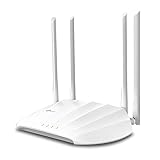
- Superior Speeds with MU-MIMO: Outfitted with the latest 802.11ac Wave 2 MU-MIMO technology, the TL-WA1201 easily delivers dual-band Wi-Fi speeds of up to 1200 Mbps to multiple devices at the same time
- Multi-Mode 4 in 1: Supports Client, Multi-SSID, Range Extender, and AP operation modes to enable various wireless applications to give users a more dynamic and comprehensive experience when using your AP
- PoE for Easy Installation: TL-WA1201 supports Passive PoE power supplies, can be powered by the provided PoE adapter, making deployment effortless and flexible
- Boosted Wi-Fi Coverage: Four external antennas equipped with Beamforming technology concentrate Wi-Fi signals towards your devices to extend reliable Wi-Fi to every corner of your home or office, even over long distances
- Gigabit Ethernet Port: Features a Gigabit Ethernet port that provides high-speed wired connectivity for devices requiring stable and fast network connections
Beamforming does not remove walls, eliminate interference, increase the client device’s transmit power, or guarantee faster internet. A phone with a weak antenna, a congested channel, a poorly positioned AP, or a 1GbE uplink can remain the limiting factor even when the AP advertises advanced beamforming.
Beamforming is most useful when combined with multiple spatial streams, MU-MIMO, OFDMA, sensible channel widths, good AP placement, wired backhaul, and compatible client radios. Terms such as “Beamforming+,” implicit beamforming, explicit beamforming, adaptive beamforming, and proprietary antenna technology should not be treated as equivalent without product documentation.
Beamforming versus directional antennas
Beamforming dynamically shapes a radio signal through antenna and radio processing. A directional antenna has a more fixed radiation pattern and is selected for a particular coverage direction. The distinction matters for outdoor links, corridors, campuses, and specialized venues. For example, Ubiquiti’s E7 Campus advertises selectable 15 dBi/50° or 10 dBi/90° directional antenna patterns, which is a different deployment proposition from ordinary indoor omnidirectional beamforming. See Ubiquiti’s enterprise Wi-Fi lineup for that positioning.
Which access point is best overall?
The Ubiquiti UniFi U7 Pro is the best overall prosumer choice when the buyer wants Wi-Fi 7, 6 GHz, centralized local-style ecosystem management, and a relatively accessible hardware price. Ubiquiti lists the U7 Pro with six spatial streams, wireless meshing, and a 2.5GbE uplink in its U7 Pro technical specifications.
Do these 3 things before closing this tab:
1Repair Windows errors before they cause bigger problems2Fix the driver behind crashes, sound loss and screen glitches3Clear out junk files and repair common Windows errorsThe U7 Pro is a good fit for a wired multi-AP home, home office, small retail location, or small office already using UniFi switches, gateways, cameras, or access control. The U7 Pro is less compelling when the existing network is limited to 1GbE and the client population contains few 6 GHz or Wi-Fi 7 devices, although buying Wi-Fi 7 can still be a deliberate future-proofing decision.
The captured US Ubiquiti store listing showed the U7 Pro from $189. That price is a hardware signal, not a complete deployment cost. The buyer may also need a UniFi gateway or controller hardware, a PoE switch or injector, Ethernet cabling, mounting equipment, and installation.
Is the UniFi U7 Pro Max worth the extra capacity?
The UniFi U7 Pro Max is the higher-capacity UniFi recommendation for larger homes, busy home offices, and small-business environments with more simultaneous clients. Ubiquiti lists eight spatial streams and a dedicated spectral-scanning engine for the U7 Pro Max, compared with six spatial streams for the U7 Pro; the captured US store listing showed a $279 price signal.
More AP-side streams primarily improve aggregate capacity and simultaneous-client handling. More streams do not turn a 2×2 phone into a 4×4 client, and additional streams do not automatically create proportionally greater coverage. The U7 Pro Max is therefore more suitable for busy environments than for a small apartment with a handful of active devices.
Why choose the TP-Link Omada EAP773?
The TP-Link Omada EAP773 is a strong value-oriented Wi-Fi 7 access point for prosumers and SMBs that want 6 GHz, guest networking, VLAN-oriented deployment, and an Omada management ecosystem. TP-Link documents beamforming, MU-MIMO, OFDMA, and Wi-Fi 7 capabilities for the EAP773 product.
TP-Link specifically qualifies that Wi-Fi 7 features including Multi-Link Operation, 320 MHz channels, 6 GHz, 4K-QAM, Multi-RU, OFDMA, MU-MIMO, and BSS Coloring require compatible clients. The AP can advertise those capabilities while most older clients continue operating with older Wi-Fi behavior.
Rank #2

- Free Omada Essentials Cloud Management: Free cloud management with no additional fees, everything is managed in the cloud without the need for hardware or software controllers. Simply launch the Omada app, scan the S/N code on the package, and you're ready to deliver
- Ultra-Fast True Wi-Fi 6 Speeds: Designed with the latest wireless Wi-Fi 6 technology featuring 1024-QAM, HE60 and Long OFDM Symbol, the EAP650 boosts dual-band Wi-Fi speeds up to 2976 Mbps
- Ultra-Slim Design: Compact design ensures simple installation while saving space. The elegant appearance makes EAP650 blend into any modern office, hotel, classroom, or cafe
- Integrated into Omada SDN: Omada Software Defined Networking (SDN) platform integrates network devices including access points, switches and gateways with multiple control options offered - Omada Hardware controller, Software Controller or Cloud-based controller. Standalone mode also supported
- Cloud Access Omada Compatibility: Remote Cloud access and Omada app enables centralized cloud management of the whole network from different sites, all controlled from a single interface anywhere, anytime
Omada can support standalone management on some models, but TP-Link says Omada Mesh, AI Roaming, captive portal, and cloud access for the EAP773 require an Omada SDN controller. Buyers who want centrally coordinated roaming, guest portals, and policy management should include the controller in the budget rather than treating the AP as a self-contained mesh system.
The EAP773’s exact specifications require attention to region and revision. TP-Link’s detailed EAP773 datasheet and its US revision page should be checked before purchase. TP-Link’s documentation lists US and EU channel differences, and the 2026 Omada catalog lists 10G/2.5G Ethernet with 802.3at PoE or DC power. Do not mix BE11000 and BE9300 labels or regional data rates as though they described one universal model.
Outdated Drivers Are Slowing You Down
One free scan finds every outdated or missing driver and matches the right update for your exact hardware.Free scan · exact hardware matchPC Slower Than It Used to Be?
A free scan shows the junk files, broken settings and background clutter dragging Windows down - then fixes them in one click.Free scan · Windows 10 & 11When is the TP-Link Omada EAP787 a better choice?
The TP-Link Omada EAP787 is the better Omada direction for high-density deployments with multigigabit switching, substantial PoE capacity, and many active clients. TP-Link’s 2026 catalog lists a 2+4+2 spatial-stream arrangement, 10G/2.5G Ethernet, 802.3bt/at PoE or DC power, and dedicated RF scanning.
According to TP-Link’s 2026 Omada catalog, the EAP787 is listed with a manufacturer maximum coverage claim of 2,050 square feet and a manufacturer concurrent-connection claim of 510+ devices. Those figures are vendor specifications, not independent measurements. Building materials, regulatory power limits, client antennas, AP height, channel reuse, and traffic patterns determine actual results.
The EAP787 is difficult to justify for ordinary broadband or a low-client home. A 10GbE access point connected to a 1GbE switch cannot provide a 10GbE wired path, and a high-power PoE requirement can force a switch upgrade.
Which NETGEAR access point is best for cloud-managed SMB use?
The NETGEAR WBE750 is the high-end Wi-Fi 7 choice for a small business that values remote deployment, cloud monitoring, and Insight management. NETGEAR lists the WBE750 as a PoE++ model with a 10G/1G Ethernet configuration in its business Wi-Fi lineup.
The NETGEAR WBE710 is a more infrastructure-friendly alternative where a 2.5GbE uplink and PoE+ are sufficient. NETGEAR’s current business access-point listings show Wi-Fi 7 models with different uplink and Insight arrangements, so the exact model should be matched to the switch and subscription plan.
NETGEAR announced the WBE750 at $699.99 in the United States including one year of Insight at launch. That is a historical announcement price, not a verified current price. Insight periods can vary by model listing, with one-year and four-year inclusion signals appearing in NETGEAR’s product information. Confirm current subscription terms before calculating total ownership cost.
When does the NETGEAR WAX630EP make more sense than Wi-Fi 7?
The NETGEAR WAX630EP is a sensible Wi-Fi 6E alternative when an organization has several Wi-Fi 6E clients, wants cleaner 6 GHz spectrum, and does not need Wi-Fi 7 features. NETGEAR lists the WAX630EP with tri-band Wi-Fi 6E, 2.5GbE and 1GbE ports, PoE++, and an aggregate performance class of up to 7.8Gbps in its WAX630EP specifications.
Wi-Fi 6E extends Wi-Fi 6 into 6 GHz. The additional spectrum can reduce legacy-device congestion and support wide channels, but 6 GHz has shorter practical reach through walls than 5 GHz and requires compatible clients. NETGEAR explains the lower-congestion positioning of 6 GHz in its Wi-Fi 6E business material.
Free tools Windows power users keep installed
One-click scans. No signup required.
Rank #3

- FREE Omada Essential Platform Centralized Remote Management: Unlock numerous advanced features by integrating with Omada Cloud Management Platform, such as network monitoring, remote network configuration, AI features, ZTP (Zero Touch Provisioning) etc. More possibilities you can find with your network management
- Dual-Band 4-Stream Wi-Fi 7: Up to 5.0 Gbps, 4324 Mbps on 5 GHz + 688 Mbps on 2.4 GHz. Powered by Wi-Fi 7 technology, enjoy faster speeds with Multi-Link Operation, increased reliability with Multi-RUs, and 120% more data capacity with 4K-QAM, delivering enhanced performance for all your devices
- Future Proof 2.5G Port: Equipped with a 2.5 Gigabit Ethernet port to support high-speed networking and future broadband upgrades-no hardware replacement required when switching to multi-gig internet plans
- Abundant Networking Features Available to Develop: Network monitoring, VLAN segmenting, Bandwidth management, Schedule Setup, Security features, PPSK all seated and right there waiting to be developed for you
- Premium WiFi Experience: Seamless roaming, Mesh, Airtime fairness and other business level wifi experience features are provided here
The WAX630EP is a poor fit for buyers who want Wi-Fi 7 longevity or who intend to avoid cloud-management subscriptions. It is also less useful when almost every client is Wi-Fi 5 or standard Wi-Fi 6, because those clients cannot use the 6 GHz radio.
What is the difference between Wi-Fi 6, Wi-Fi 6E, and Wi-Fi 7?
Wi-Fi 6 is 802.11ax and remains the value-oriented choice for broad client compatibility. Wi-Fi 6E uses the same basic Wi-Fi 6 generation in the additional 6 GHz band. Wi-Fi 7 is 802.11be and adds features such as Multi-Link Operation, 320 MHz channels, Multi-RU, and 4K-QAM when the AP, client, channel, and regulatory environment support them.
| Generation | What changes | Best reason to buy | Important limitation |
|---|---|---|---|
| Wi-Fi 6 | 802.11ax efficiency features such as OFDMA and MU-MIMO | Value and compatibility with a broad installed client base | No 6 GHz operation |
| Wi-Fi 6E | Wi-Fi 6 operation extended into 6 GHz | Cleaner spectrum for compatible clients | 6 GHz has shorter practical reach and needs 6E-capable clients |
| Wi-Fi 7 | 802.11be features including MLO, 320 MHz, Multi-RU, and 4K-QAM | New clients, high capacity, and longer-term deployment planning | Major features require compatible clients, suitable channels, and suitable infrastructure |
NETGEAR describes Wi-Fi 7 as 802.11be and contrasts Wi-Fi 7 with Wi-Fi 6 and Wi-Fi 6E in its business Wi-Fi 7 overview. Wi-Fi 7 capability on an AP does not make older client devices faster in the same way as a new Wi-Fi 7 client.
How much does 6 GHz matter?
6 GHz matters most when compatible clients operate in a congested environment and can remain relatively close to the AP. The band offers cleaner spectrum and wider-channel opportunities, but 6 GHz is not a universal replacement for 5 GHz or 2.4 GHz.
Walls and floors reduce the practical reach of 6 GHz more quickly than they reduce the reach of lower-frequency bands. A 6 GHz radio can be excellent in the same room or an open nearby area while 5 GHz remains more useful in distant rooms. Regional regulations also affect available channels and transmit power. TP-Link’s EAP773 documentation shows that channel availability differs between US and EU configurations and documents up to 320 MHz operation in suitable Wi-Fi 7 mode.
Is one powerful AP better than two or three APs?
Two or three correctly placed, wired APs are often better than one expensive AP for whole-home or whole-office coverage. AP placement, channel reuse, transmit power, and Ethernet backhaul usually matter more than buying the highest-priced model.
- Use Ethernet backhaul wherever possible because wireless mesh consumes airtime for the AP-to-AP link.
- Place ceiling APs centrally and high, away from metal, large appliances, dense furniture, and enclosed cabinets.
- Use in-wall or hospitality APs where room-by-room wall installation is more practical than ceiling mounting.
- Use outdoor-specific or directional equipment for outdoor areas rather than trying to force an indoor omnidirectional AP through exterior walls.
- Avoid maximum transmit power on every AP because excessive power can create sticky clients and poor roaming.
- Plan channels and power levels so adjacent APs do not unnecessarily compete with one another.
Roaming is not fully controlled by the AP. Controller coordination and 802.11k, 802.11v, or 802.11r support can help, but the client often decides when to leave one AP. Test roaming with the actual phones, laptops, scanners, and tablets used in the building.
What wired infrastructure does a Wi-Fi 7 AP need?
The wired network should be selected before the AP. Match the AP’s Ethernet port to the switch, router or firewall, cable run, PoE standard, and total PoE budget.
| Requirement | What to verify | Why it matters |
|---|---|---|
| Ethernet | 1GbE, 2.5GbE, 5GbE, or 10GbE port | The wired uplink can bottleneck aggregate wireless traffic |
| PoE | PoE, PoE+, PoE++, or DC input | Insufficient power can prevent startup or disable radios |
| PoE budget | Per-port output and total switch wattage | A switch may power one AP but not several simultaneously |
| Switching | Multigigabit ports and adequate backplane capacity | Multiple APs can exceed a basic gigabit switch’s practical capacity |
| Routing and policy | VLANs, ACLs, guest isolation, DHCP, and firewall throughput | Guest, staff, IoT, and security policies depend on more than the AP |
| Controller | UniFi, Omada, Insight, or enterprise controller requirements | Centralized roaming, portals, monitoring, and updates may depend on it |
TP-Link’s 2026 catalog lists the EAP773 with 10G/2.5G Ethernet and 802.3at PoE or DC power, and the EAP787 with 10G/2.5G Ethernet and 802.3bt/at PoE or DC power. NETGEAR lists the WBE710 as a 2.5GbE PoE+ access point and the WBE750 as a 10G/1G PoE++ model. Ubiquiti’s current Wi-Fi store lineup includes the U7 Pro at 2.5GbE and higher-end XG/XGS models with multigigabit or 10GbE uplink options.
How should capacity be evaluated?
Capacity should be evaluated using active clients, spatial streams, radio configuration, channel width, client mix, uplink speed, and management features—not only an AX or BE label and an aggregate wireless rate.
Rank #4

- 【Ultra-Fast Wi-Fi 6 Speeds】Designed with the latest wireless Wi-Fi 6 technology featuring 1024-QAM and Long OFDM Symbol, the EAP615-Wall boosts dual-band Wi-Fi speeds up to 1800 Mbps. With 4 Spatial streams, multi-user throughput is incredibly increased to drive more applications.
- 【Dedicated Wi-Fi Network In Each Room】Designed for office cubicals and hotel rooms while allowing guests to enjoy their own private Wi-Fi network.
- 【Gigabit Ports with PoE Support】4 Gigabit Ethernet Ports: 1× Uplink 802.3 af/at PoE powered port, 3× Downlink ports, with one access port supporting PoE pass-through to provide power for a wired device, making deployment effortless and flexible.
- 【Integrated into Omada SDN】Omada's Software Defined Networking (SDN) platform integrates network devices including access points, switches & gateways with multiple control options offered - Omada Hardware controller, Omada Software Controller or Omada cloud-based controller*(Contact TP-Link for Cloud-Based Controller Plan Details). Standalone mode also applies.
- 【Cloud Access】Remote Cloud access and Omada app brings centralized cloud management of the whole network from different sites—all controlled from a single interface anywhere, anytime.
A 4×4 or 8-stream AP can serve more clients efficiently in aggregate, but a 2×2 phone still generally connects using its own two-stream radio. Wide 160 MHz and 320 MHz channels can increase peak rates, yet 80 MHz or 40 MHz may provide better shared performance in a crowded office because narrower channels are easier to reuse and less exposed to interference.
Dedicated spectral scanning, automatic channel selection, transmit-power controls, airtime fairness, load balancing, and useful troubleshooting dashboards can matter more than a headline PHY rate. The U7 Pro Max and EAP787 are especially relevant where RF monitoring and client density justify their additional cost.
Recommended Free Tools
Manufacturer connection figures must be treated as planning signals, not promises. According to TP-Link’s 2026 catalog, the EAP773 is listed at 380+ concurrent connections and the EAP787 at 510+ concurrent connections. The catalog also lists maximum coverage claims of 1,500 square feet for the EAP773 and 2,050 square feet for the EAP787. Actual capacity and coverage depend on traffic, building materials, regulatory limits, client capability, channel reuse, and interference.
Which management ecosystem should you choose?
| Ecosystem | Best fit | Advantages | Costs or caveats |
|---|---|---|---|
| UniFi | Prosumer homes and SMBs already using Ubiquiti | Visual management and broad gateway, switching, camera, and access-control integration | Controller, gateway, PoE, and current UniFi Network feature requirements must be checked |
| Omada | SMBs needing VLANs, guest access, and controller-based coordination | Broad TP-Link networking ecosystem, standalone options on some models, centralized management | Mesh, AI roaming, captive portal, and cloud access may require an Omada controller |
| NETGEAR Insight | Businesses prioritizing remote cloud deployment | Cloud monitoring, centralized visibility, and business-oriented AP choices | Subscription terms and included periods vary by model |
| Ruckus or enterprise Ubiquiti E7 | High-density, specialized, or supported deployments | Advanced RF designs, higher stream counts, specialized antennas, and enterprise capabilities | Higher hardware, licensing, support, design, and installation costs |
UniFi is attractive when the buyer already owns UniFi network equipment and wants one management interface. Omada is a strong alternative for VLAN-heavy SMB networks, especially when the buyer wants a controller-managed guest portal and roaming workflow. NETGEAR Insight suits buyers who value cloud deployment and remote monitoring but should be evaluated with subscription costs included. Ruckus and Ubiquiti E7 products belong in a separate enterprise discussion rather than an ordinary home shortlist.
Independent reader supportYour contribution helps us test, update, and keep practical guides available for everyone.Which AP fits each environment?
Small apartment or one-room coverage
Start with one centrally placed Wi-Fi 6, Wi-Fi 6E, or entry-level Wi-Fi 7 AP. The U7 Pro can be worthwhile if the buyer already uses UniFi or has Wi-Fi 7 clients, but a premium high-stream AP is unlikely to improve coverage if the AP is hidden behind furniture or installed at the end of the apartment.
Large home or whole-home wired installation
Choose two or more wired APs with sensible channel and power planning before choosing one maximum-power model. The U7 Pro is a balanced UniFi option, while the EAP773 fits a buyer building an Omada network. Use 5 GHz and 2.4 GHz as coverage layers and treat 6 GHz as a higher-capacity, shorter-range layer.
What’s actually slowing this PC down?
Pick the symptom - the matching free tool is one click away.
Home office
Prioritize wired backhaul, low latency under load, and a multigigabit uplink if large files or local servers matter. Wi-Fi 7 is useful when the office contains recent laptops and phones, but the router, switch, NAS, and cabling must support the intended wired speeds.
Small office or retail space
Choose a controller-managed ecosystem when the office needs staff, guest, and IoT VLANs, captive portals, RADIUS, or centralized troubleshooting. The EAP773, U7 Pro, NETGEAR WBE710, and WBE750 cover different combinations of local ecosystem control, cloud management, uplink speed, and cost.
High-density office, classroom, warehouse, or venue
Design the radio network around active clients, airtime, channel reuse, roaming, and a site survey. The EAP787, U7 Pro Max, Ubiquiti E7 family, or Ruckus R770 may be appropriate depending on the required support and RF design. A single high-end AP is not a substitute for a properly engineered multi-AP deployment.
Ruckus documentation identifies the R770 as a tri-band Wi-Fi 7 AP with a 2×2 2.4 GHz radio, 4×4 5 GHz radio, 2×2 6 GHz radio, and IoT-radio capabilities. See the Ruckus R770 documentation for the documented configuration.
Best Value

- 𝐒𝐮𝐩𝐞𝐫𝐢𝐨𝐫 𝐒𝐩𝐞𝐞𝐝𝐬 𝐰𝐢𝐭𝐡 𝐌𝐔-𝐌𝐈𝐌𝐎: Outfitted with the latest 802.11ac Wave 2 MU-MIMO technology, the EAP235-wall easily delivers dual-band Wi-Fi speeds of up to 1200 Mbps to multiple devices at the same time.
- 𝐃𝐞𝐥𝐢𝐜𝐚𝐭𝐞 𝐖𝐢-𝐅𝐢 𝐍𝐞𝐭𝐰𝐨𝐫𝐤 𝐈𝐧 𝐄𝐚𝐜𝐡 𝐑𝐨𝐨𝐦: Designed for office cubical and hotel room and allows guests to enjoy their own private Wi-Fi network.
- 𝐆𝐢𝐠𝐚𝐛𝐢𝐭 𝐏𝐨𝐫𝐭𝐬 𝐰𝐢𝐭𝐡 𝐏𝐨𝐄 𝐒𝐮𝐩𝐩𝐨𝐫𝐭: 4 Gigabit Ethernet Ports: 1× Uplink 802.3 af/at PoE powered Port, 3× Downlink Ports, with one access port Supporting PoE pass-through to provide power for wired device, making deployment effortless and flexible.
- 𝐈𝐧𝐭𝐞𝐠𝐫𝐚𝐭𝐞𝐝 𝐢𝐧𝐭𝐨 𝐎𝐦𝐚𝐝𝐚 𝐒𝐃𝐍: Omada's Software Defined Networking (SDN) platform integrates network devices including access points, switches & gateways with multiple control options offered - Omada Hardware controller, Omada Software Controller or Omada cloud-based controller*(Contact TP-Link for Cloud-Based Controller Plan Details). Standalone mode also applies.
- 𝐂𝐥𝐨𝐮𝐝 𝐀𝐜𝐜𝐞𝐬𝐬: Remote Cloud access and Omada app brings centralized cloud management of the whole network from different sites—all controlled from a single interface anywhere, anytime.
Outdoor coverage
Use an outdoor-rated AP with the appropriate weather protection, mounting, antenna pattern, and regulatory configuration. Ubiquiti’s U7 Pro Outdoor and E7 Campus are more relevant than an indoor ceiling AP when the coverage area includes courtyards, yards, walkways, or campus spaces. Directional antennas are useful when coverage should be concentrated in a defined direction.
Hospitality or in-wall rooms
Use in-wall or room-oriented APs when each room needs predictable coverage, wired client ports, or a discreet installation. Do not assume that a ceiling-mounted omnidirectional AP will provide the same result through multiple walls.
Installation and configuration checklist
- Run Ethernet to every AP location where practical; use wireless mesh only where cabling is genuinely unavailable.
- Confirm the AP’s Ethernet speed, PoE standard, injector requirement, and switch-wide PoE budget before installation.
- Mount ceiling products centrally and high, away from metal objects, cabinets, large appliances, and dense obstructions.
- Use separate staff, guest, and IoT networks when the gateway, switch, and AP ecosystem support VLANs and isolation.
- Enable WPA3 for compatible clients while planning a transition mode if older devices still require WPA2.
- Begin with moderate channel widths. Increase to 160 MHz or 320 MHz only when compatible clients, spectrum availability, and channel reuse justify it.
- Use automatic channel selection only when the system can be monitored and the resulting channels are behaving well.
- Avoid maximum transmit power on every AP; balanced power levels usually produce more predictable roaming.
- Test roaming while walking through the building and during a video call, voice call, file transfer, or other continuous session.
- Measure throughput and latency at several distances, on each band, and with multiple clients active at the same time.
- Document the model, hardware revision, regulatory region, firmware, controller version, PoE port, and switch location for future troubleshooting.
Common buying mistakes to avoid
- Treating beamforming as a unique differentiator: Beamforming is common across modern Wi-Fi 6, 6E, and 7 APs.
- Ranking aggregate speed as real throughput: PHY rates are shared and depend on client capability, channel width, signal quality, and interference.
- Ignoring the wired network: A 10GbE AP connected to a 1GbE switch has a 1GbE wired bottleneck.
- Leaving out management costs: Controllers, cloud subscriptions, gateways, PoE switches, cabling, and installation can exceed the AP price.
- Using maximum transmit power everywhere: Excessive power can cause sticky clients and poor roaming.
- Using mesh by default: Wireless backhaul consumes airtime and can reduce capacity compared with Ethernet.
- Assuming 6 GHz reaches farther: 6 GHz is often most useful nearby and in open spaces, not through many walls.
- Mixing regional hardware details: Confirm the exact TP-Link revision, country, channel support, and regulatory domain.
- Buying enterprise hardware for a basic home: Ruckus and Ubiquiti E7 products can be excellent technically but economically irrational without high density or specialized requirements.
Final buying advice
Buy the access point that matches the complete network, not the access point with the most impressive beamforming label. Choose the UniFi U7 Pro for a balanced prosumer ecosystem, the U7 Pro Max for heavier UniFi client loads, the Omada EAP773 for value-oriented Wi-Fi 7 SMB deployments, the EAP787 for higher-density Omada networks with 10GbE infrastructure, and the NETGEAR WAX630EP when Wi-Fi 6E is sufficient and compatible clients are already available.
Before upgrading to a more expensive AP, check whether a second wired AP, better placement, a multigigabit switch, or a correctly sized PoE system would solve the real problem. Stable coverage, predictable roaming, low latency under load, and adequate capacity are more valuable than a theoretical peak rate or a standalone beamforming claim.
Frequently Asked Questions
Does beamforming increase Wi-Fi range?
Beamforming can improve signal quality, link stability, and usable range, but beamforming does not guarantee longer range. Walls, interference, transmit-power limits, antenna design, AP placement, and client compatibility remain decisive.
Is Wi-Fi 7 worth buying if most devices are Wi-Fi 6?
Wi-Fi 7 is worth considering for future-proofing, 6 GHz access, or a new wired multi-AP installation, but Wi-Fi 6 clients cannot use every Wi-Fi 7 feature. MLO, 320 MHz channels, 4K-QAM, and other Wi-Fi 7 capabilities require compatible clients.
Is wired backhaul better than wireless mesh for access points?
Wired Ethernet backhaul is generally better for high throughput and high-density networks because wireless mesh uses airtime for the AP-to-AP connection. Wireless mesh remains useful where Ethernet installation is impractical.
How many access points does a large home need?
The number of access points depends on building materials, floor plan, client density, and placement rather than square footage alone. Multiple lower-power APs with Ethernet backhaul often provide better whole-home coverage than one maximum-power AP.
What’s actually slowing this PC down?
Pick the symptom - the matching free tool is one click away.
The Bottom Line
Bottom line: Beamforming is a useful part of a modern access point’s radio system, not a performance guarantee. Prioritize placement, Ethernet backhaul, PoE compatibility, client support, channel planning, roaming, and total ownership cost. For most prosumer buyers, start with the UniFi U7 Pro or Omada EAP773; move to the U7 Pro Max or EAP787 when client density and infrastructure justify the upgrade.
Quick Recap
Product prices and availability are accurate as of the date/time indicated and are subject to change. Any price and availability information displayed on Amazon at the time of purchase will apply.

