
Recommended Free Tools
OneDrive becomes difficult to manage when every download, screenshot, shared folder, and old project lands at the same level. My approach is simple: use folders for structure, use short predictable names, keep rarely used content online-only, and treat shared folders differently from files I own.
These seven practices work in OneDrive on the web and in the Windows sync folder. The menu names can differ slightly between personal and work or school accounts, so I have included the exact paths where they matter.
1. Put files in folders, then use Move to
The OneDrive root should be a starting point, not a permanent storage area. I create a small number of top-level folders that match how I actually retrieve files, such as:
- Work
- Personal
- Projects
- Photos
- Archive
On the OneDrive website, select Add new > Folder, enter a name, optionally choose a folder color, and select Create. To file an existing item, select it, choose Move to, select the destination in the Move pane, and choose Move. You can also select New folder from that pane if the destination does not exist yet. Dragging files into folders works too.
#1 Best Overall

- Easily store and access 2TB to content on the go with the Seagate Portable Drive, a USB external hard drive
- Designed to work with Windows or Mac computers, this external hard drive makes backup a snap just drag and drop
- To get set up, connect the portable hard drive to a computer for automatic recognition no software required
- This USB drive provides plug and play simplicity with the included 18 inch USB 3.0 cable
- The available storage capacity may vary.
Moving an item within the same OneDrive account does not create a second cloud copy or use twice the storage quota. Be more careful when moving an online-only file outside the OneDrive folder on your computer: Windows must download it to the new location, and the item is removed from OneDrive.
A useful cleanup routine is to process the root once a week: select loose files, move each one to its proper folder, and delete only files you have positively identified as unwanted.
2. Use names that survive every device
A folder structure is only useful if the names work in Windows, macOS, OneDrive, and SharePoint. I use short names with dates in a consistent format, for example:
2025-11 Client proposal2026 Tax documentsWebsite redesign
OneDrive blocks these characters in file and folder names:
Quick wins for a faster PC:
Fix the driver behind crashes, sound loss and screen glitchesFind Drivers →Clear out junk files and repair common Windows errorsFree Scan →" * : < > ? / |
Leading or trailing spaces are also invalid. Avoid reserved names including CON, PRN, AUX, NUL, COM0 through COM9, LPT0 through LPT9, .lock, _vti_, and desktop.ini. Files beginning with ~$ are blocked as well. Temporary .TMP files do not sync normally.
I also avoid relying on # and %, because they can remain unsupported in some organizations. Semicolons can cause a separate problem: Office desktop Win32 apps cannot save through Backstage when a folder name contains ;. Older Office 2010 installations also do not support & in file or folder names.
To rename an item in Windows File Explorer, select it and press F2. On macOS, select it and press Return. If a name fails to sync, shorten it and remove punctuation before troubleshooting the OneDrive client.
3. Organize with Files On-Demand instead of downloading everything
Files On-Demand lets me keep a well-organized OneDrive without storing every file on the computer. In Windows, open the setting from:
Rank #2
- Easily store and access 1TB to content on the go with the Seagate Portable Drive, a USB external hard drive.Specific uses: Personal
- Designed to work with Windows or Mac computers, this external hard drive makes backup a snap just drag and drop. Reformatting may be required for Mac
- To get set up, connect the portable hard drive to a computer for automatic recognition no software required
- This USB drive provides plug and play simplicity with the included 18 inch USB 3.0 cable
- The available storage capacity may vary.
OneDrive cloud icon in the notification area > OneDrive Help and Settings > Settings > Sync and back up > Advanced settings > Files On-Demand
The labels may show Free up disk space, which keeps cloud files online-only by default, or Download all files, which applies Always keep on this device to the entire OneDrive folder.
| Icon | Meaning | What I use it for |
|---|---|---|
| Blue cloud | Online-only; no local disk space used | Old projects, installers, and large media |
| Green check | Stored locally and available offline | Files I recently opened |
| Green circle with white check | Always keep on this device | Current work and travel documents |
Right-click a file or folder to choose Always keep on this device or Free up space. Opening an online-only file downloads it. Choosing Free up space removes only the local copy and leaves the cloud copy intact.
There is an important distinction: deleting an online-only file is not the same as freeing space. Delete it and OneDrive deletes the cloud item, including its synchronized copies. Restore it from the OneDrive Recycle Bin if necessary.
Desktop search can find an online-only file by filename, but it cannot search the contents until the file is downloaded locally. Files On-Demand has been enabled by default for users since OneDrive build 23.066, but I still check the setting before moving a large library onto a small SSD.
4. Decide which folders appear on each computer
Files On-Demand controls whether files are downloaded. Choose folders controls whether selected folders appear in the OneDrive view on a particular computer at all. This is useful when a laptop only needs current work and not a decade of archived material.
In Windows, open:
OneDrive cloud icon > OneDrive Help and Settings > Settings > Account > Choose folders
Clear the folders that should not sync to that computer and select OK. OneDrive removes those folders from that computer’s OneDrive view; it does not delete them from OneDrive online.
Rank #3
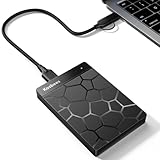
- 【Plug-and-Play Expandability】 With no software to install, just plug it in and the drive is ready to use in Windows(For Mac,first format the drive and select the ExFat format.
- 【Fast Data Transfers 】The external hard drives with the USB 3.0 cable to provide super fast transfer speed. The theoretical read speed is as high as 110MB/s-133MB/s, and the write speed is as high as 103MB/s.
- 【High capacity in a small enclosure 】The small, lightweight design offers up to 500GB capacity, offering ample space for storing large files, multimedia content, and backups with ease. Weighing only 0.35 Lbs, it's easy to carry "
- 【Wide Compatibility】Supports PS4 5/xbox one/Windows/Linux/Mac and other operating systems, ensuring seamless integration with game consoles,various laptops and desktops .
- Important Notes for PS/Xbox Gaming Devices: You can play last-gen games (PS4 / Xbox One) directly from an external hard drive. However, to play current-gen games (PS5 / Xbox Series X|S), you must copy them to the console's internal SSD first. The external drive is great for keeping your library on hand, but it can't run the new games.
I use the two settings together:
- Clear entire folders that the computer never needs with Choose folders.
- Keep important folders visible but set infrequently used files to online-only with Free up space.
- Mark only active folders or files as Always keep on this device.
This distinction also explains a common support problem: a shared-folder shortcut can appear on OneDrive.com but not in File Explorer because the folder, or its parent location, is excluded by selective sync.
5. Treat Desktop, Documents, and Pictures backup as a location change
OneDrive’s folder backup is often misunderstood as making a second copy while leaving the original folders untouched. In practice, it moves those folders into OneDrive’s managed location and synchronizes them there.
In Windows, open:
OneDrive cloud icon > OneDrive Help and Settings > Settings > Sync and back up > Manage backup
To start, toggle a folder marked Not backed up, then select Save changes. Before enabling it, check whether another backup application, company policy, or a second Microsoft account already controls those folders.
PC Slower Than It Used to Be?
A free scan shows the junk files, broken settings and background clutter dragging Windows down - then fixes them in one click.Free scan · Windows 10 & 11Crashes, No Sound, or Screen Glitches?
Random freezes, missing sound and display glitches usually trace back to one bad driver. Find and replace yours safely.Free scan · under a minuteTo stop backup, turn off the folder toggle and choose one of these options:
- Keep the files only in OneDrive, removing them from your computer
- Keep the files only on my PC, removing them from OneDrive
Do not assume that stopping backup restores everything automatically. Files already backed up can remain in the OneDrive folder and disappear from the original Desktop, Documents, or Pictures location. OneDrive may show a Where are my files shortcut; moving the files back is a manual step.
If the folder contains cloud-only files, OneDrive may report: Some files couldn’t be moved. Download them first by changing their state to Always keep on this device
. Make those files available locally before trying again. Files added to the old device folder after backup stops are not backed up automatically.
On a Mac, important-folder backup requires the standalone OneDrive sync app rather than the Mac App Store version and requires Full Disk Access. The path is OneDrive menu-bar cloud icon > three dots > Preferences > Backup > Manage backup.
What’s actually slowing this PC down?
Pick the symptom - the matching free tool is one click away.
Rank #4

- 【Upgraded version】 - The mirror logo strip is combined with the striped non-slip design. The rounded corners of the shell are more suitable for holding. The strips play a heat dissipation function to ensure a stable and fast transmission process.
- 【Ultra-thin and quiet】 - The motherboard adopts JMicron 578 noise-free solution, giving you a quiet working environment. Lightweight and portable size designed to fit in your pocket for easy portability.
- 【Ultra-Fast Data Transfers】 - Pairing this external hard drive with JMicron 578 solution USB 3.0 and USB 2.0 interfaces enables blazing-fast data transfer. It boasts theoretical read speeds of up to 125MB/s and write speeds of up to 103MB/s.
- 【Plug and Play】 - With no software to install, just plug it in and the drive is ready to use.The hard disk chip is wrapped with an aluminum anti-interference layer to increase heat dissipation and protect data.
- 【What You Get】 - 1 x Portable Hard Drive, 1 x USB 3.0 Cable, 1 x User Manual, Gift-type shell packaging ,Three-year manufacturer's warranty and free technical support services.
6. Add shared folders as shortcuts—and do not delete them casually
For a folder shared internally with me, I use Add shortcut to My files rather than downloading a separate copy or trying to recreate the folder structure.
On the OneDrive website, go to Shared > With you, select the folder, and choose Add shortcut to My files. Right-clicking the folder and choosing the same command also works.
The shortcut does not consume my OneDrive storage; the content remains counted against the owner’s storage. Microsoft documents up to 100 folder shortcuts from one person’s OneDrive or Teams site and up to 1,000 shortcuts across files and folders. Shortcuts cannot be added to folders shared with external users.
There is a crucial difference between removing a shortcut and deleting a folder:
Do these 3 things before closing this tab:
1Clear out junk files and repair common Windows errors2Scan for outdated or missing drivers - takes under a minute3Repair Windows errors before they cause bigger problems| Action | Result |
|---|---|
| Remove shortcut from My files | Removes only my shortcut |
| Delete the shared folder | Deletes the folder for everyone, subject to restoration |
To remove only my shortcut, select it and choose Remove shortcut from My files. Close open documents first, and use that command rather than deleting the shortcut from File Explorer. If files are open, deleting a shared shortcut from File Explorer can delete some or all of the files inside it.
Moving shared content can also change access. Moving an item between shared folders may change its permissions, while moving it into an unshared folder can make it no longer shared. I check ownership and permissions before reorganizing someone else’s folder.
A less obvious failure mode is a shortcut appearing as a .url Internet Shortcut instead of a folder. Opening it may launch OneDrive.com and request a sign-in. Microsoft identifies this as a backend issue that should convert back to a folder when resolved.
7. Clean up by size, then empty the right Recycle Bin
When OneDrive storage is tight, I do not start by browsing hundreds of folders. I sort by size first.
Free tools Windows power users keep installed
One-click scans. No signup required.
Best Value

- All-in-One Design: 1TB external hard drive, multi-port hub and SD/TF card reader combine to provide ample storage and comprehensive connectivity in a single device for seamless multi-device connectivity to enhance your productivity.
- Multiple Interface Support: The product has a built-in 1TB hard disk and supports USB-C, USB 3.2, USB 2.0, SD card slot and TF card slot, which meets the needs of daily work. The product connects to the computer via data cable to realize multi-device interoperability.
- Dual Socket Data Connection Cable: Equipped with USB 3.2 and USB-C dual socket data connection cable, suitable for more models.
- Wide compatibility: Supports Windows, Mac OS, Linux, Android, iOS (iPhone 15 and Later) and other operating systems. Support Desktops, Laptops, SmartPhones, Tablets, TVs and other devices.
- Note: This is only compatible with Apple devices that have a USB‑C port (including iPhone 15 and later, as well as all iPads with USB‑C). Using a Lightning to USB‑C adapter will not resolve the compatibility issue.
For OneDrive for work or school on Windows, open OneDrive cloud icon > OneDrive Help and Settings > Settings > Manage storage. On the OneDrive website, select the storage-usage value in the left navigation. Both routes lead to a largest-files view.
Look for old videos, duplicate exports, disk images, ZIP files, and abandoned project folders. After checking that a file is no longer needed, delete it and then empty the appropriate Recycle Bin. Deleting a file does not immediately free the quota while it remains recoverable in the bin.
Recycle Bin retention differs by account:
- OneDrive personal: up to 30 days
- OneDrive for work or school and SharePoint in Microsoft 365: up to 93 days, unless an administrator changes the setting
Do not permanently delete files merely to solve a synchronization problem. If a file was changed incorrectly, select its ellipsis menu on the web, choose Version history, select the ellipsis beside the correct version, and choose Restore. For deleted content, open Recycle bin, select the items, and choose Restore.
A practical OneDrive maintenance routine
Once a month, I use this short checklist:
- Move loose root-level files into named folders.
- Rename items with invalid, excessively long, or inconsistent names.
- Use Manage storage to find unusually large files.
- Set inactive folders to online-only or exclude them with Choose folders.
- Review shared-folder shortcuts and remove only shortcuts I no longer need.
- Check the Recycle Bin before assuming storage has been reclaimed.
OneDrive does not need an elaborate hierarchy. A few stable folders, names that sync everywhere, and deliberate control over local availability prevent most of the clutter and most of the dangerous cleanup mistakes.
The Tool Desk
Outbyte PC Repair FREEClear out junk files and repair common Windows errorsFree Scan →Outbyte Driver Updater FREEScan for outdated or missing drivers - takes under a minuteDriver Scan →FAQ
How many files can OneDrive sync?
Microsoft still recommends reducing the number of items above 300,000 for better sync performance. A rollout beginning April 22, 2026 supports syncing up to 1,000,000 items, but that higher limit does not remove the 300,000-item performance guidance.
Does freeing up space delete a OneDrive file?
No. Right-clicking a locally available file and choosing Free up space removes its local copy while keeping the cloud copy in OneDrive. Deleting the file is different: it deletes the cloud item and synchronized copies and sends it to the OneDrive Recycle Bin.
Why is a shared OneDrive folder visible online but missing from File Explorer?
Selective sync may be excluding the folder. In Windows, open OneDrive Settings, select Account, choose Choose folders, and check whether the shared folder or its parent folder is selected.
What happens when I stop backing up Desktop or Documents to OneDrive?
Files already backed up can remain in OneDrive and may disappear from the original device folder. OneDrive may provide a Where are my files shortcut, but files must be moved manually if you want them back in a device-only folder. New files added there are not backed up automatically.
Can I sync a mapped or network drive with OneDrive?
No. Network drives and mapped drives cannot be used as the OneDrive sync location. Symbolic links and junction points are also unsupported.
The Bottom Line
The safest OneDrive setup is not to download everything or delete everything you do not recognize. Create a small folder structure, move files instead of duplicating them, use short cross-platform names, and separate cloud organization from local storage decisions. For shared folders, remove your shortcut rather than deleting the shared content. For space problems, identify large files and empty the correct Recycle Bin only after confirming what can be permanently removed.
Quick Recap
Product prices and availability are accurate as of the date/time indicated and are subject to change. Any price and availability information displayed on Amazon at the time of purchase will apply.

